Nameshield at the CSA Summit in Cologne – From April 22 to 24, 2024

Celebrate the 20th anniversary with us and be part of the discussion about the future of commercial emails.

For 20 years, the CSA (Certified Senders Alliance) has been committed to strengthening trust in email as a communication channel. Building bridges between email senders and email providers has been the central goal of the CSA from the very beginning – this year’s anniversary summit will examine the success factors of the future under the motto ‘Trust Fuels the Future’.

Nameshield is a Gold Sponsor of the event – our team would be delighted to meet you there. Gain market-leading expertise with CSA’s insights and evolving best practices. We are particularly looking forward to the discussion around the implementation of DMARC, which is becoming a new standard.

Join an international network of brands, agencies, email service providers and mailbox vendors for a dynamic exchange of information in the well-connected email ecosystem! The CSA Email Summit is not just an event, it’s your path to realising your full potential in the ever-evolving landscape of commercial email.

The CSA Email Summit is supported by various industry associations and provides a solid platform for conversations that offer valuable insights into the future of email marketing. Learn from industry experts in workshops, sessions, short talks and masterclasses to enhance your expertise.

Please contact the Nameshield team for more information and to make an appointment at the Summit!

.FR extension is no exception to the trend towards concentration in the domain name sector

Afnic Registrar Day

On 23 January, Afnic the French domain name registry held its Registrar Day, an event aimed primarily at the registrars. Like every year, it was an opportunity to look back over the past year and look ahead to the current one.

The figures drawn up by Afnic for 2023 show an excellent dynamic. Indeed, the .FR extension has passed the 4.1 million domain names, ranking 7th among country-code Top level domains globally and still 3rd among the 27 Top level domains of the European Union. With a renewal rate of over 83% in 2023 and a 6.4% increase in new domains, the .FR domain has flattering figures for 2023.

Afnic has also drawn up an overview of its registrars. Above all, it shows increased concentration, which can also be seen in other Internet extensions and, more generally, in the domain names industry as a whole. Two figures to illustrate this: the number of accredited registrars has fallen by 40% in 10 years, and 38% of accredited registrars now account for 99.5% of the domain names managed by the French Registry.

For 2024, Afnic wants to continue to strengthen the visibility and awareness of the French Top level domain .FR. This will of course involve digital communication and in traditional media. But it also involves enhancing the accuracy and reliability of contact data associated with domain names and stepping up the fight against malicious uses with measures involving registrars. The aim of these two initiatives is to improve the reputation of, and confidence in the .FR domains, and also to honour commitments made to the French State, its mandator.

The European NIS2 directive on cybersecurity, due to come into force in October 2024, is never far away either. Indeed the directive explicitly targets the activities of the DNS and domain name stakeholders. Let’s hope that the increase in the price of the .FR domain names on 1 March does not dampen this positive momentum.

Opening of the .TR. extension in CATEGORY 3

Opening date of Turkish extensions moved forward to September 14, 2022

In this article published on October 4, 2023, we announced that the opening of the .TR extension in CATEGORY 3 will probably be in February.

Applications for the 3rd Category, where transactions will be carried out within the scope of the “a.tr Transition Process”, start on February 14, 2024.

In this category, holders of one of the following extensions: kep.tr, av.tr, dr.tr, com.tr, org.tr, net.tr, gen.tr, web.tr, name.tr, info.tr, tv.tr, bbs.tr and tel.tr will be given priority for .TR registration.

Following the application process, which starts on February 14, 2024 and will last for 3 months, it is expected that the evaluation process will be completed and the allocation procedures will be completed within 1 month (14-May-14 June 2024).

The date of your application between 14 February and 14 May 2024 is not important in the evaluation process. If the necessary conditions are met, the evaluation will be made taking into account the extension hierarchy.

Valentine’s Day is a wonderful day to make an analysis of your Turkish domain names portfolio!

Do not hesitate to contact our teams to secure your .TR!

DNSSEC: Nameshield adopts ECDSA

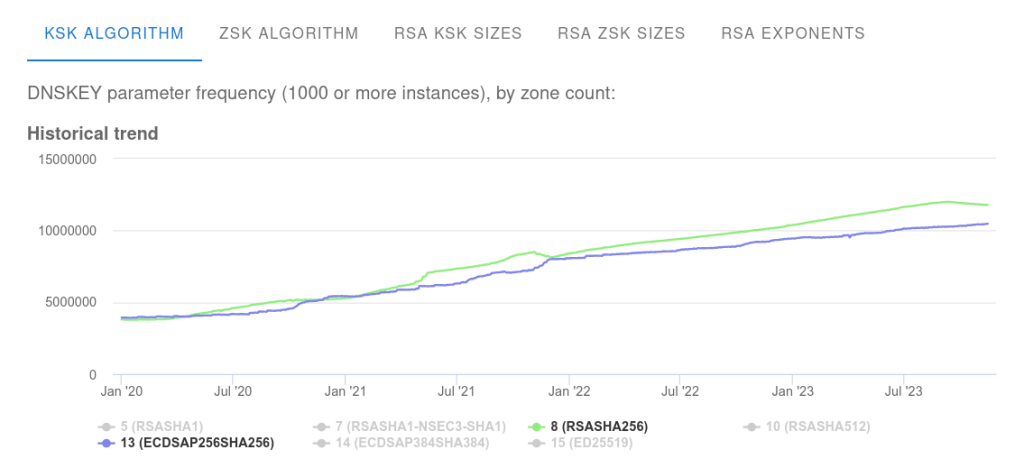
DNSSEC is the protocol that guarantees the integrity of DNS resolution by establishing a chain of trust all the way back to the root. Data security is ensured by a mechanism of cryptographic keys that sign DNS zone records. Historically, DNS operators have used RSA keys (RSASHA256 algorithm), renowned for their robustness.

As an alternative to this asymmetric cryptographic algorithm, there are elliptic curve algorithms. In the case of DNSSEC, the “ECDSA Curve P-256 with SHA-256” algorithm (RFC 6605 and 8624) offers a higher level of security with smaller key sizes.

The ECDSA algorithm is increasingly being implemented by major players in the domain names industry, such as Verisign and AFNIC, and aims to become the standard.

This has several advantages over our current implementation:

  • Smaller signatures and smaller zone files (approx. -33%);
  • Faster zone transfer and reload;
  • Improved signing performance;
  • Potentially faster DNS requests (less reliance on IP fragmentation);
  • Reduced amplification factor of DDoS attacks based on DNS.

For all these reasons, Nameshield has chosen to use this algorithm by default to secure its own domain names and those of its customers.

Image credit : Nameshield with storyset.com

Phishing, slamming and other fraudulent e-mails: Stay alert during the end-of-year holidays!

Phishing, slamming and other fraudulent e-mails: Stay alert during the end-of-year holidays!

The end-of-year holidays often announce the upsurge of fraudulent mass e-mails campaigns. Indeed, cybercriminals take advantage of this period, when vigilance can be particularly low, to launch phishing e-mails.

What are phishing and slamming?

Phishing is used by cybercriminals to obtain personal information in order to commit an identity theft.

In the world of phishing, slamming is a well-known variant that consists in encouraging domain names holders to renew their annuity with another registrar, by arguing the emergency and criticality of the concerned name’s loss. Concretely, this is an e-mail pushing its recipient to contract an unsolicited service and to proceed to the payment of this latter without delay.

Thus, the slamming may take the form of a fraudulent renewal invoice, usually associated with intimidating terms like “Expiration notice”. Under the pressure of such e-mail, generally well built, it happens that the recipient then proceeds to the payment and finds himself debited with an important amount for the so-called renewal.

In the same way, the slamming e-mail may also indicate that a “customer” of the sender, posing as a fake registrar, intends to register domain names identical or similar to your brand. Then the fraudster proposes to register them for you in order to protect you from these troublesome registrations, of course, in exchange for an urgent payment.

Another kind of attack, the suspicious e-mail attachment!

Be careful of fraudulent e-mails with infectious attachments: a single entry point is enough to destroy a network!

The aim of a trap and thus malicious attachment is to pose as a legitimate file (PDF, Word document, JPG image…), while hosting and hiding a malicious code: this is what we generally call Trojans.

Some simple rules to protect against them

  • Always stay alert when someone asks you your personal data;
  • Do not ever open an attachment from an unknown sender, or from one who is not entirely trustworthy;
  • Check the links by hovering the cursor over them (without clicking) to ensure that they link to trustworthy websites;
  • Never reply under the pressure of this kind of solicitation and of course do not proceed to any payment;
  • If there is any doubt, do not reply to the e-mail and contact the sender through another method who will confirm whether it really is a fraud attempt or not.

To remind you of this more often, you can find a wallpaper to download on the Nameshield website: