ICANN72, between prioritisation needs and fragmentation risks

ICANN72, between prioritisation needs and fragmentation risks

At the end of October, the 72nd ICANN summit was held, devoted to the development of policies that impact the domain name system (DNS) and the global Internet community. As already announced during the past summer, this latest annual meeting was to be held by videoconference in the time zone of Seattle in the United States. “Sleepless” were therefore not in Seattle but rather in Europe.
ICANN72, between prioritisation needs and fragmentation risks

The thorn in the side of the next round of new generic extensions

A month before this summit, ICANN announced the schedule for the Operational Design Phase (ODP) for one of the most anticipated topics by the contracting parties: the organisation of a future round of applications for new generic extensions. The ODP is a new mechanism now linked to the policy development process (PDP). It is similar to a project scoping exercise as it aims to identify the steps, risks, costs and resources to be allocated to implement a project, in this case a new round of generic extensions. The PDP was conducted between 2015 and 2020, with the submission of a final recommendations report to the ICANN Board in March of this year. However, it is not until February 2023, almost two years later, that the Board should consider these recommendations, the time to let the ODP conduct. Indeed, ICANN confirmed before the opening of ICANN72 that this scoping phase should last sixteen months in its entirety, including ten months for the conduct of the ODP, three months upstream to initiate the latter and in particular to constitute the teams that will conduct it and three months downstream to conclude the work. This timetable surprised many of the contracting parties and gave rise to much discontent. These discontents were particularly expressed through the Brand Registry Group that represents and promotes the interests of its members, dotBrand owners. For most members, things are not moving fast enough and the ODP would even be partly useless since some aspects overlap with the work already conducted during the previous PDP. Another aspect pointed out was the cost of the ODP estimated to $9 million, which is not a small amount.

The clouds are gathering as are the processes underway

As the other sessions scheduled during the week-long summit progressed, it was clear that the clouds continued to gather in the weather of ICANN’s policies. For example, the announcement of the launch of an expedited policy development process (ePDP) to review the Uniform Domain-Name Dispute Resolution Policy (UDRP), which allows for the recovery of disputed domain names, caused a great deal of misunderstanding, given that a review of all rights protection mechanisms (RPMs) has already been conducted between 2016 and 2020 and its final recommendations have not yet been examined by the ICANN Board. Now this review to validate the recommendations is scheduled to take place at best in the summer of 2022, by which time the aforementioned ePDP should be finalised. This example illustrated the gap that is being created between the community’s expectations for decisions and ICANN’s decision-making bodies, which seem to be overwhelmed by the policy negotiation processes that are piling up and stretching out over time, risking rendering decisions obsolete if they are made too late. According to some participants, this even affects ICANN’s ability to continue to carry out its mission as set out in its founding documents: To preserve and enhance the operational stability, reliability, security and global interoperability of the Internet.

“Prioritisation”, the word is out

On the first day of the sessions, ICANN CEO Goran Marby defended himself against the idea that the Board was slow to make decisions. He pointed out that the Board had recently examined 228 recommendations from the Competion Consumer Choice & Consumer Trust (CCT), which had just conducted a review to assess the extent to which the expansion of generic TLDs, gTLDs, had promoted competition, consumer confidence and consumer choice. 166 have been approved to date, 44 placed on hold and 18 rejected. Many of these measures are correlated with research and data collection to better understand market trends for new gTLDs.

Goran Marby also justified the delays in decision-making by the large number of ongoing and overlapping issues and by the fact that ICANN sometimes needs additional expertise to make decisions. In response to the criticisms, he also indicated that ICANN is now working on some form of prioritisation, a wish expressed by NAMESHIELD that seems to have been heard. However, Marteen Botterman of the Board nuanced this by specifying that prioritisation is not the Board’s responsibility, as it must ensure that the multi-stakeholder model is respected and must therefore maintain a certain neutrality on the subjects submitted to it.

A risk of fragmentation

From an organisation that has difficulty in making decisions, to its questioning, there is only one step. From the first day of the sessions, Goran Marby, who was particularly involved in the exchanges, spoke of “threats to ICANN”. ICANN is working on a risk management framework for the organisation. He also spoke of the need to talk more closely with governments as the current governance model is being challenged. Indeed, one only has to look at Russia to see that in November 2019, the Russian government introduced new regulations that create a legal framework for centralised state management of the internet within Russia’s borders. Russia has also proposed to hand over the management of the root servers to BRICS (Brazil, Russia, India, China and South Africa) member states. Proof that the States are going on the offensive in terms of their legislation, recent European directives also have an impact on the governance model, such as the General Data Protection Regulation (GDPR) and the forthcoming NIS2 (Network and Information Systems) directive, subjects which were also recalled at the summit. In China, for example, a law strengthening controls on digital services operated in China has just been adopted.

The failure of the ICANN governance model, if confirmed, could lead to a fragmentation of the DNS as we know it today, a fragmentation which takes shape as ICANN becomes bogged down in sterile debates. This summit has highlighted that the community and ICANN leadership have identified this major risk. The challenge for the future is to address it. We will watch the next ICANN summit scheduled in March 2022.

The observation that DNS regulation policies are bogged down, particularly at ICANN72, was widely shared by NAMESHIELD well before this summit. In particular, NAMESHIELD had expressed the need to prioritise topics in agreement with the community during the ICANN72 preparatory sessions. NAMESHIELD, which participates in working groups working on recommendations in the context of the periodic reviews conducted by ICANN, also advocated for re-enchanting voluntary work and helping diversify representatives in these working groups, in particular from small structures. Indeed many volunteers are now overwhelmed by the increasing volume of topics to be considered as the processes accumulate and decisions do not follow. New participants are discouraged from taking an interest in these topics by lengthy and cumbersome processes.

Image source : David Mark via Pixabay

New document : 5 minutes to understand domain names extensions (TLD)

5 minutes to understand - Domain names extensions (TLD) - Nameshield

The “Top Level Domains” also called TLD or extensions, are defined by the IANA (Internet Assigned Numbers Authority) which depends on ICANN since 1998.

ICANN and IANA are in charge of allocating Internet protocol (IP) addresses space, assigning protocol identifiers and managing the top level domain names system, i.e. the “Top Level Domains”.

Find out in this “5 minutes to understand” document, available for download on the Nameshield’s website, the different types of top level domains.

New document : 5 minutes to understand who manages the Internet

5 minutes to understand - Domain names - Who manages the Internet - Nameshield

There is a multitude of players involved in the management of the network of networks !
Its management is the responsibility of a decentralized and international multiparty network of independent groups from civil society, private sector, governments, academic and scientific communities, and national and international organizations.

Find out in this “5 minutes to understand document”, available for download on the Nameshield’s website, who manages the Internet, what are the roles of ICANN, registries and registrars.

Data escrow no longer escapes the concentration of the domain names industry

concentration of the domain names industry

There is a lot of talk about the concentration that is taking place in registries and registrars, two of the key actors in the domain names ecosystem. The two companies that have been in the news the most in the last two years, are Ethos Capital and Clearlake Capital, two private equity firms that have specialised in acquisitions in this sector.

Ethos Capital, founded in 2019, had proposed in November in a 1.135 billion euros deal to acquire Public Interest Registry, the registry in charge of the historical extension .ORG, which then claimed some 10.5 million registrations.  If this deal was not done after a surprise veto from ICANN as part of a provision of the Registry agreement that provides for an approval process for each type of transfer whether it is a change of control or a major subcontracting agreement, Ethos Capital was quickly comforted with the confirmed acquisition on March 31, 2021 of the registry Donuts, which in December 2020, had concluded the acquisition of Afilias, the registry operator of the .INFO and .MOBI gTLDs, among others. Donuts currently claims 270 generic extensions out of a total of 1268, i.e. 21% of them! It recently acquired the .watches extension from the luxury goods manufacturer Richemont.

As for Clearlake Capital Group, this company founded in 2006, acquired Endurance International in a $3 billion deal and recently took a significant stake in Web.com. The two entities were merged to form a new company called Newfold Digital. Newfold’s portfolio includes registrars such as Register.com, Network Solutions, Domain.com, BuyDomains, BigRock, PublicDomainRegistry and CrazyDomains as well as BlueHost and HostGator, two very important companies in the field of web hosting. The group claims approximately 16.5 million domain names.

Another well-known player, the American registrar GoDaddy, announced in February 2021 that it was raising 800 million dollars to make acquisitions. Since then GoDaddy seems to have gone on the offensive. The world’s largest registrar by volume is currently finalising the acquisition of Minds & Machines, a registry of new generic extensions (27 in all) in a deal worth 120 million dollars. Europe is of course not immune to the concentration phenomenon, even if the deals taking place are not as high as those mentioned above.

Indeed, these are just a few examples of a concentration that seems to be accelerating unstoppably in the domain name sector. Yet another important key players in the domain name management, the escrow operators whose critical mission is to store and safeguard domain name data for registrars and registries, rather like a bank, seemed less exposed to the phenomenon until now. However, if we look at the list of ICANN-designated agents, we recently noticed that one of them, namely Iron Mountain, has disappeared. This is not due to an error but to the fact that this actor has been absorbed by its competitor NCC Group. The deal, made in June, is estimated to be worth 165 million dollars. 

Across the concentrations now taking place in all the key areas necessary for the management of domain names portfolios, questions arise about the range of services on offer, which is constantly shrinking as a few major players take over the market, and also about prices (PIR had obtained from ICANN the lifting of the ceiling on .ORG prices just before Ethos Capital made its takeover offer) and the control of the domain name data, a control that seems difficult with the globalisation of the market. It should be remembered that NAMESHIELD remains an independent French company for which all these issues are at the heart of its concerns.

Image source : Geralt via Pixabay

What is Extended Validation (EV) and how important is it?

Cybersecurity - SSL certificate - EV

SSL certificates ensure the encryption and integrity of data exchanged between a browser and a web server. There are different levels of certificates, Extended Validation (EV), Organizational Validation (OV) and Domain Validation (DV), which vary depending on the degree of authentication. The Extended Validation type SSL certificate provides the highest level of SSL authentication. It is obtained through a comprehensive and globally standardized identity verification process established by the CA / Browser Forum.

Regardless of the selected SSL level, encryption and data integrity can be guaranteed by Extended Validation (EV), Organizational Validation (OV) and Domain Validation (DV), but they do vary depending on the degree of authentication. The Extended Validation type SSL certificate provides the highest level of SSL security. It is obtained through a comprehensive, globally standardized identity verification process ratified by the CA / Browser Forum.

The EV SSL certificate enables HTTPS security and the now gray padlock in the browser’s address bar, just like DV and OV certificates. The additional cost and time spent on verification makes it more difficult to obtain EV level certificates for phishing sites. Therefore internet users can use this certificate as a mark of trust and feel more secure when communicating and making purchases.

On June 12, 2007, the CA/Browser Forum officially ratified the first version of the Extended Validation SSL Guidelines, which took effect immediately. The formal approval successfully brought to a close more than two years of effort and provided the infrastructure for trusted website identity on the Internet.

Most major browsers created visual indicators for pages loaded over HTTPS and secured by an EV certificate soon after the standard was created: they displayed the validated identity, which is a combination of organization name and legal status, in the URL bar. Safari for iOS, Windows Phone, Firefox for Android, Chrome for Android and iOS, also added these indicators.

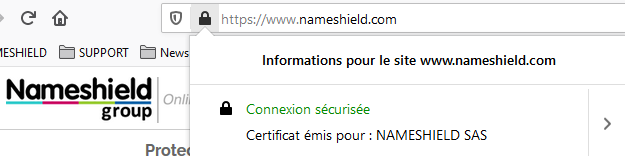
In May 2018, Google announced plans to redesign Google Chrome user interfaces and remove emphasis on EV certificates. Chrome 77, released in 2019, removed the EV certificate indication from omnibox. Firefox 70 followed and removed the distinction in the omnibox or URL bar : EV and DV certificates are displayed similarly with just a padlock icon, but the information on the EV certificate status is still accessible in the more detailed view that opens after clicking on the padlock icon.

SSL EV certificate - Nameshield

An EV certificate displayed in Firefox

The increasing use of mobile devices and the removal of the visual indicator EV by browsers has significantly reduced the interest of some entities in using this level of security, but the EV is still very important in our daily lives.

Today, phishing websites are unfortunately still a major threat to legitimate websites and online services. These cybercriminals use DV certificates, usually obtained from a free SSL service that does not conduct adequate phishing checks, to make their sites appear more trustworthy. They are able to easily deceive unsuspecting victims and trick them into disclosing financial or personal information.

A very strong increase in phishing has been observed since March 2020, with the beginning of lockdown and remote working for many people: the volume of phishing sites increased by 47% for the first quarter of 2020, and 82.7% of attacks phishers used DV SSL certificates. This problem is only growing and increases the need to verify identities online.

Image source : TheDigitalArtist via Pixabay