EuroDIG: Building the European Internet of tomorrow and celebrating .eu 

EuroDIG 2026

On the 26th and 27th of May 2026, Brussels hosted the 19th edition of the European Dialogue on Internet Governance (EuroDIG), organised at the European Commission’s Charlemagne Building by EURid, the registry managing the .eu top-level domain. This edition took place as part of the celebrations marking the 20th anniversary of the operational launch of the European .eu top level domain. Under the theme ‘European Voices for the Future of the Internet’, the event brought together European policymakers, representatives of Internet governance bodies, technical stakeholders, digital companies, researchers and civil society organizations to discuss the major challenges facing Europe’s digital future. 

EuroDIG2026
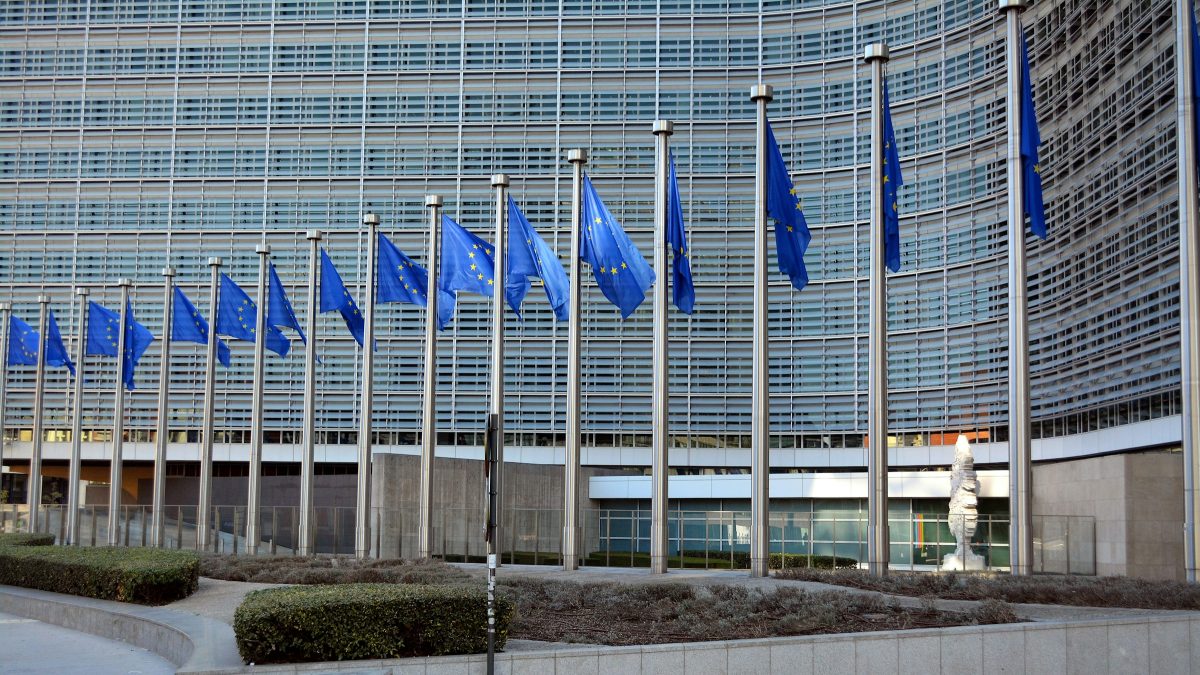
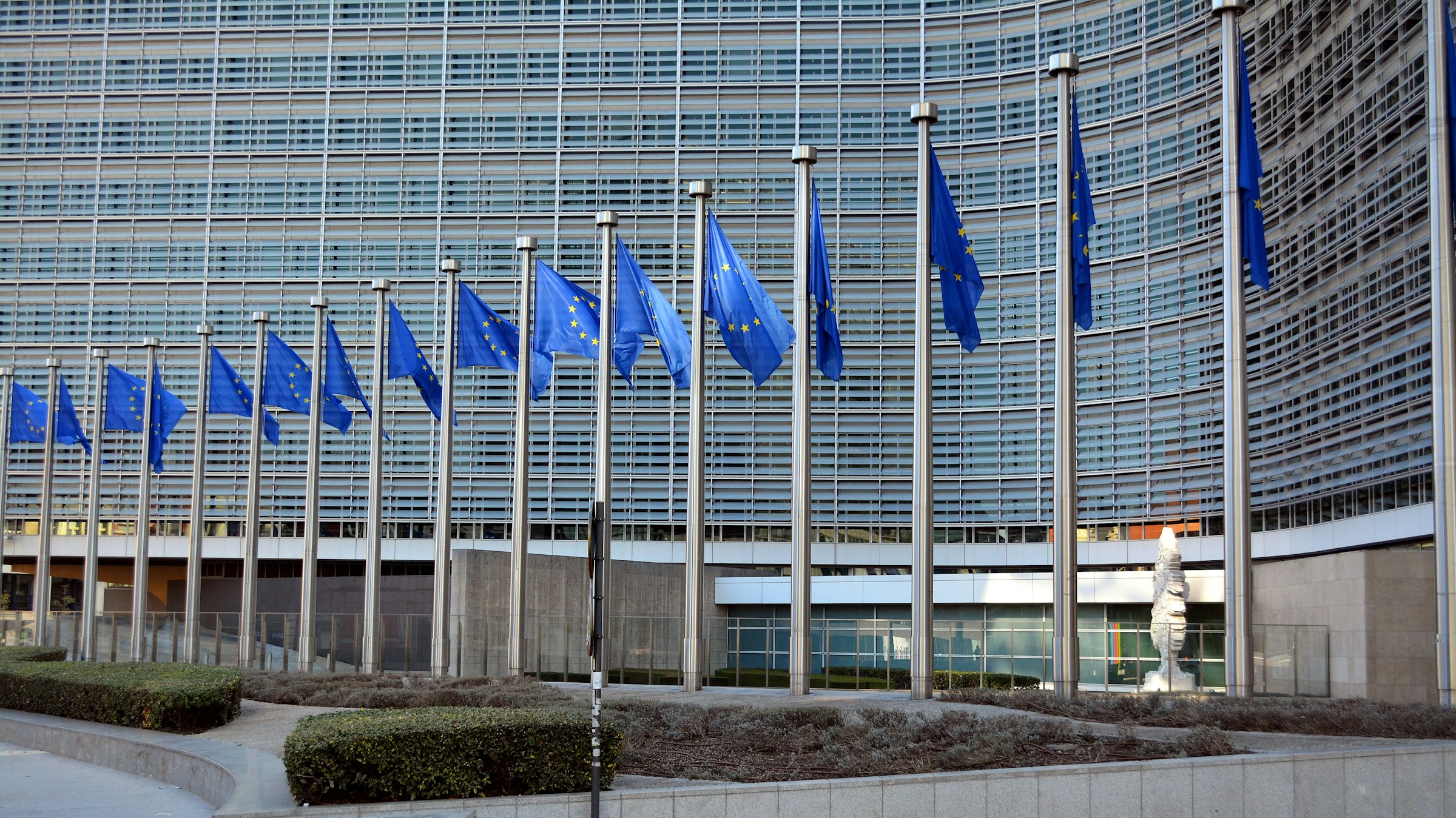
The European Commission premises where the latest EuroDIG event took place

The two-day meeting opened with a topic of critical importance in the current geopolitical context: the European digital backbone. This term refers to the entire range of critical digital infrastructure that the European Union is seeking to develop or bring together in order to reduce its dependence on American and Chinese giants: fibre – optic and submarine networks, cloud computing, data centres, AI, Internet interconnections, cybersecurity, and sovereign data platforms and services. 

Two major concepts have emerged:  

  • the Gaia X project  
  • the more recent EuroStack initiative 

They aim to create a resilient, sovereign European Internet.  

Gaia X aims to create a federated, interoperable, secure cloud and data infrastructure that is compatible with the European standards of the various countries. 

EuroStack, meanwhile, aims to build a comprehensive European technology stack to make the EU independent in several critical areas: 

  • semiconductors,  
  • connectivity,  
  • the cloud,  
  • AI,  
  • platforms,  
  • software,  
  • digital identity,  
  • digital public services, 
  • cybersecurity. 

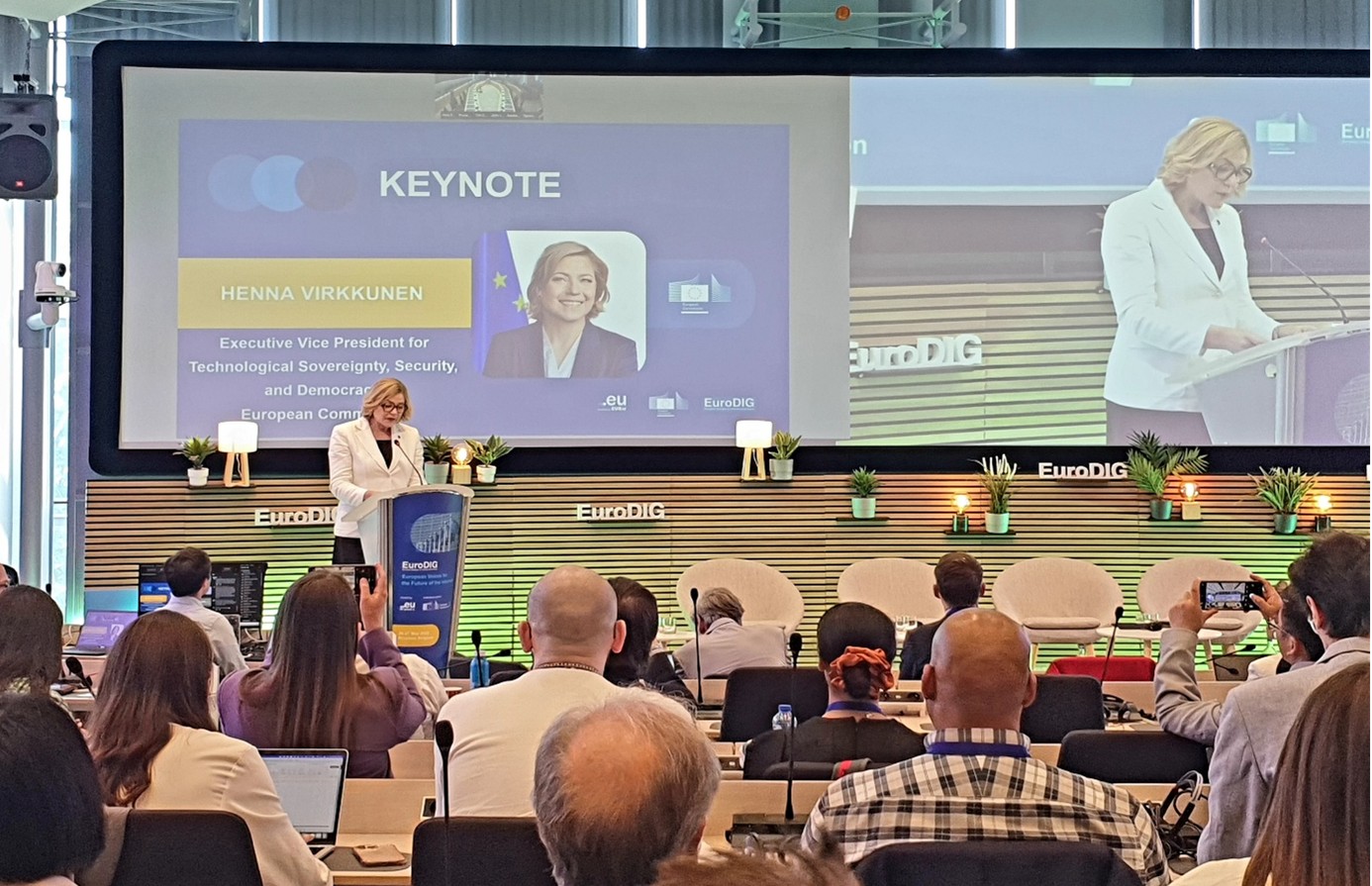
To support these projects and consolidate the legislative framework, Henna Virkkunen, Executive Vice-President for Technological Sovereignty, Security and Democracy, highlighted the ‘Tech Sovereignty Package’— a cross-cutting legislative and industrial package she is spearheading — which is designed to strengthen the European Union’s technological autonomy in digital sectors deemed critical. The forum’s central themes — sovereign cloud, trustworthy AI, infrastructure resilience, cybersecurity, European digital identity, data governance and strategic autonomy — aligned directly with the package’s priorities. Henna Virkkunen also reiterated that data control remains a key element of this sovereignty, advocating for data storage with European providers in Europe. This is an important point when one considers, for example, that 70% of the global cloud is currently owned by Amazon, Google and Microsoft. 
EuroDIG 2026
Henna Virkkunen, Executive Vice-President for Technological Sovereignty, Security and Democracy

In the field of quantum technologies, research topics and technological advances were also presented. In particular, the EU has invested in research through the ‘EU Quantum Flagship’, a funding program launched in 2018. Regarding AI, the desire to have sovereign AI systems was highlighted, whilst emphasizing that we must maintain a critical perspective on this technology, which is becoming increasingly prevalent in our lives. 

Europe has also been built around the .eu top level domain, which has celebrated its 20th anniversary  

EuroDIG served as a reminder that the EU is taking the lead on many issues to make Europe more resilient and distinctive in Internet technologies in a world that has become uncertain. But these initiatives must also be backed and supported by the multitude of Member States and citizens that make up the EU. Among the issues that Europeans have fully embraced – and which can therefore be counted as successes – is the pan-European digital identity, the .eu. Launched on 7 December 2005, the .eu now has 3.8 million registered domains, with a renewal rate of around 81%, reflecting a stable and loyal user base. The domain extension is among the top 10 country code top-level domains (ccTLDs) worldwide and is available in the various alphabets used within the European Union thanks to the variants .ею (Cyrillic) and .ευ (Greek). Peter Janssen, General Manager of EURid, reiterated the essence of .eu: “.EU represents an open, secure and aligned with democratic values namespace”.  

EuroDIG pointed out that the European Internet remains heavily dependent on non-EU countries, both in terms of infrastructure and technology, and that the solution does not lie in geographical isolation either. The growing awareness, along with the various current initiatives and measures at the EU level, are to be welcomed in a world that has become increasingly fragmented and unstable. While Nameshield has always promoted its solutions towards a sovereign European approach, this is an opportunity to reiterate that domain names and the DNS are central elements in companies’ digital strategies. Building digital sovereignty requires making informed choices about the partners we work with and adopting solutions that support a corporate digital sovereignty strategy. A hot topic at the moment, the Brand TLD — a solution offered by Nameshield — is one such solution. 
.EU: Brexit and UK citizens, what will happen at the end of the transition period ending on 31/12/2020

Image source: MIH83 via Pixabay

Last January, we indicated that we would keep you informed of the expected updates from Eurid regarding the conditions of registration of the .EU for UK citizens following the Brexit.

Eurid has indeed announced that from January 1st, 2021, it will NO LONGER allow the registration of any new domain name by UK holders.

The registry will also refuse the update of a domain name to a UK registrant.

Registrants who do not comply with these rules will be notified as of 21/12/2020.

The new eligibility conditions for a .EU domain name will be as follows:

TO BE:

  • a citizen of the European Union, independently of their place of residence; or
  • a physical person who is not a citizen of the European Union and who is a resident of a Member State; or
  • a company established in the European Union; or
  • an organization established in the European Union, without prejudice to the application of national law.

So be vigilant with your currently registered .EU in order to comply with these new rules that will come into force, as a reminder, in January 2021.

PLEASE NOTE:

  • Union citizens who are residing in the United Kingdom will remain eligible to hold a .EU domain name after the end of the transition period. They will have to update their registration data and prove their Union citizenship.
  • UK citizens residing in a Union Member State will remain eligible to hold a .EU domain name after the end of the transition period. UK citizens residing outside of the Union Member States, on the other hand, will no longer be eligible to hold a .EU domain name after the end of the transition period.

BREXIT – The plan of the .EU for UK citizens

Following BREXIT, Eurid (.EU registry) had recently updated its Domain names Registration Policy, by modifying the conditions of attribution of a .EU domain name for the British and Gibraltarians, according to the plan below:

* From 1st November 2019, EURid will NOT allow the registration of any new domain name where the registrant’s residence or establishment country code is either GB or GI, unless the citizenship country code of the registrant corresponds to an EU27 Member State.

* On 24 October 2019, and following explicit confirmation by the Commission, EURid will notify by email both GB and GI registrants and their providers about their forthcoming non-compliance with the .eu regulatory framework.

During this two-month period, the domain names concerned remained active and could continue to be used by their holders.

* As of 1 January 2020, all registrants who did not demonstrate their eligibility will be deemed ineligible and their domain names will be WITHDRAWN. A WITHDRAWN domain name no longer functions, as the domain name is removed from the zone file and can no longer support any active services (such as websites or email).

Twelve months after the UK withdrawal, i.e. on 1 November 2020, all the affected domain names will be REVOKED, and will become AVAILABLE for general registration. Their release will occur in batches from the time they become available.

* No transfer to GB / GI registrants will be possible during the two-month period between 1 November and 1 January, unless they have a citizen country code from an EU27 member state. The transfer to a non GB / GI registered will remain possible.

Following the UK’s official leave from the European Union on January 31, the United Kingdom and the EU will enter into the so-called “transition period” until December 31, 2020.

During this “transition period”, residents and citizens of the United Kingdom will continue to be able to own and register .eu domain names. The plan described above will apply from the end of the transition period and will soon be updated accordingly.

Nameshield will keep you informed as soon as Eurid will update the rules.

For its part, the British register (NOMINET) has no plans currently to restrict .uk domain names – they can be registered irrespective of nationality or place of residence. All are eligible.

New eligibility criteria for .EU

New eligibility criteria for .EU
Image source: OpenClipart-Vectors via Pixabay

As of October 19, 2019, internationally-based EU citizens can now register .EU or .ею domain names.

The .EU is the country code top level domain for the European Union. More than 3.6 million registrations spread out across Europe make this TLD a popular extension. Initially, this extension is only reserved to companies and individuals residing within EU and EEA member states. However in order to meet the needs of an ever-changing digital environment, EURid, the .EU registry, changes this eligibility criteria to extend it to all EU citizens living around the world.

We are excited to be able to extend the registration criteria to EU citizens around the world. The .eu domain is now closer to your ambitions, achievements and dreams. It is the bridge connecting you to your friends and family – even if you live outside the EU. It will always show your roots, your outlook, and your cultural values.” – Marc van Wesemael, EURid`s CEO.

For more information on the conditions for registration of your .EU, don’t hesitate to contact us.

Europe decides to apply sanctions to transboundary cybercriminals

Europe decides to apply sanctions to transboundary cybercriminals
Image source: GregMontani via Pixabay

On Friday May 17th, 2019, the Council of Ministers of the European Union presented the creation of a blacklist identifying the perpetrators of cybercrimes located outside the EU.

Thus this is a new legal context which has been validated by the EU in order to try to reduce the continuously growing cyberattacks’ number. Now, the EU will indeed be able to sanction individuals or entities involved in the cyberattacks carried out from outside the EU.

Europe seeks through this measure to protect as far as possible the most critical infrastructures, regarding electoral or health systems for example, from cybercriminals, by abolishing the impunity which the international hackers seemingly enjoyed.

If there is no name on this famous list today, the situation could change soon.

Recently, the British Foreign Secretary, Jeremy Hunt declared that “for too long now, hostile actors have been threatening the EU’s security through disrupting critical infrastructure, attempting to undermine democracy and stealing commercial secrets and money running to billions of Euros. Hence, this decision was necessary.”

It’s now very clear that the cyberattacks carried out by nations, against nations or entities, tend to multiply. It’s important to note that these sanctions can be retroactive. To this day, the sanctions are not clearly defined: travel bans and assets freeze against those we know have been responsible for these actions? Several options are presently being studied.

Brexit and .EU domain names: EURid’s action plan on hold

Brexit and .EU domain names: EURid’s action plan on hold
Image source : Tumisu via Pixabay

On the article dated from February 22, 2019, we discussed about the Brexit’s consequences on the .EU domain names and the publication of the action plan by EURid, the .EU registry, following two scenarios, in case of no deal or in case of a withdrawal agreement between the United Kingdom and the European Union.

In short, as a result of the Brexit, companies and individuals, holders of a .EU will no longer be able to renew or register names in .EU if they are not residing in the European Union.

In case of no deal, .EU domain names’ holders will have 2 months from March 30, 2019 to demonstrate their eligibility or to transfer their name to an eligible registrant (whose country code isn’t either GB/GI). All registrants who did not demonstrate their eligibility will be deemed ineligible and their domain names will be withdrawn.

In case there is a withdrawal agreement, this plan of actions will be implemented as of January 1, 2021.

Due to ongoing uncertainties over the United Kingdom’s withdrawal from the European Union, EURid announced on March 22, 2019, that this plan would be placed on hold while waiting for an official update from the European Commission.

To be continued.

Brexit’s consequences on .eu domain names : EURid’s action plan

Brexit’s consequences on .eu domain names : EURid’s action plan
Image source : Tumisu via Pixabay

In a previous article, we discussed the Brexit’s consequences on .EU domain names, the European Commission announced on 28 March 2018 that companies and individuals, holders of a .EU will no longer be able to renew or register names in .EU if they are not residing in the European Union.

With the Brexit’s date approaching, EURid, .EU registry, has recently published its action plan that has two scenarios depending on the case there is no deal or the case there is a withdrawal agreement between the United Kingdom and the European Union. In the second case, it will be the same actions but they will be implemented on different dates (from December 2020).

Scenario 1: The United Kingdom leaves the European Union with no deal on 30 March 2019 

New registrations

  • From 30 March 2019: EURid will not allow the registration of any new domain name from registrant declaring an address in Great Britain (country code GB) or in Gibraltar (country code GI).

.EU domain names that have GB/GI as the registrant country code within WHOIS, at the time of UK withdrawal

  • On 23 March 2019: EURid will notify by email both GB/GI registrants and their registrars about the forthcoming non-compliance of the data associated to their domain name within the .EU regulatory framework.
  • On 30 March 2019: EURid will again notify by email both GB/GI registrants and their registrars that their domain name is not in compliance with the .EU regulatory framework.
  • Before 30 May 2019: Registrants will be given the possibility to demonstrate their compliance with the .EU regulatory framework by updating their contact data.

During this two months period, the domain names in question will remain active and the following actions are possible:

-Contact data changes including updates to existing contact details pertaining to phone number, email address, postal address and country code;

-Updating a contact or linking a new contact;

-Name server and DNSSEC changes;

-Transfer the domain name to a non GB/GI registrant.

During this two months period, the following actions are not possible:

-Transfer the domain name to a GB/GI registrant;

-Term extension, unless accompanied by a transfer request to an eligible registrant;

-Automatic renewal for domain names that expire in the period between 30 March 2019 and 30 May 2019.

  • As of 30 May 2019: All registrants who did not demonstrate their eligibility will be deemed ineligible and their domain names will be withdrawn.
  • On 30 March 2020, i.e. twelve months after the UK withdrawal: All the affected domain names will become available for general registration.
  • For. EU domain names that are in the ON-HOLD status at the time of UK withdrawal: They will remain registered until there is an outcome of the court case. However, they will be suspended and will cease to function as of 30 May 2019.

-If a court ruling establishes a transfer to an eligible party, that decision will be implemented in the usual way.

-If the domain name stays with the GB/GI registrant, the domain name will be withdrawn.

  • For .EU domain names that are in the SUSPENDED status at the time of UK withdrawal: Evaluation by the registry on a case-by-case basis, moving forward if appropriate, with the withdrawal of the domain name.
  • For .EU domain names that are in the QUARANTINE status at the time of UK withdrawal:

-No transfer to GB/GI registrants from quarantine will be possible during the two months period.

-Transfer to a non-GB/GI registrant will be possible.

Scenario 2: The United Kingdom leaves the European Union with a planned transitional period on 31 December 2020

It will be the same actions but they will be implemented on different dates.

New registrations

  • From 1 January 2021: EURid will not allow the registration of any new domain name from registrant whose country code is either GB/GI.

 .EU domain names that have GB/GI as the registrant country code within WHOIS, at the time of UK withdrawal

  • 23 December 2020: First email sent about the non-compliance of the data associated to the domain name.
  • 1 January 2021: Second email sent about the non-compliance.
  • Before 2 March 2021: Possibility for the registrants to demonstrate their compliance with the .EU regulatory framework by updating their contact data.
  • As of 2 March 2021: All registrants who did not demonstrate their eligibility will be deemed ineligible and their domain names will be withdrawn.
  • On 1 January 2022: All the affected domain names will become available for general registration.

The actions planned in the first scenario regarding the different status « ON HOLD », « SUSPENDED » and « QUARANTINE », will also be applied in the second scenario.

The Brexit’s consequences thus force the British to rethink their domain names strategy. Indeed, the loss of their .EU domain names will be an opportunity for cybersquatters who reside in the E.U. and meet the eligibility criteria, they would then have the rights to register these .EU domain names. Nameshield’s team is at your disposal to reply to all your questions and to propose you the best recommendations regarding your domain names’ portfolio management.