BIMI and VMC: display your logo with emails

BIMI and VMC: display your logo with emails

BIMI (Brand Indicators for Message Identification) allows you to authenticate your emails and reinforce the trust of your customers by displaying your logo in their inbox. VMC (Verified Mark Certificate) is a certificate associated with BIMI, which ensures the authenticity of the logo displayed.
BIMI - Nameshield

What is BIMI?

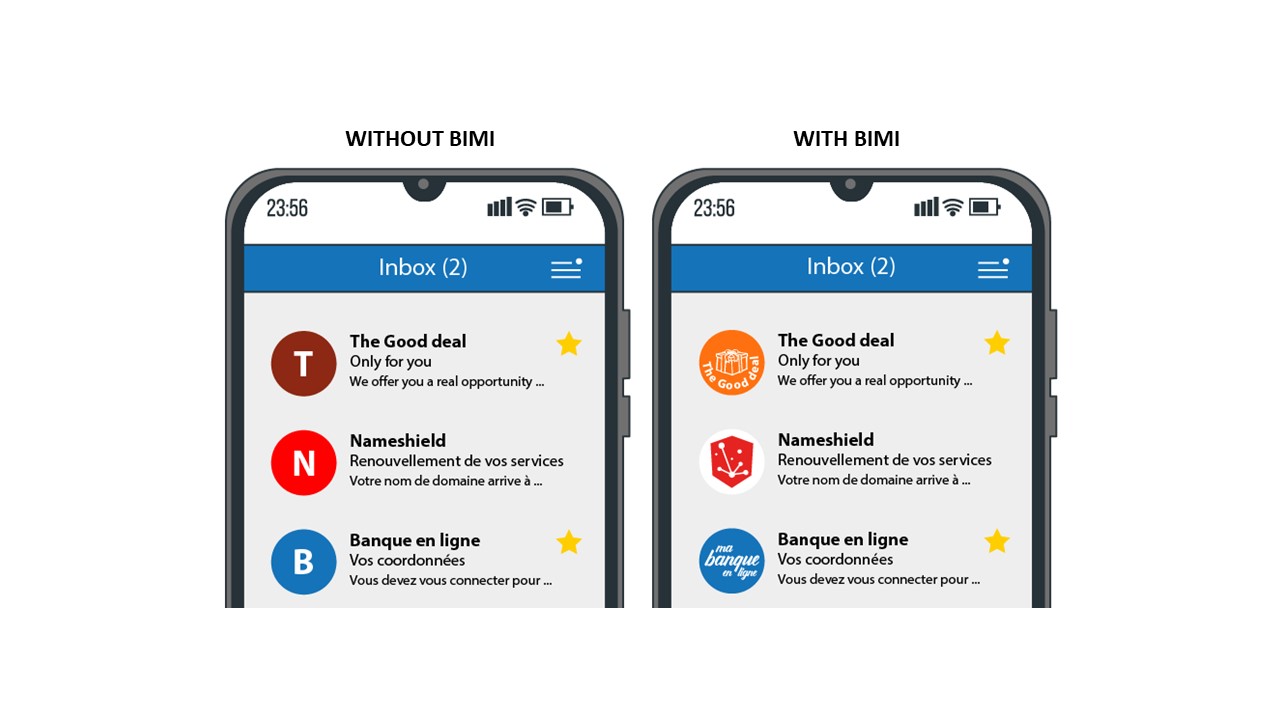
BIMI is an industry initiative aimed at standardizing the use and display of brand logos in email clients. By placing a brand or company logo next to an email, it is more easily identifiable by customers and users, builds a sense of legitimacy and trust, significantly impacts open rates, and increases consumer protection against fraudulent emails.

Technically speaking, BIMI is an emerging security technology that works alongside DKIM, SPF and DMARC protocols to protect your domain name from being used by malicious actors to send fraudulent emails.

Before BIMI, the steps to get your logo next to an email were specific to each email service your message was sent to. Sometimes the process was entirely manual or relied on other applications to aggregate your brand information and share it across participating platforms.

The AuthIndicators group, which includes email service providers such as Google, Verizon Media, IONOS by 1&1 and Fastmail, is working to implement BIMI in the most common email clients. Many players have already adopted BIMI, others are in the process, Microsoft’s and Apple’s positions are expected to drive final adoption of the standard.

Why is BIMI important?

To complete the arsenal of a brand’s protection on the Internet, more specifically against hijacking attempts through fraudulent spoofing emails whose goal is to deceive the user and lead them to phishing sites.

306 billion emails circulated worldwide in 2020, with an ever-increasing proportion of fraudulent emails hijacking brands.

To increase the desirability of emails, particularly in marketing campaigns. The implementation of BIMI and more widely of security protocols and certificates on the domain name associated with a brand is essential today and has a major impact on online reputation.

Because it is becoming a market standard, easy to implement unlike the number of existing anti-fraud email solutions that are often difficult to test and implement.

How does BIMI work?

BIMI uses a process of several steps to validate emails by ensuring that they are actually associated with the sender’s domain name. Senders must add a TXT DNS record dedicated to BIMI.

For BIMI to work, domain names must also have several other fraud protections, including:

  • SPF (Sender Policy Framework): authenticates emails by identifying mail servers authorized to send from specific domain names ;
  • DKIM (DomainKeys Identified Mail): adds a digital signature to each email to verify that it was sent from an authorized domain name;
  • DMARC (Domain-Based Message Authentication, Reporting, and Conformance): confirms SPF and DKIM records and specifies how non-compliant emails should be handled.

When emails are sent using BIMI, the receiving mail server will first do the standard DMARC/DKIM authentication and SPF validation. If the email passes these checks, the mail server will verify that it has a valid BIMI record and display the brand logo.

How does BIMI interact with DMARC, DKIM and SPF?

The first step towards using BIMI to display a logo is to implement DMARC. This is stored as a DNS record of TXT type on the domain name. For DMARC to work with BIMI, the reject policy in this record must be p=quarantine or p=reject for all emails sent from your domain.

BIMI requires DMARC… and DMARC requires your domain name to have DKIM records to work. While DMARC only requires SPF or DKIM to work, it is best to include SPF records for more security when using BIMI. These 2 security tools are also stored as TXT DNS records in the domain name zone.

VMC, the final link in the chain

A Verified Mark Certificate is a digital certificate that authenticates the ownership of a logo, and completes the use of BIMI in email clients such as Gmail.

The VMC certificate guarantees the authenticity of the logo displayed, which is necessarily owned by the domain name holder sending the email. It is the last link in the chain to guarantee the authenticity of the email received.

When you send an email to a contact, the receiving mail server that manages their inbox will take the URL of the tag that indicates where the logo should be displayed. It will then check the VMC certificate to ensure that the correct logo is used. Once the logo is verified by the VMC, BIMI will display it next to the email in the inbox.

To obtain a VMC certificate, the implementation of DMARC on the domain name is a prerequisite. Then follows a reinforced authentication process with a Certification Authority that will validate the identity of the Organization, the registration of the logo with a certified body and will issue the certificate after a one to one meeting with a notary.

Depending on the country, the intellectual property offices for logos registrations may vary as well as the rules of acceptance to issue the certificate. The notions to keep in mind, the authorized trademarks can be:

  • Design trademarks: consist exclusively of a design;
  • Verbal trademarks: contain words, letters and/or numbers, without any particular font, size, color or style;
  • Combination trademarks: include a combination of words with a design, stylized letters or numbers.

While this is not a requirement for implementing BIMI on your domain name at this time, VMC should be part of the standard in the future.

Entrust Datacard and DigiCert are the first 2 companies to issue VMC certificates for the BIMI standard. Nameshield is a partner of both companies and will assist you in obtaining VMC certificates. You can contact directly our certificates department for any question on the subject.

BIMI + VMC = Guarantee of authenticity

BIMI, VMC… and Nameshield

Nameshield now assists its customers in all aspects of the implementation of DMARC, SPF, DKIM, but also BIMI protocols and the obtaining of associated VMC certificates. The domain name is at the core of the implementation of these different protocols. Our historical business as a registrar and DNS zones manager allows us today to assist our customers on these major subjects of the fight against online fraud and the increase of emails desirability.


New document : 5 minutes to understand monitoring solutions

5 minutes to understand - Domain names - Monitoring solutions - Nameshield

A domain name is not static, it evolves. It can be inactive, associated to a website, to a messaging service. The website can be operated, deactivated or its content can change. So many constant modifications that require a particular follow-up in the form of monitoring of domain names that may infringe your brand.

Find in this “5 minutes to understand” document, available for download on the Nameshield’s website, the different monitoring solutions that provide you with information to protect your domain names and brands from possible infringements.

To understand all about Metaverse and alternative domain names

Metaverse and alternative domain names

The word “Metaverse” refers to everything related to virtual worlds (3D, augmented reality, virtual reality), and designates a “future” vision of the Internet, with fictive spaces such as stores, rooms or even games. It’s a bit of a buzzword of the moment, which was put forward by Facebook in October 2021, when it announced the creation of a metaverse (Meta). There is of course a trend effect, however several major brands seem to be working on the subject.

Many projects have used the term “Metaverse” around their services and products. There are projects related to digital assets, such as cryptocurrencies and NFTs, which allow the representation and exchange of value on the Internet. But also alternative domain names, like .eth, .crypto, .metaverse, etc. It’s also related to the concept of “web3”, which is a vision of a more decentralized web.

Regarding the alternative domain names, you have to know that they are extensions that are not regulated by ICANN, so they are not official. This explains why it is not possible to have WHOIS information. Furthermore, most alternative domain names systems do not work with the DNS protocol, but are built on a Blockchain infrastructure.

Here are some examples:

ENS (Ethereum Name Service): .ETH

ENS is one of the most used alternative domain name systems with .ETH. It is built on the Ethereum blockchain, through smart contracts, and allows to register domain names in order to link addresses of crypto wallets, websites or any other type of registration. A domain name can be registered for several years, and there are no domain name recovery procedures for trademark holders, as it is a decentralized project: the holder of an .ETH domain name is the only one who can control it.

The registration procedure is done through the use of an Ethereum wallet, and the payment with the ether cryptocurrency ($ETH).

ENS also allows traditional domain names holders to register their domain names on their system.

Unstoppable Domains: .CRYPTO, .ZIL, .COIN, .WALLET, .BITCOIN, .X, .888, .NFT, .DAO, .BLOCKCHAIN

This is also a domain names system developed on the Ethereum blockchain. It allows, like ENS, to register domain names with different extensions. Unstoppable Domains do not expire and do not need to be renewed. There is, however, a procedure for trademark holders.

Namebase

This is a project that allows the creation of all kinds of top-level extensions. It is built on the HNS blockchain.

Namecoin: .BIT

One of the first alternative domain names project on Blockchain.

Touchcast: .METAVERSE

This is a recent project that offers .METAVERSE domain names for sale. There is not much technical information about their system, and their community seems to be quite limited compared to their number of followers on social networks.

Other alternative domain names projects have also emerged. It is important to know that anyone can create an extension not regulated by ICANN.

For users, it is necessary to use another means than a classic DNS resolver to use these extensions (browser extensions, dedicated applications, etc.).

As expected, there is a lot of speculation and cybersquatting related to this type of domain names.

Image source : xresch via Pixabay

Changes in the administration of Turkish extensions

Changes in the administration of Turkish extensions

It is a new change that has been in preparation for a few years in the digital world of Turkey.

Indeed, the administration of extensions in Turkey (.com.tr, .net.tr and .org.tr…) has been entrusted to .TR Network Information Systems (“TRABİS”) which will be incorporated under the Information and Communication Technologies Authority (“BTK”).

With TRABIS, changes will therefore occur in the process of assigning domain names.

The allocation of domain names under the extensions com.tr, net.tr and org.tr, under this new system will be liberalized and will answer to the principle of “first come, first served” (without required supporting documents).

As a reminder, under the management of NIC.TR, it was necessary to justify a trademark or the name of the company with an official document to register a .com.tr (the most used extension).

It will be easier to register a domain name in Turkey in a few weeks.

This change of rules was initially planned for January 2022 but has not happened yet.

BTK will announce soon the official dates and we hope to be able to confirm this liberalization of .com.tr, .net.tr and .org.tr during February 2022.

Do not hesitate to prepare your orders and contact your consultants and account managers to check your .com.tr domain names portfolio.

Image source : RiZeLLi via Pixabay

New document : 5 minutes to understand DNS cache poisoning

5 minutes to understand - Domain names - DNS cache poisoning - Nameshield

The DNS (Domain Name System) is a key service of the Internet. It is a giant, hierarchical and distributed directory that associates IP addresses with domain names that are easier to identify, remember and transmit. It is the cornerstone of the Internet, whose infrastructure has flaws by its very conception, making it an ideal target for attacks.

On one hand, the DNS service is based on the authoritative DNS, which holds the information, and on the other hand, the resolver DNS, which carries out the resolution for the web users.
The DNS cache poisoning attack targets resolver DNS.

Find in this “5 minutes to understand” document, available for download on the Nameshield’s website, what is this DNS cache poisoning attack and how to protect against it.