
ICANN79: A summit that builds on decisions taken in 2023

ICANN79

After ICANN29 in 2007 and ICANN61 in 2018, Puerto Rico hosted its third Internet Governance Summit, ICANN79, at the beginning of March. Six days of meetings, exchanges and encounters in a studious atmosphere, with ongoing issues moving forward. The star topic: the next round of new generic extensions. Other major subjects, such as the NIS2 European cybersecurity directive and the appointment of a new President for the organisation, were discussed on the sidelines.

Three women at the centre of ICANN: Tripti Sinha on the left, Manal Ismail in the centre and Sally Costerton on the right

The next round of new generic extensions, a priority topic

On Saturday 2 March, the launch day of ICANN79, a session was held on the implementation of the recommendations from the Subpro policy development process (PDP), which aims to enable the launch of the next series of new generic Top level domains. This constituted an initial focus on this central issue, which is now bound to come to a conclusion as the next application window has been set for April 2026.

At this first session, attention was focused on the recommendations that the ICANN Board had not adopted as part of a resolution on the PDP passed in March 2023. At the previous summit (ICANN78), 14 recommendations remained outstanding, 6 were rejected. The body responsible for generic policies, the GNSO (Generic Naming Supporting Organization), which has got into the habit of creating small teams to work on blocking issues, has invited a small team to address these recommendations. At the same time, an implementation team is working on other recommendations approved by the ICANN Board and on the new version of the Applicant guide book. This central document for future applications is currently being written. Its finalised version should be available by the end of next year at the latest. At the end of ICANN79’s week of debates, it was clear that the work carried out during the many sessions on the next round had been fruitful. The Small Team found a compromise on the recommendations not approved by the ICANN Board and was even able to avoid a meeting scheduled in the summit agenda.

At least twelve ongoing topics

A GNSO session on Sunday provided an inventory of the policy development processes underway and those still being studied, such as the accuracy of registration data. The list includes at least twelve topics, some of which are blocked and where, due to the length of the process, the history is sometimes difficult to find for current GNSO members. This is the case for the protection of the names of inter- and non-inter-governmental organizations. Examples include the International Olympic Committee (IOC) and the Red Cross. In 2012, a PDP was launched to study the question of specific protection for the names of these bodies, bearing in mind that the contracts of the registry operators of the new generic extensions resulting from the 2012 round require them to be blocked from registration. At the beginning of 2019, the ICANN Board adopted the final recommendations of an extended PDP, which should enable them to be implemented. However, the body representing governments, the GAC, considered that not all the issues had been addressed, in particular that of specific protection for the acronyms of these organizations. This issue is still open today, and the recommendations have not yet been implemented.

Three women honoured at the Opening Ceremony

Monday marked the official launch of the summit, with the much-anticipated opening ceremony, which always takes place on a Monday morning. Tripti Sinha, Chair of the ICANN Board of Directors, recalled that the previous ICANN summit in San Juan took place “just after the devastating hurricane Maria”. She also referred to 2023, a year in which Sally Costerton took on the role of interim President of ICANN and in which ICANN celebrated its 25th anniversary in Hamburg. On the appointment of a new President for ICANN, participants were informed that the process is underway after listening to stakeholders in 2023. A group of candidates has emerged and will now lead to the selection of the future ICANN President and CEO. For her part, Sally Costerton repeatedly used the expression “superpower” to refer to ICANN’s mission to maintain a single global Internet. A difficult mission in a shifting geopolitical and technological context. But perhaps the most striking moment of the summit was the image of a third woman, Manal Ismail, who joined Tripti Sinha and Sally Costerton at the opening ceremony. Manal Ismail, who played an important role in the IANA transition and as chair of the GAC for more than five years, was honoured with the ICANN Community Excellence Award 2024.

Decisive milestones reached in 2023 which will materialize over the next three years

To the credit of ICANN’s current president, it must be said that many issues have moved forward under her leadership in 2023. If 2024 marks the entry into force of new obligations for registries and registrars on malicious uses, this is indeed the fruit of the work carried out last year. This central issue for Internet users had given rise to years of fruitless debates. The next round of new generic TLDs has made significant progress, with the adoption of recommendations and a roadmap towards a new application window now set for April 2026. We can add the Registration Data Policy, which will replace the Temporary Specification resulting from the GDPR (General Data Protection Regulation) by 2025. A related issue is the future Standardized System for Access to registration Data, which has entered an experimental phase in an attempt to reconcile protection with the need to respond to real needs for access to registration data. The inclusive Internet is entitled to a dedicated international day following the launch of the first UA Day (Universal Acceptance Day) in 2023. Finally, “ICANN grant”, a programme aimed at financially supporting projects to unify and make the Internet more inclusive, has also been launched. It is based on the substantial amounts raised by the 2012 auctions of new generic extensions. An envelope of USD 10 million will be allocated at the end of March.

We’re not winning on all fronts

While progress has been made on a number of fronts, there has been little progress on others. This is the case with a new holistic review of ICANN and the review of the organisation’s Accountability and Transparency. These reviews are necessary to bring about improvements in security and consumer choice, in the services associated with domain name registration databases, and in the security, stability and resilience of the DNS. This important subject is impacted by the many projects currently underway, and ICANN has also embarked on a continuous improvement project that could replace these processes.

As far as the European directive on NIS2 cybersecurity is concerned, the main point to note is that the contracting parties and the ICANN Board of Directors have emphasised that this legislation does not conflict with the ICANN policies in place. For the Board, which has indicated that it is working with the European Commission on this subject, there are, however, issues such as data accuracy that need to be considered.

While ICANN79 was not the subject of any noteworthy announcements, the main thing to remember is the studious atmosphere after a pivotal year in which many subjects passed decisive milestones towards their implementation. This is the case for the next series of new generic extensions, the previous one having been introduced twelve years ago. If a form of agility seems to have won over ICANN under the leadership of Sally Costerton and Tripti Sinha, this approach is also that of Nameshield, which adapts to your needs to provide you with tailor-made answers on the new TLD projects and many others.

.FR extension is no exception to the trend towards concentration in the domain name sector

Afnic Registrar Day

On 23 January, Afnic the French domain name registry held its Registrar Day, an event aimed primarily at the registrars. Like every year, it was an opportunity to look back over the past year and look ahead to the current one.

The figures drawn up by Afnic for 2023 show an excellent dynamic. Indeed, the .FR extension has passed the 4.1 million domain names, ranking 7th among country-code Top level domains globally and still 3rd among the 27 Top level domains of the European Union. With a renewal rate of over 83% in 2023 and a 6.4% increase in new domains, the .FR domain has flattering figures for 2023.

Afnic has also drawn up an overview of its registrars. Above all, it shows increased concentration, which can also be seen in other Internet extensions and, more generally, in the domain names industry as a whole. Two figures to illustrate this: the number of accredited registrars has fallen by 40% in 10 years, and 38% of accredited registrars now account for 99.5% of the domain names managed by the French Registry.

For 2024, Afnic wants to continue to strengthen the visibility and awareness of the French Top level domain .FR. This will of course involve digital communication and in traditional media. But it also involves enhancing the accuracy and reliability of contact data associated with domain names and stepping up the fight against malicious uses with measures involving registrars. The aim of these two initiatives is to improve the reputation of, and confidence in the .FR domains, and also to honour commitments made to the French State, its mandator.

The European NIS2 directive on cybersecurity, due to come into force in October 2024, is never far away either. Indeed the directive explicitly targets the activities of the DNS and domain name stakeholders. Let’s hope that the increase in the price of the .FR domain names on 1 March does not dampen this positive momentum.

Opening of the .TR. extension in CATEGORY 3

Opening date of Turkish extensions moved forward to September 14, 2022

In this article published on October 4, 2023, we announced that the opening of the .TR extension in CATEGORY 3 will probably be in February.

Applications for the 3rd Category, where transactions will be carried out within the scope of the “a.tr Transition Process”, start on February 14, 2024.

In this category, holders of one of the following extensions: kep.tr, av.tr, dr.tr, com.tr, org.tr, net.tr, gen.tr, web.tr, name.tr, info.tr, tv.tr, bbs.tr and tel.tr will be given priority for .TR registration.

Following the application process, which starts on February 14, 2024 and will last for 3 months, it is expected that the evaluation process will be completed and the allocation procedures will be completed within 1 month (14-May-14 June 2024).

The date of your application between 14 February and 14 May 2024 is not important in the evaluation process. If the necessary conditions are met, the evaluation will be made taking into account the extension hierarchy.

Valentine’s Day is a wonderful day to make an analysis of your Turkish domain names portfolio!

Do not hesitate to contact our teams to secure your .TR!

.FR: Increased unaided awareness among French VSEs and SMEs

In October 2023, Afnic, the French Association for Cooperative Internet Naming, which manages the .fr domain, carried out a survey on the perception of .fr among 502 tradespersons, retailers or VSE/SME managers selected on the basis of company size. Here are the results of the survey:

  • For 70.9% of French VSEs and SMEs, the .fr extension is spontaneously cited, that’s 6.2 points more than in 2022, ahead of .com (69.1%) and .org (20.5%).
  • 61% of French VSEs and SMEs consider that .fr has a very good reputation (that’s 11 points higher than .com) and 38% consider it to have a fairly good reputation.
  • And finally, for 88% of French VSEs and SMEs, .fr is perceived as the extension that enables them to promote French expertise in France and abroad.

For more information and to register your .FR domain name, don’t hesitate to contact a Nameshield consultant.

ICANN78: Ahoy, the ICANN boat sails for 25 years

From 21 to 26 October, Hamburg in Germany, hosted the 78th ICANN Summit, the Internet’s regulatory body. Hamburg, the connected city par excellence and Germany’s leading intelligent city, succeeds Berlin as the second German city to host such a summit. Berlin hosted ICANN2 in 1999. This 78th edition brought together more than 1,600 participants from 175 countries and territories. It also marked the 25th anniversary of ICANN and the 20th anniversary of the Generic Names Supporting Organization (GNSO), the body responsible for policies applying to domain names in generic extensions.

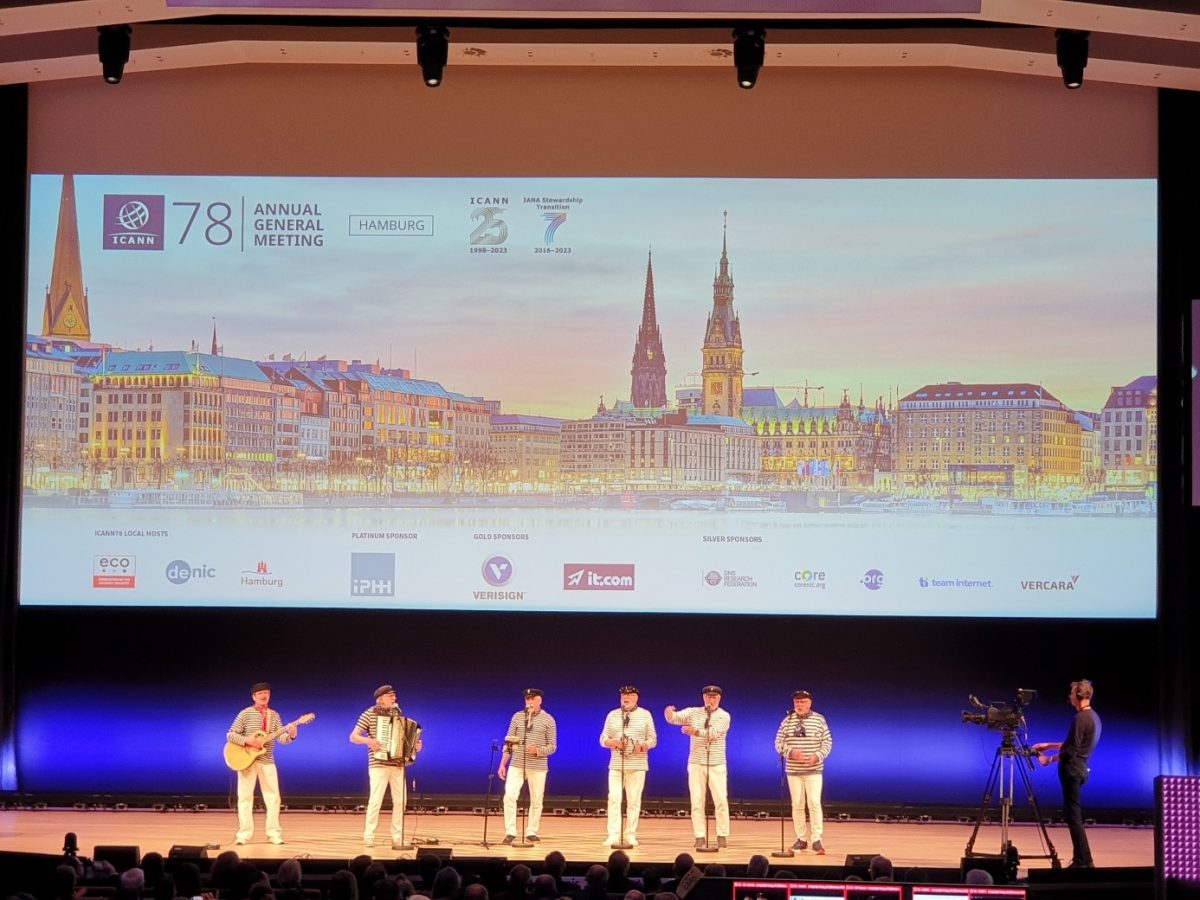
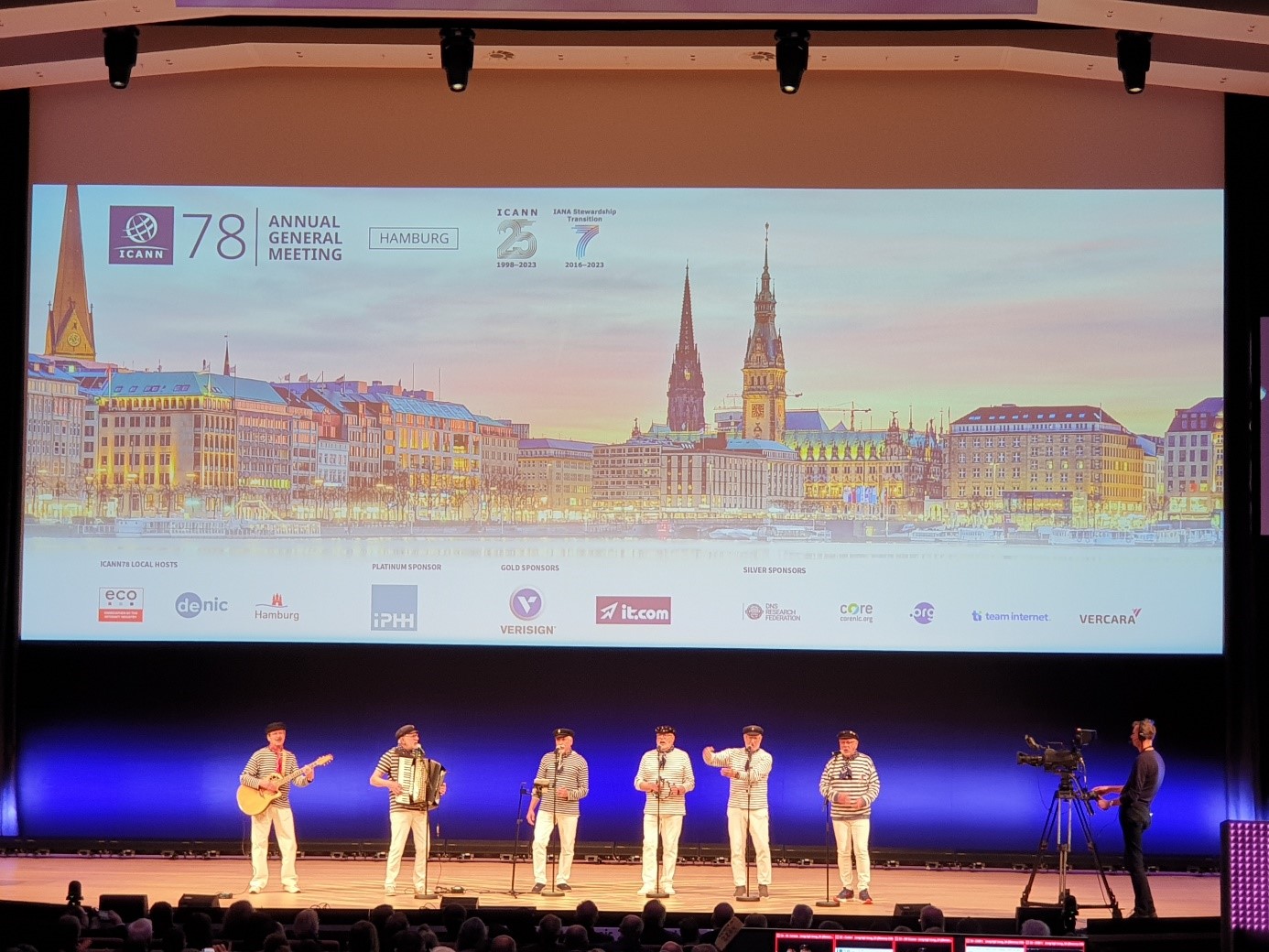
De Elbschippers at the ICANN78 Welcome Ceremony, on October 23, 2023

ICANN faces new challenges

“On 30 September 1998, ICANN was incorporated as a private, not-for-profit organisation in the State of California”. With these words, Tripti Sinha, the Chair of ICANN’s Board of Directors, began a dense speech at the Welcome ceremony of ICANN78. She reminded us that most of today’s Internet tools, including smartphones, have been developed and launched during this period, and that while “25 years is not much”, “the world has changed remarkably” in the meantime. Today, it is the context of wars and technological transformations, in particular “artificial intelligence and quantum technology”, that constitute major challenges for the multiparty model. To these can be added alternatives to domain names that use the DNS, such as blockchain domains, which are outside the scope of ICANN. These were highlighted at ICANN78. Their protagonists like to call them “domain names”, while others would like to differentiate them by talking about “wallet domains”. ICANN’s interim President, Sally Costerton, made a point of emphasising the word “trust” in her introductory speech. “Trust is a fragile thing” she said, “difficult to build and easy to lose”.

On the subject of trust, Sally Costerton pointed out during the ICANN Board’s question and answer session that significant progress has been made on a number of important issues since her appointment in December 2022. In March of this year, for example, the first international Universal Acceptance Day was held, or how to make the Internet more inclusive and thus closer to the way its users use it. At the ICANN76 summit, also in March, the next series of new generic extensions was confirmed. More recently, the Registration Data Request Service (RDRS), a prototype of the future System for Standardized Access to Domain name registration data (SSAD) for legitimate requests, was launched. And the year 2023 will have seen a concrete proposal to strengthen the means of combating abuse of the DNS after years of fruitless exchanges. A proposal to revise the contracts of registry operators and registrars is currently being put to a vote by the parties concerned, with adoption expected between December 2023 and January 2024.

Registration Data Policy: Let it go let it go

The fact that ICANN represents numerous sensibilities whose interests are often divergent, but also that it operates with consensus as its totem, partly explains why the finish line is often far removed in time from the starting line. The Registration Data consensus Policy has not escaped this reality. This policy is intended to replace a Temporary Specification implemented as a matter of urgency on 17 May 2018, eight days before the General Data Protection Regulation (GDPR) came into force thus to integrate the GDPR requirements into the DNS ecosystem. The Registration Data Consensus Policy is the culmination of phase 1 of a Policy Development Process (PDP) initiated on this occasion. While a final report with a view to its implementation was issued at the beginning of this year, it was ICANN78 that enabled the implementation review team work to be concluded. The blocking point on the wording relating to the deadlines granted to operators to deal with urgent requests for access to registration data in the event of law enforcement, could be removed. The policy, which now has a permanent framework, will now be implemented by the parties concerned, registry operators and registrars.

The next round of new generic extensions

The next round of new generic extensions remained another major topic of this edition. While ICANN is now putting forward the date of April 2026 for the next application window (editor’s note: the previous window took place between January and April 2012), ICANN78 highlighted the progress made in implementing the recommendations arising from the Policy Development Process known as “PDP Subpro” (editor’s note: Subsequent Procedures). Earlier in March, some thirty recommendations had not been adopted by the ICANN Board and had been referred to the GNSO for clarification. Thanks to the work of a Small team, 12 additional recommendations have just been adopted by the ICANN Board, bringing the total number of adopted recommendations to 104. 13 remain in the balance and 7 have been rejected. For the latter, we will now have to assess their impact and consider remedies. The implementation team can therefore make progress on just over 80% of the recommendations arising from the Subpro PDP. The revised guide for future applicants is progressing in line with initial forecasts with at least 18 months to go.

The issue of closed generic extensions and diacritical letters

Considered but not proposed due to a lack of consensus in 2012, then discussed for five years, the topic of closed generic extensions was relaunched in 2022 with a view to a new series of generic extensions. In practice, they would allow organisations under certain conditions to use a generic term (editor’s note: for example .CHARITY) with the same rights as a brand extension. Access to the extension to create new domain names would therefore be very restricted. A year ago, a discussion group comprising the Governmental Advisory Committee (GAC), which represents governments, the At-Large Advisory Committee (ALAC), which represents end-users, and the GNSO was set up to try to address this issue. Last July, they proposed a framework detailing the many aspects to be considered to introduce this new type of extensions. However, at the end of their work, each body sent a separate letter to the ICANN Board of Directors, proof that their positions remained far apart. Barring any surprises, there should therefore be no closed generic extensions in the next round.

Québec, whose .QUEBEC was integrated into the DNS root in April 2014, has also invited itself into the discussions concerning the next series of new generic extensions. In 2012, Québec announced its wish to obtain .QUEBEC as well as .QUÉBEC. Although in the end they only applied for the non-accented version, they had hoped to be able to use .QUÉBEC as well. They were not granted this right because of a risk of similarity. ICANN78 highlighted the fact that perceptions remain different depending on whether or not .QUÉBEC is a variant of .QUEBEC. The pronunciation for French speakers is the same, but the presence of a diacritical letter (editor’s note: letters to which signs such as the acute accent, the grave accent, the circumflex accent, the umlaut are added) makes encoding in ASCII characters different and technically feasible. While their request has little chance of success, it has also served to focus attention on important issues for registry operators, where the answers provided are often ill-suited to their needs.

ICANN78 was ICANN’s last annual summit. All eyes now turn to 2024. A new year is approaching, which may or may not see the conclusion of contractual amendments to registry and registrar contracts, with specific obligations to remedy malicious use, the continuation of implementation work on the next series of generic extensions, the likely launch of an ICANN holistic review or even the prospect of the scheduled Sunset of the Whois protocol in early 2025.

For Europeans and companies operating on European territory, it is the NIS2 directive that will crystallise all attention, as it must be transposed into the national laws of the Member States by October 2024. On this subject, ICANN representatives indicated at the traditional closing Public Forum that the policies for generic extensions are not “in contradiction with the NIS2 directive and that the parties concerned have the latitude to implement measures to comply”. The European Top Level Domain Information Sharing and Analysis Center (European TLD ISAC) is to be commended on this point, as it will be a useful relay in implementing the NIS2 Directive in the domain name industry.

Nameshield, an independent European company that has been ISO 27001 certified since 2017, will comply with the directive and will be keen to help its customers to comply. Nameshield also has the expertise to manage your projects for new generic extensions.

Finally, in terms of leadership, the GNSO, the body responsible for generic extensions, now has a new Council team appointed at ICANN78, while ICANN Org will be appointing a new president in 2024. See you next year.

Image source : ICANN‘s website