.BRAND : 4 episodes, for this summer

.BRAND : 4 episodes, for this summer
Photo : CC BY-SA 3.0 Nick Youngson – source : http://nyphotographic.com/

Act 3: Depression


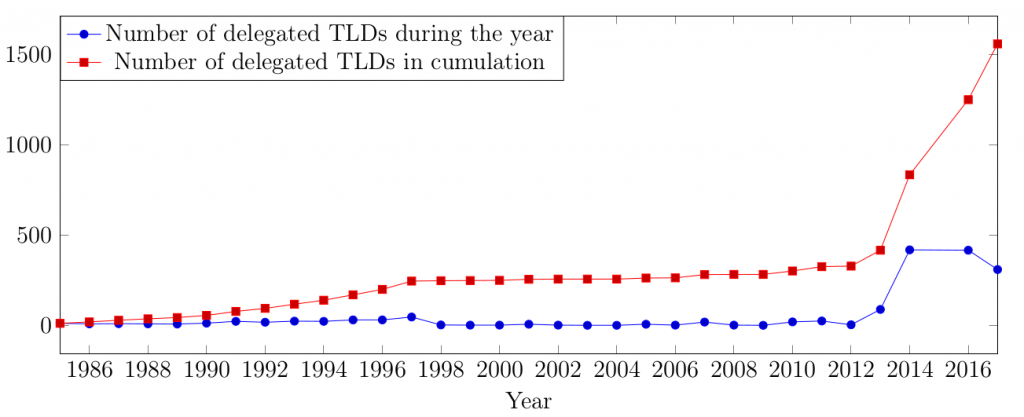
Five years ago, the number of domain name extensions was alright: less than 500. It was still possible to register its trademark and its company’s name in the extension of its choice and to act against fraudulent deposits. Attacks were unusual and you defended yourselves when smart little ones made contentious deposits. Some extensions only accepted subdomains registrations, such as Australia and the United Kingdom. Impossible to save at the root and impossible to register without having any rights: .CO.UK for companies, .AC.UK for the academic world,…

But that was before.
 

Domain names - Number of delegated TLDs


Then arrived several generic extensions and if the rare extensions created, caused only few problems (.MUSEUM, .MOBI, .AERO,…), this was not the case for the thousand new delegated extensions following the new gTLD program, opened on January 12, 2012. Although brands have filed .BRAND or .COMPANY to protect their territories, many extensions were open and the registration race allowed smart little ones to create big damage. The registration of BLOOMBERG.MARKET and VINCI.GROUP are two particularly well-known examples.

Today, the management of domain names is managed by people dedicated to this activity, mostly within marketing, legal and IT departments.

But what do you have to do? Register your brand in all TLDs? Spend an important amount in domain name retrieval procedures? An in-between?

Interesting alternatives are born from the opening of the new gTLDs:

  • Create a closed extension with subdomains to find the identification-trust link, such as the .FX project I presented a few days ago to NetWare2017 ;
  • Create your own extension: some already do this well, like .BNPPARIBAS or .LECLERC ;
  • Help the end user and this is the project of the Nameshield’s CEO, through Brandsays, a browser extension.

If the brands continue to rightfully submit domain names, they will also develop other means of access, such as SEO or social networks.

While INTA, in its recent study, highlighted impressive figures regarding defensive actions, to get the right answer, you have to ask the right question. We will see in the fourth and last episode of this summer saga, how to understand the .BRAND strategy.
 

Read act 1: Denial (and Anger)

Read act 2: Expression

Read act 4: Reconstruction

Have you heard of Esperancia?

Esperancia_logo - Nameshield

Surely, you have already noticed the Esperancia logo in the email signature of your Nameshield partner. But do you know how it works?

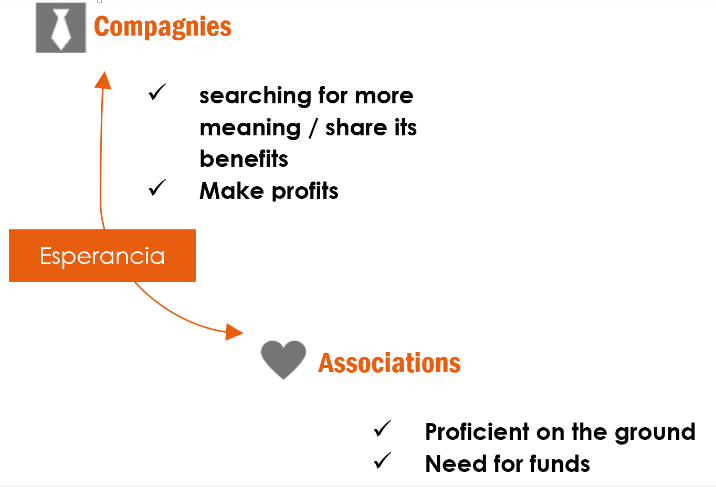
Esperancia is an endowment fund with an innovative and ingenious concept: the search for long lasting funding. This system ensures to maintain its purpose: a long-term action to the associations it supports.

Esperancia - Nameshield


If Esperancia owns 15% of our company’s shares, Nameshield also transfers 1% of its annual revenue to Esperancia.

Therefore, as a Nameshield customer, you also participate to the development of Esperancia.

This endowment fund works in a unique way. In that regard, Nameshield and the other sponsoring companies are pioneer companies.

Thanks to the funds collected by donations in euros or in capital, Esperancia assists and supports existing associative projects aimed to protect and help children and underprivileged youth to become self-sufficient adults able to take their place in society.

Esperancia intends to be a “purveyor of hope” to young people in difficulty. At the same time, Esperancia brings a complementary meaning to the commitment of our collaborators and to their involvement in our company: we commit ourselves to social projects at their side.


Last July, Nameshield hosted an event for the project “Réussir Angers”, created to help vulnerable 18-30 years old young people, who have for example, the common point of disregarding professional codes.

One of the purposes of this day was to educate those young adults, to initiate them to the corporate world, and make them feel more confident about themselves.

Over a convivial meal, the young people could listen to four Nameshield collaborators discussing about their personal and professional background.

In this favorable context, reassuring and free of pretense, the young people integrated to the project, could explore the doubts, obstacles and difficulties experienced by our fellow volunteers as well as their achievements, their successes, small and big.

A moment of exchange and sharing, enriching for every participants on each side of the stage.

.BRAND : 4 episodes, for this summer

.BRAND : 4 episodes, for this summer
Photo : CC BY-SA 3.0 Nick Youngson – source : http://nyphotographic.com/

Act 2: Expression


We left off on the time when the brands did not feel the Internet revolution, the techniques evolving and the registered domain names. (Read act 1: Denial (and anger))

The example of McDonald’s is interesting. In 1994, Wired, an American magazine created a year earlier, communicates about the case of mcdonalds.com. Joshua Quittner, a journalist at Newsday, contacted McDonald’s and asked if they would be interested in registering mcdonalds.com. There was little to no answer. He registers the name, contacts McDonald’s which does not answer. Then he publishes his article on Wired, putting the contact address ronald@mcdonalds.com.

McDonald’s complains and Quittner asks for a donation for charities: it will be 3500USD for the computer equipment of a school in New York.

McDonalds - .brand domain name example


In analogy, we can remember when a Russian worker asked for a gift from Vladimir Putin, who could not refuse in front to the camera. Putin offered him his watch worth a year’s salary.

The virulent attacks of trademarks are legion in order to recover the domain names from little jokers, some of them could be part of the company, such was the case for mtv.com.

Brands federate among themselves, contact ICANN to develop simplified procedures, even if, according to the famous trademark dilemna, the American organization had known the risk of cybersquatting for a long time.

On the side of lawyers, training courses are launched on each side of the Atlantic and the UDRP, SYRELI, URS and others, are created in order to defend the digital territories.

France, known for a long time as a country supporter of trademarks, will not remain passive and is today, the second country in the world in the disputes resolutions concerning domain names.

Thus, in the virtual territory, and in contrast to the reality, the police is financed by trademarks. The holders of a territory, similar to countries, are doing nothing or almost nothing: recovering a .Fr can be possible using a SYRELI procedure, while for our friends from the outside of Rhine, no alternative procedure exists: to apply for its .DE, it is the court or nothing.

Nevertheless, an economy of defense of brands is organized and thus, an ecosystem is developed.

Everything seems to be going well, until the arrival of the new extensions, as called in the field, the first round…


Read act 3: Depression

The acquisition of Rightside Group by Donuts becomes a reality

new gTLDs - The acquisition of Rightside Group by Donuts

It’s at mid-July that ICANN has given its consent regarding the merge of Rightside Group, the registry behind the 40 new gTLDs (.ATTORNEY, .NINJA, .PUB, .DENTIST, .NEWS, .ROCKS, .LIVE, etc.) and the other well-known registry in the new gTLDs’ world, Donuts Inc (more than 200 TLDs: .LIFE, .LOANS, .MEDIA, .SOLUTIONS, .WORLD, etc.).

Donuts will then acquire Rightside at the price of 10.60$ per action, in the context of a takeover offer, i.e. an operation of approximatively 213 million in total.

Donuts, already largely dominant with its hundred extensions, continues to reinforce its position and benefits from difficulties faced by some registries suffering from deficit of commercial success.

This new operation highlights a fact: many new extensions didn’t obtain the expected enthusiasm and the registries which created them are in difficulties.

Are we heading slowly but surely towards a retrieval by Donuts of unsuccessful registries seeking to limit the losses?


Black July for the .xyz

 .XYZ - new gTLD

The volume leader of the new gTLDs has seen its zone file cut by more than half.

While it started its July month with more than 5.2 million of registered domain names in its zone, it had only 2.5 million on Monday 17, letting the .top get its way back to the top in the meantime.

How to explain such a phenomenon?

First of all, the multigenerational extension doesn’t escape the non-renewal law.

A year after having massively registered at the derisory price of 0.01$ or even received for free their domain names in .xyz, the acquirers simply don’t renew these latter, hence a considerably reduced zone file.

Last but not least, a big part of the non-renewals comes from the ban done to registries by the China Ministry of Industry and Information Technology to sell .xyz.

Yet, half of the registered domain names in .xyz were owned by people in China.

The case is currently in the process of being resolved, so the .xyz has yet to type its final point.