
Slamming: a scam still too common

Slamming: a scam still too common

The slamming is a fraud aiming to deceive companies in order to sell by emails unsolicited services for domain names.

These slamming attempts are easily recognizable and play on their contacts lack of knowledge in some cases. The slammers propose services that you didn’t solicit with your official registrar (registration, whois’update, owner or registrar transfer…) at high prices. These emails are sources of anxiety and lead you to take a quick decision.

For example, a standard slamming email would encourage you to register domain names in emergency because a third party would have done a domain names’ registration request using exactly your company name or your lead product, identically (as if by chance). They recommend you to register them without delay to prevent any cybersquatting. Obviously, the “fake registrar”, in its great magnanimity has put on standby the domain name registration order for the good of the company…

Warning, the slammer uses visual references and the right technical vocabulary, misleading that way the company. They can also make reference or put the logo of some registries or actors of the Internet environment in order to give credibility to their speech.

What to do if you have any doubts?

Forward your emails to Nameshield, which will confirm you if these mails are fraudulent.

We recommend a management of your domain names centralized and managed by a person informed of the operations associated to domain names. Don’t take any decision in a hurry. You can also make a whois to verify the sender’s identity and the existence of the “registrar” company. You will then notice that most of the domain names used for slamming campaigns have been recently registered and that the companies holding the names are unrelated to the registration office activity.

Be careful, your domain names are intangible assets to protect, secure and value.

Nameshield assists you on a daily basis, in the management of your domain names portfolio, your digital brands protection and the risks management on the web.

PyeongChang Olympic Games: Cyberattack

PyeongChang 2018 Olympic Games: Cyberattack

It’s during the opening ceremony of the PyeongChang Winter Olympic Games that a cyberattack has aimed at the host infrastructure IT department.

Around 45 minutes before the start of the event, the servers and WI-FI network have been hit by an attack, which fortunately has not impacted the ceremony. However, in the Olympic Village, the press zone has been deprived of Internet connection and television. Furthermore, the official website of the PyeongChang 2018 Olympic Games has been unreachable for hours, hindering web users to print their tickets to access to the event. 12 hours were needed to completely restore the services.

The CIO didn’t wish to communicate on this attack origin, but PyeongChang 2018’s spokesperson points that “there was a cyberattack, the server has been updated yesterday (Sunday February 11), and we know the cause of the problem. We know what happened, this is a usual thing during Olympic Games. We will not reveal the source.” The CIO’s communication director, has assured “We refuse for now to reveal the details of our investigation, but we will do it.”

A cyberattack with destructive aim

Talos Security company’s two researchers have analyzed the attack though and observed that the purpose was not to retrieve sensitive or personal data contained on the organization server, but clearly to interfere with the games ‘running.

The virus samples’ analysis allowed to highlight its main purpose: the destructive aspect. Concretely, the effects caused by this cyberattack, were to delete the events of the calendar and the documents, and above all, to make the affected machine inoperable.

PyeongChang Games, victims once again

At a global scale and ensuring a visibility of choice for cybercriminals, this is not the first cyberattack suffered by the PyeongChang Olympic Games. At the end of December 2017, the infrastructure was hit by an attack mainly consisting of the sending of emails to the event organizers. According to the McAfee company, those mails contained Word files infected by a virus.

Russia, North Korea: the different leads considered

The potential attack’s perpetrators could be Russia, of which the delegation has been denied of the Games for doping reasons: before the Games, McAfee declared to have information indicating that hackers located in Russia had planned attacks in retaliation.

A possible North Korean involvement was also mentioned, despite the rapprochement that could be observed by the viewers during the opening ceremony.

An attack that shows, once again, the IT infrastructures ‘vulnerability despite the means implemented.

FIC 2018: Nameshield’s DNS Premium solution labelled France Cybersecurity

FIC 2018: Nameshield’s DNS Premium solution labelled France CybersecurityThese 23 and 24 January, has taken place in Lille, the 10th edition of the International Cybersecurity Forum (FIC). With 7000 participants, 240 partners and 60 represented nationalities, it is a major event in terms of cybersecurity and digital confidence, gathering all the actors in France and in Europe.
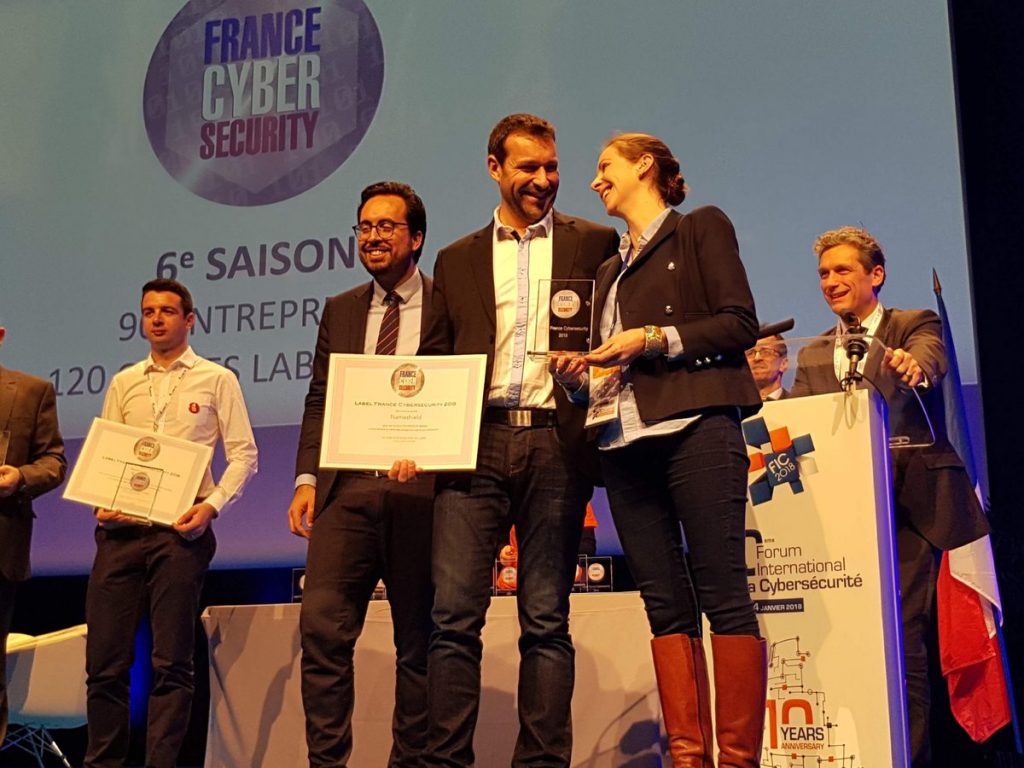

On this occasion, and for its first participation as a partner, Nameshield was given the France Cybersecurity label for its DNS Premium solution.

FIC 2018: Nameshield’s DNS Premium solution labelled France Cybersecurity
France Cybersecurity Label given by Mounir Mahjoubi, Secretary of State for Digital

The Nameshield’s labelled DNS Premium solution

The DNS is a well-known attack vector: DDoS, spoofing, Man in the Middle. The attacks are various and sophisticated. In front of the magnitude of these threats, maintaining its DNS infrastructure is complex.

Reliable and strong, the Nameshield’s highly secured DNS Premium is a DNS solution high availability, anycast and offers expert functionalities (anti-DDoS filter – Failover – GeoIP – DNSSEC – detailed statistics – etc.).

This solution labelled France Cybersecurity, thus allows to its users to protect their digital assets from any attack and ensures a high availability of their Internet services.

What is the France Cybersecurity label?

FIC 2018: Nameshield’s DNS Premium solution labelled France CybersecurityThe France Cybersecurity label is the guarantee for users that the Nameshield’s products and services are French and possess clear and well defined functionalities, with a certain level of quality in terms of cybersecurity, verified by an independent jury.

The France Cybersecurity Label answers to several needs and objectives:

  • Raise awareness among users and international ordering parties regarding the importance of the French origin of a Cybersecurity offer and its intrinsic qualities
  • Certify to users and ordering parties the quality and functionalities of labelled products and services
  • Promote French cybersecurity solutions and increase their international visibility
  • Certify to users and ordering parties the quality and functionalities of labelled products and services
  • Increase their overall use and the users’ security level

This label is governed by a committee composed of representatives gathered in 3 colleges:

  • College of officials: representatives from the Direction générale de l’armement (DGA, the French Government Defense procurement and technology agency), the Direction générale des entreprises (DGE, the French Directorate General for Enterprise within the Ministry of Economy, Industry and Digital), and the Agence nationale de la sécurité des systèmes d’information (ANSSI, the French National Cybersecurity Agency).
  • College of users: representatives from groups of users, such as: CIGREF, GITSIS, CESIN, CLUSIF ISSM space.
  • College of industrials: representatives from the “Alliance pour la Confiance Numérique” (ACN – Alliance for digital confidence) and HEXATRUST.

Nameshield certified ISO 27001 on all its registrar activity, was able to bring all the necessary guarantees to obtain the France Cybersecurity Label for its domain names securing offer, the DNS Premium and as highlighted by Gérard Gourjon, Nameshield’s Deputy Director-General: “Obtaining the France Cybersecurity Label illustrates our engagement to provide the best services and standards regarding cybersecurity to our customers. At Nameshield, we are proud to see our highly efficient and highly secured DNS infrastructure being labelled.”

For more information on our labelled solution DNS Premium: https://www.nameshield.com/en/cybersecurity/dns-premium/

For more information on the France Cybersecurity Label: https://www.francecybersecurity.fr/en/

SSL certificates reduction to 2 years maximum

SSL certificates reduction to 2 years maximum

The CAB forum, organization which defines the SSL certificates issuing and management rules approved the SSL certificates reduction to a duration of 2 years against 3 previously. Initiated by the browsers Chrome and Mozilla heading, this decision moves in the direction of an always more secured Internet by forcing the actors to renew more often their security keys and to stay on the last standards of the market.

This decision will be applicable to all Certification Authorities from March 1st 2018. In order to ensure a smooth transition, from February 1st 2018, Nameshield will not propose certificates with a 3 years duration anymore.

What impact for your certificates?

The new certificates will thus have a maximum duration of 825 days (2 years and 3 months to cover the possibility of 90 days early renewal). EV certificates were already under this scenario, so are concerned the DV and OV certificates in all their forms (standard, multi-sites or wildcard). Nothing in particular for these certificates.

For existing certificates, this new duration will have a consequence, since it will apply to all the certificates from March 1st. A 3 years certificate issued recently and which would need to be replaced beyond the 825 days deadline, will then have to be authenticated again. It is then important to know it to prevent urgent reissue, including for the simple SAN adding. You have to check beforehand if the certificate to replace may be impacted, this is the case of DV and OV certificates, the EV are also not concerned here.

Nameshield’s SSL team will inform you regarding the concerned certificates.

South Africa, domain names and brands: the advantage of a simultaneous registration

South Africa, domain names and brands: the advantage of a simultaneous registration

The domain name is to the virtual, what the brand is to the real. It is actually a little more complicated but this small sentence allows to associate brands and domain names.

It’s in the context of this shared vision, that the South African brands registration Office, CIPC has developed a partnership with the registry of .ZA, the South Africa geographic extension.

Thus, the brand applicants can choose the “domain name” option, registering that way the two protections. This is here the first collaboration I’ve seen between these kinds of registration office.

For more information, you can read the CIPC press release.

Note that a webinar is planned on Thursday January 25 2018.