ICANN66 at Montreal – A contrasting summit

During the first half of November, the 66th ICANN Summit was held in Montreal, Canada. This third and final annual summit devoted to policies applicable to Internet naming was eagerly awaited as the topics under discussion are numerous. At its closing, however, it left many participants a little bit disappointed.

A preview of the topics and postures during the weekend before the official launch of the Summit

The weekend before the official opening of the Summit is usually an opportunity to get an overview of the topics and postures involved. Not surprisingly, the expedited Policy Development Process (ePDP) which aims to develop a consensus rule to specify future conditions of access to personal data that are no longer published in the WHOIS, the domain name search directory, due to GDPR, is one of the major topics.

Among other related topics, the replacement of the same WHOIS by the RDAP (Registration Data Access Protocol) probably next year for generic domain names. This replacement is not insignificant when we know that WHOIS has been in use for nearly 35 years.

The body representing governments, the GAC, has weighed up the issue of domain name abuse, which has taken off considerably on the new generic extensions launched in 2012. When we know the rise of Internet practices aimed at weighing on elections in certain countries and the economic impact of computer attacks and hacking, we understand that this subject is being pushed by the GAC. While one of ICANN’s topics is to clarify in their texts the notion of malicious uses, this term refers to domains registered for phishing, malware, botnets and spam, the other part concerns the means to stem them. The existence of abusive domains indeed threatens the DNS infrastructure, impacts consumer safety and threatens the critical assets of public and commercial entities. Finally, and not surprisingly, the subject of a future round of new generic extensions has also been on many lips.
ICANN66 at Montreal - A contrasting summit
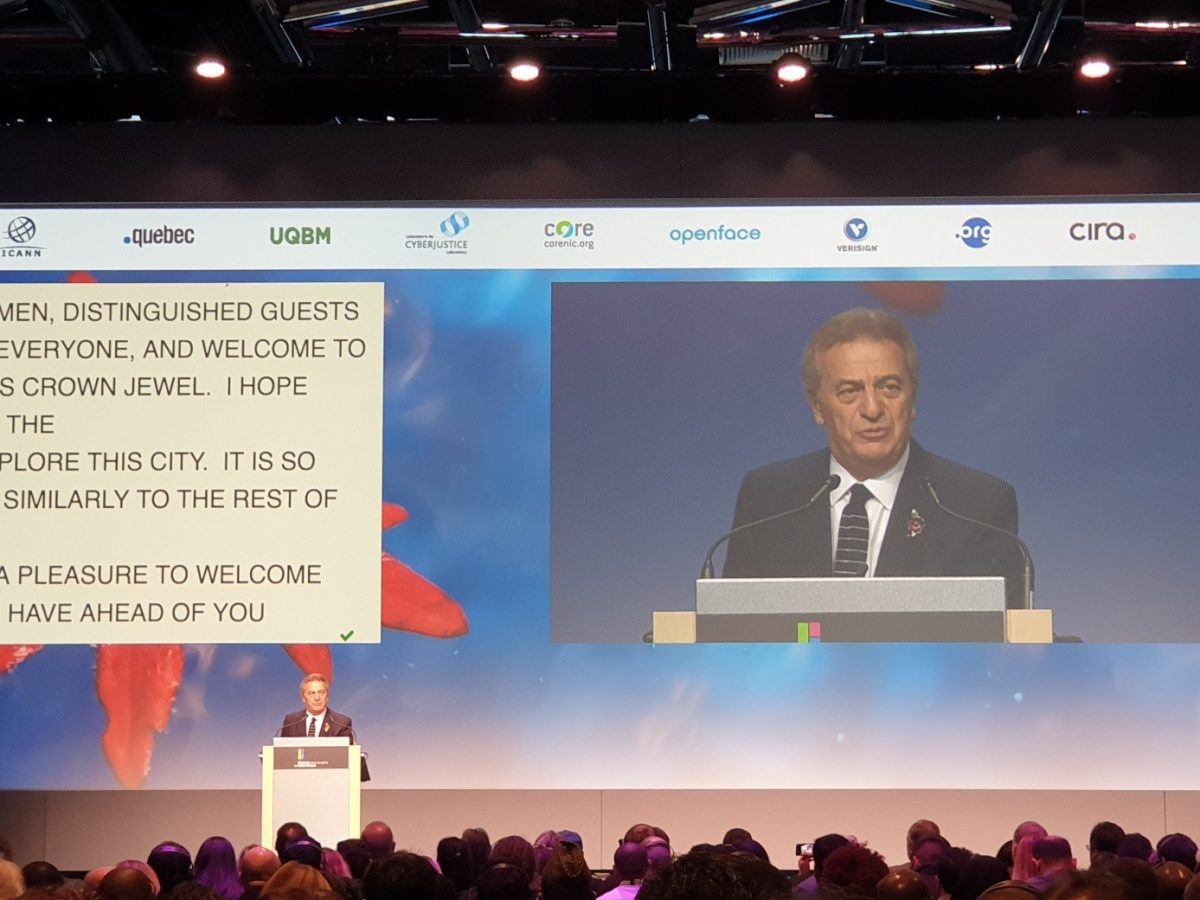
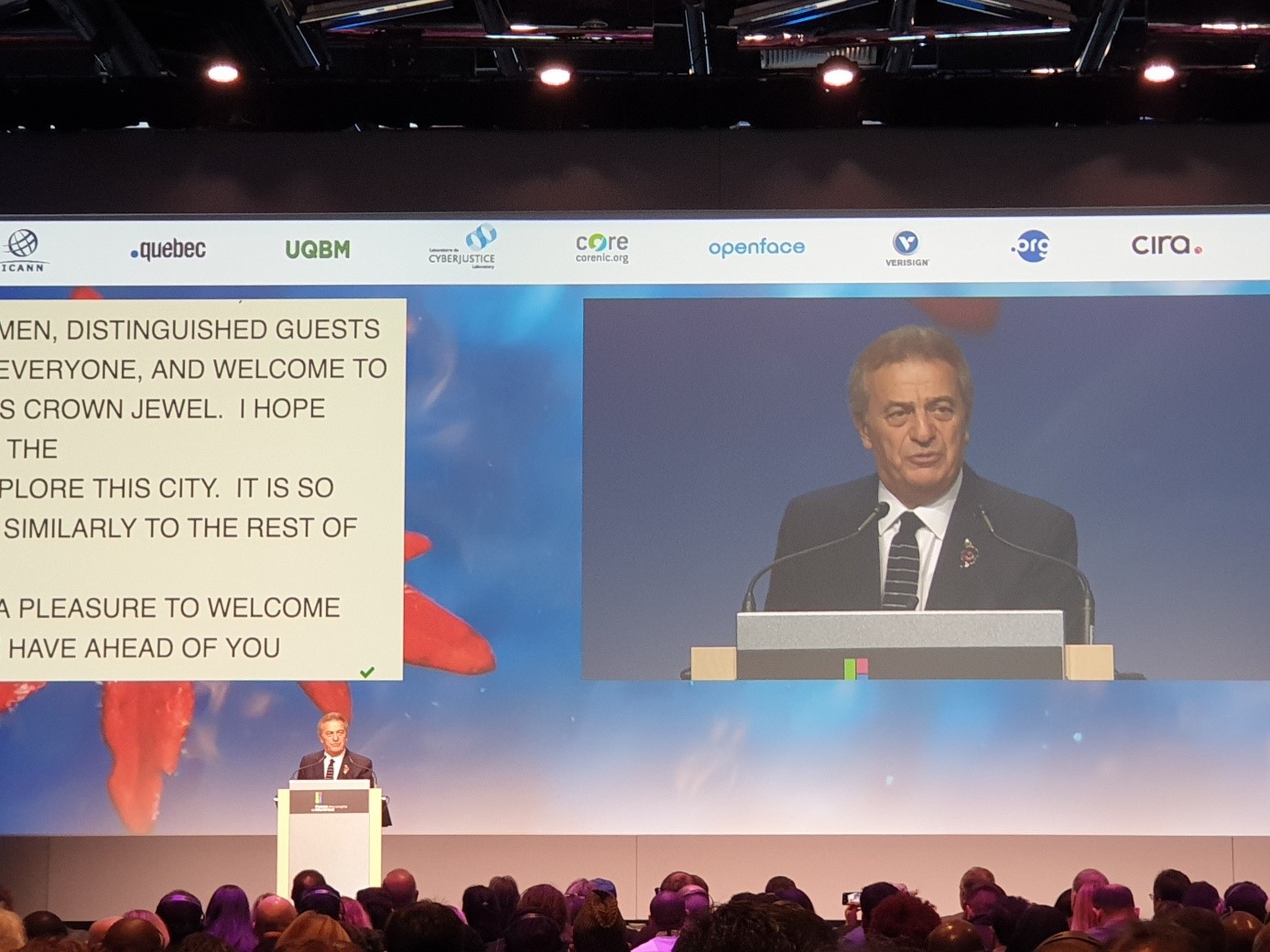
Cherine Chalaby at the ICANN Summit held in Montreal

“The best ICANN summit”, really?

During the traditional opening ceremony, which brings together all the guests for one hour (2500 according to Goran Marby, ICANN CEO) in a huge room to listen to various speakers, including Martin Aubé of the Quebec Government’s Ministry of Economy and Innovation, Cherine Chalaby, one of the ICANN Board members whose term ends at the end of the year, told his audience that ICANN66 would be the “Best ICANN summit”. It must be said, however, that at the end of the week of debates and meetings, which followed one another at a sustained pace, while the subjects under discussion are really numerous, the feeling regarding this assertion was more than mixed for many participants.

First, the expeditious process for access to WHOIS non-public data is progressing with a framework constrained by ICANN and the Personal Data Protection Authorities. The outcome of this process is envisaged between April and June 2020 and it is currently a centralized model where ICANN would allow the future lifting of anonymity of data that are now masked due to GDPR which holds the line.

Then the subject that was probably most often mentioned during this new summit week concerned abuses with domain names. For ICANN, the subject is central because it is directly correlated to its totem: the stability of the Internet for which they are the responsible. Since February 2019, ICANN has been publishing some metrics on malicious practices identified through DAAR, their Domain Abuse Activity Reporting.

Their latest report presented in Montreal shows that 364 extensions (mainly new generic extensions from the 2012 round) revealed at least one threat posed by one of the domain names activated on these extensions. More worryingly, new generic extensions would still account for nearly 40% of malicious uses, compared to 60% for historical generic extensions. This figure should be highlighted with the volume of these two categories of extensions. Indeed, out of just over 200 million generic names, new generic domains represent only 15% of the total number of registered names. ICANN therefore wants this subject to be taken up by the entire community present in Montreal.

Proposals were made by the various bodies present, some of which went so far as to request a policy development process (PDP). This last proposal, if it were to obtain ICANN’s approval, would have the unfortunate consequence of postponing the hypothetical schedule for a next round of new extensions, a subject that interested many of the guests present in Montreal. Indeed, for ICANN, the problem of the concentration of malicious practices in the new generic extensions must be solved before any future round, so that the PDP still in progress on the review of the last round of 2012 has gone almost unnoticed.  

If the rules are slow to evolve on malicious uses, your Nameshield consultant can already provide you with adapted solutions to your needs on this key matter.
Nameshield signs up the Paris Call in order to actively contribute to the Internet’s stability

Paris Call - Nameshield

Just one year ago, in the context of the first Paris Peace Forum, the French President, Emmanuel Macron, launched the Paris Call for trust and security in cyberspace. This call is a political declaration aiming to express a mobilization on the stability in the cyberspace and strengthens the efforts of the international community and many actors involved in the digital security issues. This text reminds some principles that we think are fundamental, like the application of the international rights and the Human rights in the cyberspace. It also highlights the need of a multi actors’ approach, to create standards which will allow us to fully benefit, i.e. in a reliable and secure way, from opportunities provided by the digital revolution.

Lastly, the Paris Call promotes the strengthening of the digital products and services’ security that we use for example, in our daily lives. The text aims in that sense, to prevent cyberattacks perpetrated by malicious actors, which threaten all the users of the cyberspace.

Aware that our Society’s development, on the economic, cultural and democratic fronts, requires a strengthened trust of the information that flows through the Internet, Nameshield, which has worked for 25 years to protect the digital identity of its clients; companies, local collectivities and administrations through the use of their domain names, wished to join this initiative and sign the Paris Call.

Its job consists in ensuring the integrity and resilience of the identity of individuals and organizations on the Internet, represented today by the domain name. By highly protecting data on domain name identity cards (Whois) and by providing a high availability and high performance service through the associated Domain Name System (DNS), Nameshield contributes to a large extent to the second principle of the Paris Call: Protecting the Internet. To prevent activity that intentionally and substantially damages the general availability or integrity of the public core of the Internet.

Cornerstone of the Web, the Domain Name System (DNS) serves as the Internet directory. This protocol translates a domain name into an IP address, based on a database distributed on thousands of machines. If the DNS falls because of data corruption or a denial of service attack, all your websites and emails would become inaccessible, which is completely unthinkable nowadays! The DNS must be protected and must stay highly available.

Protocol created in the 1980’s, security flaws regarding the usual functioning of the DNS have been identified since its creation. That is why, a new secured protocol, DNSSEC, has thus been developed to ensure the authenticity of the exchanges through a certified signature. Other solutions can complete the resilience of your identity on the Internet: the registry lock, SSL certificates…

The security solutions proposed by Nameshield, an independent French company that stores its data in France and possesses its own anycast and resilient DNS infrastructure, certified ISO 27001 on all its domain names activity, are compliant with the ANSSI recommendations on the good practices regarding the domain names’ acquisition and exploitation.

In the context of the 2nd Paris Peace Forum, the Ministry of Foreign Affairs wished to illustrate the second principle of the Paris Call: Protect the Internet by highlighting the services proposed by Nameshield. The company is proud to be able to collaborate, at its level, with the actors implicated in digital security issues in order to make the Internet more reliable and thus contribute to the security of the cyberspace.

https://pariscall.international/en/principles

Advices on how to change the domain name without losing its referencing

Advices on how to change the domain name without losing its referencing
Image source: DiggityMarketing via Pixabay

During a rebranding for marketing purposes, in the context of a merger or an acquisition for example, a company can change its website’s domain name.

At the search engines’ level, it is all the pages that change, as if this was a brand new website. Therefore, how not to lose the work done on the SEO and make a successful transition, in particular if the website is old?

In the case of a rather old website with an optimal referencing on the existing domain name, transferring a website on a new name can ruin the time-consuming work that is the SEO. If the decrease of the traffic from organic search is normal (and temporary), some advises can help lessen the downturn, at least during the transition period.

Copy identically your website and implement 301 redirections

The first tip is to completely keep the website’s architecture, so that only the domain name changes in the URL.

Then, permanent redirections (301 redirections) must be created from each pages of the former website towards the corresponding page of the new website. Do not implement multiple redirections.

This process must be closely monitored to ensure that each 301 redirection is effective. The search engines will know that it’s not necessary to index the former name anymore but it’s the new one that must be indexed now. To ensure this, it is necessary to check that none of the former pages is accessible through the former domain name.

Have the backlinks updated

Google uses parameters linked to confidence indicators in its algorithm, thus to trusted websites, deemed as such by the search engine (indicators like the age of the website, the transparency of the legal notices, the ratio links number/words number per page, the links number pointing from other websites to this one, the extensions like .edu, .gov, the institutional websites, media websites, etc.) Hence, it can be interesting to quickly obtain the links from this kind of trusted websites at the time of the migration.

Along the same lines, reviewing your backlinks and requesting to the websites that refer to your website to update these links, so they link towards the new name, is an advantage. Of course, if you have many backlinks, concentrate on the more important backlinks regarding the referencing.

Inform Google

Lastly, it’s possible to directly inform Google of the changing through Google Search Console, the search engine will then update its index.

Register the sitemap

By submitting a sitemap file for the new website to the search engines, you will gain time in referencing by immediately giving to the engines the pages to index.

Keep the same holder for the new domain name

Make sure that the new domain name has the same proprietary information on its whois as the former domain name. Google may check these data.

Be patient

Do note that on Bing you will need an average of 2 months to get your referencing back, and about 6 to 7 months on Google.

[New gTLD] Launch of .NEW by Google

[New gTLD] Launch of .NEW by Google
Image source: 377053 via Pixabay

Following the launch of .APP, .PAGE, and .DEV among others, Google (Charleston Road Registry), launches the new extension .NEW in Sunrise period as of October 15, 2019.

Conditions for registration of a .NEW

  • All domains on .NEW must resolve to action generation or online creation flows. Once resolved, the web user should be able to ‘create’ something without any further navigation. For example, docs.new proposes a dedicated page proposing the direct use of Google online word-processing software allowing a new document creation page.
  • Any .NEW domain will need to be live within 100 days of registration.

If these conditions are not respected, the registry will consider the registration as non-compliant with the registration policy. In this case, the name will be placed on hold. The registrant will then be notified to correct and apply these conditions, if no action is taken, the domain will be blocked then deleted.

Launch calendar

  • Sunrise period: from October 15, 2019 to January 14,2020
  • LRP (Limited Registration Period): from January 14 to July 14, 2020
  • General availability: from July 21, 2020

For more information on the conditions for registration of your .NEW, don’t hesitate to contact us.

The alarming Kaspersky report: nine times more attacks aiming connected objects than in 2018

The alarming Kaspersky report: nine times more attacks aiming connected objects than in 2018
Image source: TheDigitalArtist via Pixabay

Last October 15, Kaspersky, the antivirus software company, published an edifying report about the volume of cyberattacks directly aiming connected objects.

Although the industry expected that this new generation of objects would be directly targeted by cyberattacks, the increase in the cyberattacks number is alarming and lets easily imagine the security flaws that the connected objects present.

According to the estimation presented by Kaspersky, between the beginning of 2018 until mid-2019, the attacks would have reached the record of 105 million, i.e. nine times more than the previous year as a whole.

In order to conduct this research, Kaspersky used the trap technique by deploying more than 50 honeypots across the world. A Honeypot is a program that imitates the connected objects’ signature specifically created to attract cybercriminals. It was then possible to detect attacks from pirates that fell into the trap set for them. According to Kaspersky, during this experience, more than 20 000 sessions would have been infected every 15 minutes. 105 million attacks from 276 000 unique IP addresses have then been detected (compared to 12 million in 2018).

Furthermore, the report indicates that both in 2018 and 2019, China and Brazil are vying for the top position of the countries that served as the origin of the attacks launched.

The main malwares that use the security flaws of connected objects are well known (Mirai for example) and identified.

While we are aware that IoT is a privileged playground for pirates, the first security measures are far from being systematically applied. It’s essential for example to change the password installed by default for each connected devices’ purchase. For reminder, although technologies of cyber malice are indeed more and more sophisticated, the first gateway for pirates remains the users’ lack of vigilance.