Alibaba’s use of technology to fight counterfeit reaps first rewards

In December 2016 Alibaba was placed on a US blacklist for fakes. A US industry watchdog called the company’s Taobao website (the world’s largest e-commerce platform) a “notorious” market for counterfeiting and piracy. Now Alibaba is diligently combatting this label. Via a program called Operation “Cloud Sword” big data technology such as advanced algorithms, machine learning, optical character recognition (OCR), and mapping technologies, is used to generate clues to help identify and take down fakes.

In January Alibaba sued two fake Swarovski watch sellers who allegedly link merchants with people willing to falsify purchases and write positive comments on its Taobao e-commerce platform for violations of goodwill and contract. The company claimed 1.4 million yuan, or about $201,000, in damages. Shenzhen police raided the seller and confiscated about 125 counterfeit watches after Alibaba’s claim. Alibaba used gathered and analysed data to identify the counterfeit Swarovski merchants and subsequently purchased a watch from the seller in a test-buy program.

Zheng Junfang, chief platform governance officer of Alibaba Group said. “We will bring the full force of the law to bear on these counterfeiters so as to deter others from engaging in this crime wherever they are.”

Has President Trump’s executive order on ‘Public Safety’ killed off Privacy Shield?

Governments rightly accord great attention to the importance of privacy and human rights but are also cognisant that there are situations where public authorities require access to the content of electronic communications. Three decades of negotiations and agreements on what constitutes acceptable levels of sharing of personal data and communications between the US and Europe resulted at the start of 2016 in the Privacy Shield agreement which provided obligations to protect and monitor the shared personal data of Europeans.

In his first week in office President Donald Trump signed six executive orders (Obama managed 5 in the same period). The order “Enhancing Public Safety in the Interior of the United States” has caused a huge reaction and controversy due to the attempted ban on citizens from seven countries but there are also important implications for data protection and human rights beyond those boarders.

Section 4 of the Executive Order instructs agencies to employ “all lawful means to ensure the faithful execution of the immigration laws of the United States against all removable aliens”. And Section 14 states that “agencies shall, to the extent consistent with applicable law, ensure that their privacy policies exclude persons who are not United States citizens or lawful permanent residents from the protections of the Privacy Act regarding personally identifiable information”.

These sections relate to all visitors and foreign nationals irrespective of nationality. A removable alien refers to all non-USA citizens. The Order makes it quite easy for any non-USA national to be considered a risk to public safety and therefore become a legal subject for agencies to access the content of electronic communications and personally identifiable information.

Fundamental stipulations of the Privacy Shield agreement are that companies operating in the EU can only share and send personal data to “third countries” outside the EEA if they guarantee adequate levels of protection, ensure equivalence of privacy protections for European citizens’ data in the U.S. and that the monitoring remains necessary and proportionate (unlike the U.S. Government mass surveillance programs which led to the invalidation of the Safe Harbour agreement). The essence of the fundamental right to respect for private life must not be violated.

By considering any non-USA citizen as a removable alien it is difficult to see how the equivalence of protection for US and EU citizens can be ensured.

HTTPS and SSL: Google continues its offensive

https-chromeChrome 53 launched on 31 August 2016 and with it Google is continuing its offensive for a safer internet.

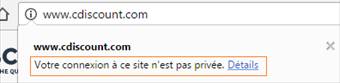
With its Chrome navigator, Google signals even more clearly when as site does not use httpS on its landing page. And the version to come will continue in this vein barring purely and simply HTTP with a Red cross. This  ‘ugly defacement’ will be difficult to accept on corporate websites, in particular well-known brands.

Http Cdiscount
Website http
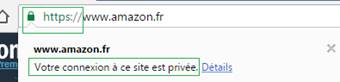
Https Amazon
Default httpS website
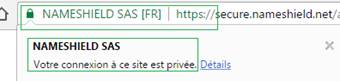
Https Nameshield
Website httpS EV (Extended Validation)

Firefox has already announced a similar measure. Add to that the httpS as an additional factor in SEO and the inclusion of httpS for personal data entry pages in the results for Google shopping, if you have not yet considered it, it’s time to prepare to migrate your web site to a more secure environment.

Why adopt HTTPS now?

  • It is becoming essential.
  • It is good for your online image, especially with Extended Validation (Green Address bar).
  • The transition from HTTP to HTTPS is becoming more pressing and it is better to prepare for it now rather than as a matter of urgency.

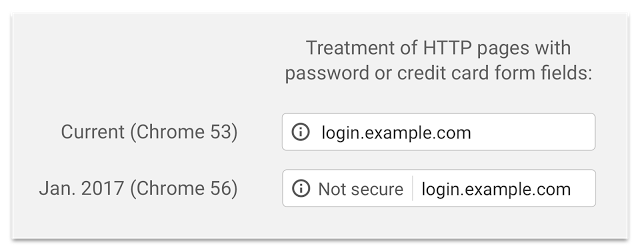
What will the navigation bar look like in January 2017?

On the pages of websites offering HTTP password entry or accepting credit card details there will be a small warning graphic and will feature the text  “Not Secure”.

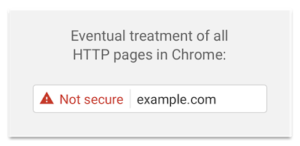
Going forward, What Chrome proposes to display

For all websites, Google’s ultimate goal is to display the not secure wording for all HTTP pages.

Note secure

Source : https://security.googleblog.com/2016/09/moving-towards-more-secure-web.html

The Nameshield team can assist you in selecting the most appropriate SSL certificates for HTTPS, contact your account manager to discuss.

Sponsored Links – an opportunity and a threat to your brand

21666662780_27f0e79d81_bTitle : Adwords – Author : Christophe Benoit – Photo : licence CC BY 2.0 – www.tyseo.net

What is a “Sponsored Link”?

It’s a paid advertisement in the form of a hypertext link that shows up on search results pages. The ads are typically for products and services that are generally or very specifically related to the keywords in the search query.

The most well known sponsored links, Google Adwords, is an advertising service offered by Google for businesses wanting to display ads on the search engine and its advertising network. Businesses set a budget for advertising and pay when people click the ads.

“Google Adwords, is an advertising service offered by Google for businesses wanting to display ads on the search engine and its advertising network.”

What appears on your screen when you use an online search engine?

Results returned by a Search Engine typically fall into 2 categories:

  • Sponsored links (adwords): The customer bids on keywords and the advert (usually a small amount of text and a hyperlink) is displayed in a priority position, but only if the searched keywords match those that have been purchased by the advertiser.
  • Organic search listing: The results in this listing are based upon the relevance of the content on websites that have been referenced by the search engine being used.

On Google’s search results page, the two types of results are displayed differently

  • Sponsored links (adwords) are posted at the top of the list of results with the heading “AD”
  • Organic results are displayed in an order that depends upon how well they match the search query.
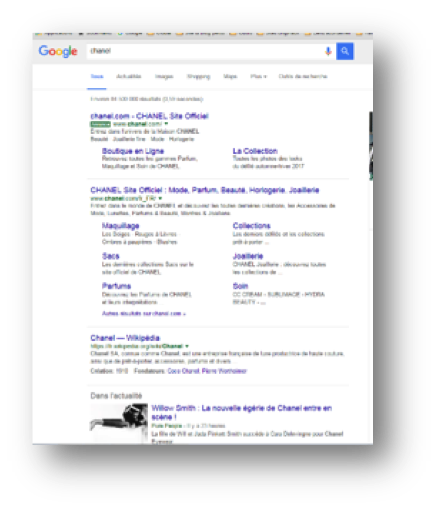
google_linksThe criteria taken into account by Google in order to display sponsored links are the same as organic listings in addition to taking into account the geographic location of the searcher.

Adwords can be purchased on a specific geographical area (a continent, country, region or city). Google uses the IP address of the computer on which the search request is being submitted to determine which sponsored results to return.

“Google designed Adwords to be a fully automated service that facilitates the selection of keywords and advert creation.”

Google’s Adwords service

The search engine that is targeted the most by unauthorised practices is Google that, for scalability reasons, designed Adwords to be a fully automated service that facilitates the selection of keywords and advert creation.

Given that, in the last quarter of 2014, sales of Google Adwords were estimated to be $10.50 bn on a net total revenue of $16.96 for the year, we can better understand the importance of this service.

“Google is acting only to host the advert on its advertising network and therefore its responsibility is limited.”

In order to avoid abuse, it is essential that the advert which appears after having typed a search term allows the normal internet user to know whether the Adword, which is promoting products or service, belongs to the brand owner, is a business linked to the brand or a third party organisation. It sits with the advertiser to choose one or more keywords, which determine when the advert is displayed. Therein lies the subtlety of Adword definition.

In this case, Google is acting only to host the advert on its advertising network and therefore its responsibility is limited with respect to inappropriate or adverts linking to counterfeit goods. Indeed, to determine the liability of a search engine, a judge must look at the degree of automation in order to determine whether the role of the operator   is neutral or not. If there is no control of stored data, liability of the search engine operator cannot be proven.

Various court rulings have declare that Google was not a counterfeiter despite proposing keywords, which reproduce distinctive marks (including registered trademarks) by storing and displaying adverts based on keywords. According to the courts, Google does not use these Keywords “in its own business communications”. That is to say, that Google makes keywords available to third parties but does not use that in its own publicity.

Court cases related to Adwords

With most Pay-Per-Click (PPC) programs on search engines, it is easy to buy competitors’ brand names as a keywords. For ethical reasons, this practice is not recommended. However, some less scrupulous companies do not hesitate.

Internet abuse, such as traffic diversion, cybersquatting, copycat website and counterfeiting products and services are still widespread on the Internet. However, on sponsored links, brand hijacking remains the most prevalent.

“On sponsored links, brand hijacking and traffic diversion are the most common forms of abuse.”

Brand hijacking can take two forms:

  • An advertiser buys a registered trademark as a keyword in order to have its adverts displayed when Internet users are searching for a particular brand
  • An advertiser places the brand in the text of its sponsored link advert which appears prominently on the search engine results page

These infractions have resulted in a number of well-publicised court cased where the definition of an Adword was recalled, such as:

These cases demonstrate the importance of the presentation of the advert so that it does not reproduce, in any way, a trademark registered by a third party in the Advert. In doing so it must not deceive the average consumer of the essential representation and functioning of the mark (as a function of its origin, as a function of its promotion, as a function of the investment in and reputation of the mark).

In the face of these very real threats, what steps should brand owners take?

It is essential that a brand owner files one or more trademarks for their brand. In order that proof of registration can be submitted in any complaint to the search engine or Advertising Network provider or in launching a legal action.

“Recent court cases reinforce the importance of presenting an advert so that it does not reproduce, in any way, a third party registered trademark.”

Reduction of brand risk is all about speed. It is as much about speed of detecting an infringement or fraudulent practice as it is about selecting the appropriate remedial action.

It is therefore important to actively monitor sponsored links for infringements rather than waiting to be made aware of an infringement by a disgruntled prospective customer who has purchased a counterfeit product in error.

Monitoring of Adwords should be a part of a multi-layered brand protection programme that is right for your business. Such a programme may include some or all of the following elements: Trademark monitoring, domain name monitoring, website discovery, search engine monitoring, content monitoring, sponsored link discovery, social network monitoring, and affiliate control.

“Monitoring of Adwords should be a component in a multi-layered brand protection programme that is constructed for your particular business needs.”

Building a brand protection programme that fits the needs and risk profile of the brand puts you in control of threats to your brand and allows you to respond with an appropriate level of rapidity and robustness.

If you have discovered a brand infringement on a Sponsored link network, it is important to know that it is possible to request that the hosting network remove adverts that misrepresent or use identical or near identical terms contained in a registered trademark. If your brand is suffering from widespread infringement and abuse such activities can be outsourced to specialist online brand protection which can handle as much or as little of the brand protection operation as the brand owner desires, from a simple detection service to a full suite of detection, analysis and enforcement capabilities.

“Building a brand protection programme that fits the needs and risk profile of your brand puts you in control of threats to your brand and allows you to respond with an appropriate level of rapidity and robustness.”


Why are Dot Brands dragging their feet?

Ok so here’s the thing, we’re over 2 years into the new gTLD rollout now, a new era of the Internet, and everything seems to be going swimmingly…. Or is it?

On the face of it, momentum is building. Over 16 million domain names registered in the past 2 years and 60% of them would still have been available under a .com e.g. nameshield.website and its .com equivalent nameshieldwebsite.com. That’s great because it means that New gTLD domain names are being registered instead of the equivalent .com.

But there is still one thing lacking, something I have been quite vocal about in the past, and that is the fact that very few people actually know that there has been a fundamental shift in the naming infrastructure on the Internet.

To put in another way – the general public don’t know about new gTLDs.

Two years down the line and society is still living in the dot com age and will continue to do so until the .BRAND applicants start to use their gTLDs in their marketing, promotional and operational activities.

“WWW, shhhh, dot com, dot org.”

                      Dr. Evil, Austin Powers Goldmember 2002

What has changed in 14 years?

A new .brand of concern

Here is where things start to get a bit more worrying. Of the 589 .BRAND applications received, 558 of them have signed their ICANN contracts, 289 of them have been delegated and are live on the Internet but only 64 of them are in active use and most of those still redirect to the corporate homepage, usually a .COM!

One of the most prolific .BRAND registrants is Bradesco (a Brazilian Bank) and that has an underwhelming 90 .bradesco names under management. Despite this poor showing, it is the banking sector which is leading the way. BNP Paribas, for example, has been very active promoting its .bnpparibas domain extension e.g www.histoire.bnpparibas and www.mabanque.bnpparibas

www.Epic.Fail?

One notable, and unfortunately a rather embarrassing, example of how the .BRANDs should be promoting their domain extensions is www.booking.com which spent a fortune on its highly successful booking.yeah advertising campaign.booking.yeah-pr-still-5

The booking.yeah campaign is a shining beacon to .BRAND owners, lighting the way with a clear, concise and powerful example on how to use your new gTLD to maximum effect.

Unfortunately, no-one thought to inform the Booking.com marketing department that they could actually own the .YEAH domain extension and so this multi-million dollar advertising campaign, which is centred around a really great and very memorable domain name ‘booking.yeah’, does not and cannot resolve to a website because no one actually applied for .YEAH.

use it or lose it!

The clock is ticking for those that own a .BRAND. Not simply because there is a time limit before the registry has to be operational, nor because domain extensions have to be operated for a minimum of 10 years, but because there will undoubtedly be another round of applications.

At present owners of a .BRAND are in a privileged competitive position online when compared to counterparts which failed to apply for a .BRAND. For example, Nike owns .NIKE whereas Adidas did not apply for .ADIDAS.

There is a limited window of opportunity to steal a march on the competition in a big way by ushering in the Not Com era.

.BRAND owners know that while they procrastinate, dither and generally do nothing with their expensive and highly valuable Internet asset they are frittering away the opportunity to put clear water between themselves and their competitors online.

So why then aren’t more .BRAND owners rushing to promote their new internet address?

If I’m honest, I believe it is because to date, the champions in the majority of .BRANDs applicants have been those that understand and are responsible for the legal, technical and risk reduction benefits of owning and operating a Top Level Domain rather than the outward facing sales, marketing and strategic positioning benefits that operating a .BRAND can bring.

In my experience, when the Sales and Marketing functions truly understand what you can actually do with a .BRAND, when it is closely aligned with marketing campaigns and business development strategies, the real power of the Not Com era becomes blindingly obvious.

Andy Churley,
CMO Nameshield Group