What is the appropriate way to deal with inappropriate content on the internet?

The internet is a great place to find content of all sorts. Videos of cats doing crazy stunts, memes, thought provoking lifestyle messages. But this rich availability means ease of access to a wide variety of inappropriate content.

Inappropriate content means any material that is disturbing, improper, and just wrong. It can be images of real or simulated violence or of a sexually explicit nature. Recently there have been concerns raised around disturbing YouTube videos. These strongly resemble videos of popular cartoons but contain disturbing and inappropriate content not suitable for children. In some cases the videos are parodies, some are clear cases of copyright infringement where unauthorised use is made of authentic cartoons or characters, most are simply not aimed at an audience of children.

So what is the best way to deal with cases that you discover?

Google and social media sites offer reporting tools highlighting inappropriate content and copyright or trademark infringement cases.

A copyright infringement submission is a legal process and only accepted from the right owner or their authorised agent.  But it is essential to consider if the content is being used fairly. Fair use generally covers adaptations of original works for the purpose of parody or comment. Parodic uses of copyrighted works are normally justified by freedom of expression but the key factor is that the public must be able to differentiate between the works. If the content is being used fairly then it is best to avoid submitting what might be considered a false claim and maybe even provoking further parodying activity. In summer 2015 the artist Banksy launched the clearly satirical Dismaland, an obvious play on words and “look and feel” of Disneyland, but Disney (sensibly) remained silent.


Dismaland


Inappropriate disturbing content should be flagged using the platform system. YouTube takes feedback very seriously and they appreciate people drawing attention to problematic content and make it easy for anyone to flag a video.  Flagged videos are manually reviewed 24/7 and any videos that don’t belong are removed within hours.  In addition they have a YouTube Kids app which helps limit access to flagged content.

Of course no filter is 100% accurate and nothing replaces vigilance. Careful monitoring can help ensure that your copyright protected content is not being used unfairly and allow you to submit takedown notices. But there is no product which can ever replace parental awareness.


YouTube

Towards a 100% encrypted web, the new challenges of HTTPS

Between Mars, 2016 and Mars, 2017, Let’s Encrypt has issued 15 270 SSL certificates containing “PayPal” term, 14 766 of these certificates were issued for domains leading to phishing websites. It’s the result of the recent analysis led by Vincent Lynch, SSL expert.
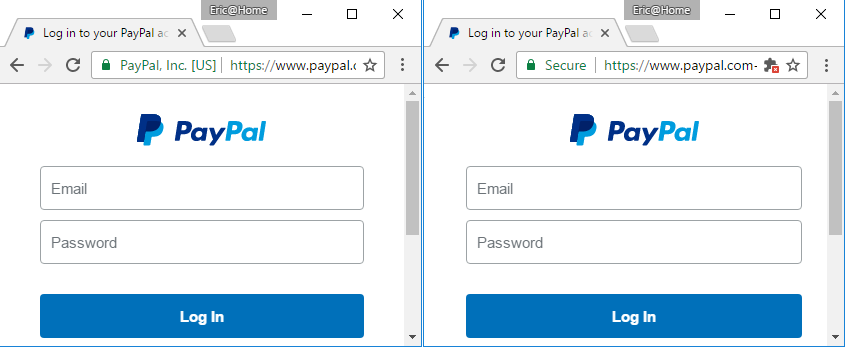
 

Paypal fake or real


Lynch was closely interested in this case, after an interesting article published by Eric Lawrence (Google Chrome Security Team) in January 2017, the image above is from this article named “Certified Malice “which exposes deceitful SSL certificates and counts “only” 709 cases for PayPal and much more for big American brands: BankOfAmerica, Apple, Amazon, American Express, Chase Bank, Microsoft, Google…

What’s the impact on web users?

In January 2017, Google and Mozilla have updated their browser with Chrome 56 and Firefox 51, and a major change has appeared for web users: “Secure” and “Not secure” have appeared in the address bar.

In 2015, the initiative Let’s Encrypt, supported by big names of Internet (EFF, Mozilla, Cisco, Akamaï…) was created with the purpose of massively and freely spreading SSL certificates to the whole world. One year and a half later, Let’s Encrypt issued millions of certificates and other initiatives have followed.

Who says free, says few or no verification for delivering certificates, and an army of cybercriminals who rush towards these certificates to secure their illicit contents: phishing, malware… and show the term “secure” on their address bar. How can the random web user easily differentiate between real and fake?

For reminder, there are three verification levels for certificates allowing to show HTTPS: Domain Validation (DV) considered as low authentication, Organization Validation (OV) with high authentication and Extended Validation (EV) with strengthened authentication.

Free certificates are DV, and represent almost 90% of certificates, most of the time on “small” websites. OV certificates (9%) and EV certificates (1%) are fewer but protect almost all websites with high traffic. GAFA (Google, Apple, Facebook, Amazon), are all in OV or EV for example.
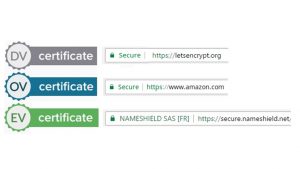
SSL Certificates - DV OV EV

The problem for web user is the lack of distinction in browsers between DV and OV certificates. These two types are shown the same way, as being “secure”, but EV certificates display the name of the certificate’s owner in the address bar.

By looking at the image at the beginning of this article, we understand easily the concern on EV for PayPal: to easily differentiate real from fake. This is the reason why Nameshield will systematically advise the use of EV for display website, in particular for their clients exposed to cybersquatting, phishing or counterfeit.


Two forces opposed for the future of HTTPS

Sadly, things aren’t so simple, and where logic would like to differentiate clearly between the three types of certificates, or at least two types (DV/OV), Google disagrees and wishes, on the contrary, to suppress the EV display altogether. Chris Palmer (Senior Software Engineer for Chrome) subtly confirms this point in his article published here.

Today we are in a situation where Historical Certification Authorities, Microsoft and to a smaller extent, Apple, are facing Google, Mozilla and Let’s Encrypt in a perspective resumed here:


Google/Mozilla/Let’s Encrypt perspective:


HTTP = not secure


HTTPS = secure

Historical Certification Authorities/ Microsoft/Apple perspective:

HTTP = not secure

HTTPS DV = no sign in the address bar

HTTPS OV = secure

HTTPS EV = company’s name in the address bar


Inside the higher authority of SSL, the CAB/Forum, the discussion is still opened at this moment. We can easily understand that Certification Authorities look unfavorably at the end of the visual distinction between DV/OV/EV in browsers, it’s their purpose to deliver certificates with high authentication, but is it wrong? It’s to reassure the web users by securing the identity of the website they visit.

In the opposite, Google and Let’s Encrypt don’t hesitate to say that phishing and guarantee of website content, don’t depend on Certification Authorities, and that there are other systems responsible for that (for example, Google Safe Browsing). Therefore we have to have a binary perspective: exchanges are encrypted and inviolable (= HTTPS = secure) or they aren’t (= HTTP = not secure). We can simply wonder by this perspective, which defends itself, if it’s not a semantic problem of the used term “secure” instead.

What does “secure” mean for web users? By seeing “secure” in their address bar, do they enter their login/password or credit card numbers? We can think that yes, they do, and in this case, actual risk does exist. Kirk Hall (Director Policy and Compliance – SSL, Entrust) has done a noticed intervention at the last RSA conference on this subject (if you have time, the record is here).

You can’t neglect financial industry weight and big companies which look unfavorably at the growth of fraud online risk, Google can’t ignore that.


How to reassure web users?

For the time being, we can only encourage you to choose Extended Validation certificates for your display websites and/or your e-shop in order to facilitate web users’ tasks and to stay informed of what’s going on on the web. To reassure and educate web users by mentioning on your website the choice you have made in security and authentication.

As you probably monitor domain name registrations on your brands, today you can also monitor certificates registrations so you can react quickly.

And as web user, when the term “secure” is mentioned in the address bar, systematically control the certificate’s details to see who the owner is.

The launch of .AFRICA

After more than five years of legal dealings and battles, South African organization .ZA Central Registry (ZACR) is now designed to commercialize the internet extension “.AFRICA” which will be opened to all. As presented by Koffi Djossou, member of UNIFORUM ZACR, future domain names in .AFRICA will “promote African companies, people and culture on Internet”. President of the African Union Commission Nkosazana Dlamini Zuma, has already saluted the end of this battle as the moment when Africa “has finally acquired its own digital identity”.


new gTLD .africa


We will go back to present the facts: in the application call for new extensions launched by ICANN, they were two to claim the .AFRICA. On one side, we have South African national extension operator .ZA (ZACR). On the other side, we have an African/American business woman Sophia Bekele, the DotConnectAfrica (DCA) founder.

With the geographical and cultural nature of the .AFRICA, the extension couldn’t be sold by bidding. So ICANN has required the participants to obtain the support of at last 60% of the concerned region governments. After this, ZA Central Registry (ZACR) has benefited from many official supports (39 African governments) like the African Union. While DotConnectAfrica (DCA), has been the object of many mails opposed to this “dissident application”.

In early 2014, ICANN has finally given the delegation of the .africa domain to ZA Central Registry (ZACR). At that time begins this unprecedented judicial marathon, after DotConnectAfrica (DCA) submits a claim against ICANN for fraud and unfair business practices. DotConnectAfrica (DCA) has requested to the United States Federal Court to stop ICANN from giving the delegation of .africa domain to ZA Central Registry (ZACR) during the trial.  Even if the last request was finally denied, the claim against ICANN is still ongoing…

This highly political saga has ended in February 15th, 2017 but for ZA Central Registry (ZACR), the work begins now: to make of .Africa a real banner of the African continent.

Find more information on http://nic.africa/ or contact Nameshield regarding the conditions and the open period for the registration of your .AFRICA.

Alibaba’s use of technology to fight counterfeit reaps first rewards

In December 2016 Alibaba was placed on a US blacklist for fakes. A US industry watchdog called the company’s Taobao website (the world’s largest e-commerce platform) a “notorious” market for counterfeiting and piracy. Now Alibaba is diligently combatting this label. Via a program called Operation “Cloud Sword” big data technology such as advanced algorithms, machine learning, optical character recognition (OCR), and mapping technologies, is used to generate clues to help identify and take down fakes.

In January Alibaba sued two fake Swarovski watch sellers who allegedly link merchants with people willing to falsify purchases and write positive comments on its Taobao e-commerce platform for violations of goodwill and contract. The company claimed 1.4 million yuan, or about $201,000, in damages. Shenzhen police raided the seller and confiscated about 125 counterfeit watches after Alibaba’s claim. Alibaba used gathered and analysed data to identify the counterfeit Swarovski merchants and subsequently purchased a watch from the seller in a test-buy program.

Zheng Junfang, chief platform governance officer of Alibaba Group said. “We will bring the full force of the law to bear on these counterfeiters so as to deter others from engaging in this crime wherever they are.”

Has President Trump’s executive order on ‘Public Safety’ killed off Privacy Shield?

Governments rightly accord great attention to the importance of privacy and human rights but are also cognisant that there are situations where public authorities require access to the content of electronic communications. Three decades of negotiations and agreements on what constitutes acceptable levels of sharing of personal data and communications between the US and Europe resulted at the start of 2016 in the Privacy Shield agreement which provided obligations to protect and monitor the shared personal data of Europeans.

In his first week in office President Donald Trump signed six executive orders (Obama managed 5 in the same period). The order “Enhancing Public Safety in the Interior of the United States” has caused a huge reaction and controversy due to the attempted ban on citizens from seven countries but there are also important implications for data protection and human rights beyond those boarders.

Section 4 of the Executive Order instructs agencies to employ “all lawful means to ensure the faithful execution of the immigration laws of the United States against all removable aliens”. And Section 14 states that “agencies shall, to the extent consistent with applicable law, ensure that their privacy policies exclude persons who are not United States citizens or lawful permanent residents from the protections of the Privacy Act regarding personally identifiable information”.

These sections relate to all visitors and foreign nationals irrespective of nationality. A removable alien refers to all non-USA citizens. The Order makes it quite easy for any non-USA national to be considered a risk to public safety and therefore become a legal subject for agencies to access the content of electronic communications and personally identifiable information.

Fundamental stipulations of the Privacy Shield agreement are that companies operating in the EU can only share and send personal data to “third countries” outside the EEA if they guarantee adequate levels of protection, ensure equivalence of privacy protections for European citizens’ data in the U.S. and that the monitoring remains necessary and proportionate (unlike the U.S. Government mass surveillance programs which led to the invalidation of the Safe Harbour agreement). The essence of the fundamental right to respect for private life must not be violated.

By considering any non-USA citizen as a removable alien it is difficult to see how the equivalence of protection for US and EU citizens can be ensured.