The CAB forum, organization which defines the SSL certificates issuing and management rules approved the SSL certificates reduction to a duration of 2 years against 3 previously. Initiated by the browsers Chrome and Mozilla heading, this decision moves in the direction of an always more secured Internet by forcing the actors to renew more often their security keys and to stay on the last standards of the market.
This decision will be applicable to all Certification Authorities from March 1st 2018. In order to ensure a smooth transition, from February 1st 2018, Nameshield will not propose certificates with a 3 years duration anymore.
What impact for your certificates?
The new certificates will thus have a maximum duration of 825 days (2 years and 3 months to cover the possibility of 90 days early renewal). EV certificates were already under this scenario, so are concerned the DV and OV certificates in all their forms (standard, multi-sites or wildcard). Nothing in particular for these certificates.
For existing certificates, this new duration will have a consequence, since it will apply to all the certificates from March 1st. A 3 years certificate issued recently and which would need to be replaced beyond the 825 days deadline, will then have to be authenticated again. It is then important to know it to prevent urgent reissue, including for the simple SAN adding. You have to check beforehand if the certificate to replace may be impacted, this is the case of DV and OV certificates, the EV are also not concerned here.
Nameshield’s SSL team will inform you regarding the concerned certificates.
The domain name is to the virtual, what the brand is to the real. It is actually a little more complicated but this small sentence allows to associate brands and domain names.
It’s in the context of this shared vision, that the South African brands registration Office, CIPC has developed a partnership with the registry of .ZA, the South Africa geographic extension.
Thus, the brand applicants can choose the “domain name” option, registering that way the two protections. This is here the first collaboration I’ve seen between these kinds of registration office.
A victim of phishing from 2015, asked her bank for a refund of 3300€, which was the amount diverted by a fraud author. However, during the legal procedure, the Justice has cancelled the judgement of the local court of October 2017, which has requested to the bank of the victim to refund the corresponding amounts of the phishing operation.
The reason of this cancellation? The victim has deliberately communicated some confidential data regarding her credit card, by falling into the trap of a phishing email (the scammer has posed as the telephone operator of the victim).
This cancellation argument argues that indeed, the mail didn’t have any recipient nor sender name and that the reject or unpaid mention was inexact. Also the victim could have prevented the trap set and not communicate her banking information. Therefore, it was her responsibility, which indeed cancels the request for the stolen money refund by the bank.
The majority of phishing websites use domain names associated to an existing activity or referring to an activity, with the aim to deceive users, by inviting them to click on the links of legitimate websites. It allows to increase the likelihood of the attackers’ success.
The phishing concept is to retrieve personal data on Internet via identity theft, adapted to digital support.
If it is true that fraudulent payment online is directly caused by the victim’s negligence, yet, she didn’t communicate neither her credit card confidential code, nor the 6 digit 3D SECURE code, which was sent to her by SMS to validate the payment. The victim has blocked her credit card the same day, after the reception of two 3D secure messages.
However, in this case, the bank affirms that regularly, it has raised its customers ‘awareness and communicated with them, in order to alert them of phishing risks and warn them to never communicate their confidential banking data.
Thus, the Court of Cassation has judged that the victim acted carelessly and could have prevented to fall into the trap of the fraudster.
Cyber threats heavily rely on web users’ bad practices, as the SANS Institute confirms. The threats the most frequently encountered in companies are phishing (72% of the respondents), spywares (50%) and ransomwares (49%).
According to the American company Webroot, about 1.385.000 unique phishing websites are created each month, with an impressive peak of 2.3 million during May 2017.
Be aware that these phishing websites stay active during a very short period: between 4 and 8 hours maximum, to prevent to be followed or blacklisted.
Of course, this case reminds that vigilance remains crucial more than ever!
Recently, some Amazon users have been the victims of a quite sophisticated phishing attack.
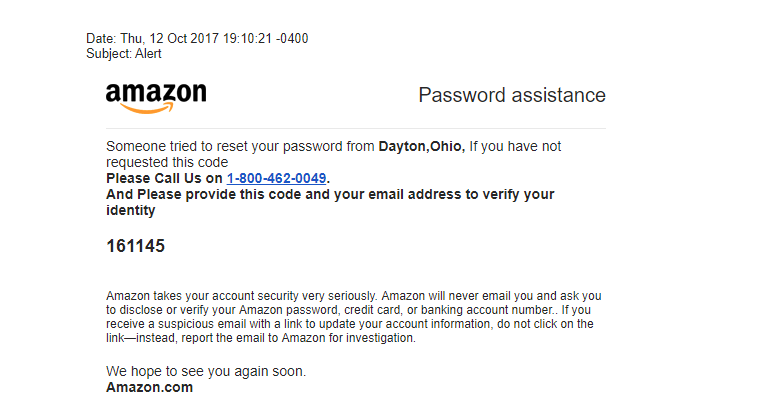
They received a fake e-mail from Amazon, alerting them that someone attempted to connect to their account by trying to change their password. A six digit code was transmitted with the instruction to call a number to verify the user’s identity. If the web users were not the source of these actions, they were invited to follow a specific procedure to secure their account. When they called the supposed Amazon number, they were directed to a Customers service department, located abroad. During the call, they had to go on a website and communicate the code to ensure the security of the account.
The copy of the phishing message:
Fortunately, many web users have detected this phishing attack and didn’t fall into the trap. But for the others, were they victims of a malware or a data theft?
All web users are hit by these phishing attempts. They are part of our daily lives, but many brands raise awareness among their customers against these actions (mostly the banking industry which is the privileged target of hackers).
The case of Ethereum foundation and the «.ETH » extension.
Ethereum is a foundation created during 2015, by Vitalik Buterin, a 21 years old Canadian. This foundation aims to promote the Ethereum blockchain technology, created by this young computer engineer, who proposes in addition to a virtual currency, like the Bitcoin blockchain, the possibility to create applications ensuring traceability, inviolability and sustainability of the transactions they manage. To allow to the greatest number of people to access to these applications, the Ethereum foundation has recently presented the ENS for «Ethereum Name Service», and its corollary, the «.ETH» extension.
Thus, if we take the example of the Bitcoin blockchain, the purpose was to create a virtual currency. The major interest consists in the absence of any central regulatory body, since it is controlled and managed by the community members, in a fully decentralized way. Any transaction done on the blockchain leads to an inscription in a block, published on a registry shared between the members. The transactions’ inscription in a block is carried out by « miners », who check, register and secure the transactions in the blockchain. This database hence lists all the transactions in blocks, creating a blocks chain supposed to be immutable and inviolable, due to the use of electronic signatures, and redistributed on the network, since it is decentralized.
Ethereum blockchain also has its currency, namely the Ether. But unlike Bitcoin, Ethereum didn’t create a virtual currency but has extended the use of the blockchain to other applications: the «smart contracts». Thus, Ether must not be considered as a currency but rather as a consumable allowing to exchange on the blockchain, use the applications it hosts.
The « smart contracts » concept
Ethereum proposes many possibilities of decentralized applications usable on its blockchain. These smart contracts are defined by the Blockchain France website as being « autonomous programs, which once started, automatically execute predefined conditions. They operate as any conditional instruction of « if – then » type (if such condition is verified, then such consequence is executed) ».
Concretely, this is a decentralized application, developed according to the Ethereum programming language (the Solidity), which automatically executes predefined instructions, on the conditions that the requirements are met, without the assistance of a third party, and ensuring that no modification is possible. These programs are executed on the Ethereum blockchain and controlled and certified by its members.
Thus, the promise is to delete intermediaries thanks to the total decentralization, managed by the processes automation.
For example, among possible applications, Ethereum foundation has announced on May 4th 2017, the creation of Ethereum Name Service, allowing domain names registration using «.ETH » extension.
Names’ registration in «.ETH »
The Ethereum Name Service, or ENS, corresponds to the Internet DNS, managed by ICANN, but unlike the latter, ENS is not based on root servers, but on the multitude of servers/machines, members of the Ethereum blockchain.
This is not a new registry having created another extension, but rather an alternative notion of the Internet.
Indeed, ENS is neither attached to the Global DNS, or to the IANA organization, nor to ICANN. ENS is a naming system specific to the Ethereum blockchain.
Domain name registration using «.ETH » is operating in a different way than classic domain name registration. This is a bidding system by anonymous deposit of a number of Ethers. In short, the name request opens a 72 hours period allowing other persons to bid. A second period of 48 hours then opens, during this period, each bidder must disclose their bid. The best bidder wins the name registration and is refund of their bid, minus the value corresponding to the difference of amounts between the two best bids. These funds are kept in a contract during 1 year minimum and can be removed at the end of this period, subject to release the name. If the name is the subject of one bid only, the bid’s winner is refund of the invested Ethers, except 0.01 Ether, corresponding to the minimum bid. This system should allow according to the ENS developers to prevent from speculation on domain names registration.
The system then doesn’t need an authority like ICANN, since the names ‘attribution is automated thanks to an IT program distributed and secured on the blockchain.
Nevertheless, if you type a domain name in «.ETH » in your browser search field, like Google Chrome, or Mozilla Firefox, an error page will be displayed. Indeed, the registered names in «.ETH » are not recognized by these browsers, since they aren’t part of the DNS network, they aren’t recognized as a domain name. Google Chrome extensions are proposed to create a bridge between the « web Ethereum » and the Internet that we know.
Hence, essentially, names currently registered in «.ETH » are only usable on the Ethereum blockchain, and therefore don’t affect the general public.
Lastly, the first use of ENS is, like the DNS, to allow the user to read and remember more easily an address by giving it a meaning. The DNS allows to translate an IP address in a legible address via the domain name.
Thus, ENS allows to translate an Ethereum user’s address (a user portfolio) of type «f14955b6f701a4bfd422dcc324cf1f4b5a466265 » in « myfirstname.eth ».
For example, when a user wishes to send Ether to another user, they only have to know their domain name and not their user address anymore. These domain names have a quite limited use, but may thereafter be used to access to future Ethereum applications.
The risks of the «.ETH » for brands owners
To this day, current web browsers don’t support these extensions, it seems that brands owners have no need to worry.
However, many French and international brands are « cybersquatted ». I.e. Ethereum users have won bids on brands names like « samsung.eth » or « volkswagen.eth ». They take over the name’s ownership for one year.
At the end of this first year of registration, the owners may release these names to retrieve the Ether stock associated to the name.
Risks should not be excluded in a near future if the «.ETH » are led to become more common and to offer interesting uses for the general public. Under this hypothesis, current web browsers could natively integrate «.ETH », in the same way as «.COM » or «.XYZ ».
Therefore, the owners of «.ETH » taking registered trademarks, for example may seek to benefit from this registration by using the reputation or identity of these protected brands, in order to divert the traffic to their own products or services. It may also be competitors seeking to tarnish their competitor’s brand image.
In the ICANN system, the rules enacted, in particular with UDRP procedures, propose to overcome these risks afterwards by allowing brands owners to try to recover a domain name using unjustly their brand. The restrictive nature of these rules, accepted and respected by registration offices, facilitates the application of the decision of Arbitration Center experts, and thus a domain name transfer to their rightful owner.
In the ENS system, there is no central authority which could enact these rules. Furthermore, domain names in «.ETH » have no real Whois file. To register such a domain name, they need to have Ethers and to create a portfolio. The identity is concealed behind a characters sequence, i.e. the digital impression of a cryptographic key. Therefore, it seems difficult to know the real identity of an owner in «.ETH ».
Furthermore, unlike the current system, it seems difficult to justify a territorial competence for «.ETH». The blockchain is not linked to any territory, it is distributed on all its members ‘machines, and thus all around the world.
The solution could eventually be developed by the Ethereum users themselves. It’s not to be excluded that an application is created in order to check the legitimacy of a domain name owner, on the basis of criteria defined in a program, like for example, the risk of confusion regarding a preexisting brand, and the good faith criteria in the use made of them. The constitution of a «popular jury » with voting materials would allow to decide on the issue as the result of a complaint from another member.
Nameshield uses cookies
Nameshield wishes to use cookies to ensure the proper functioning of the site and, with our partners, to measure its audience🍪.
Nameshield wishes to use cookies to ensure the proper performance of the website and, with our partners, to monitor its audience. More information in our Cookie Policy 🍪.
Necessary cookies are absolutely essential for the website to function properly. These cookies ensure basic functionalities and security features of the website, anonymously.
Cookie
Duration
Description
cookielawinfo-checkbox-advertisement
1 year
Set by the GDPR Cookie Consent plugin, this cookie is used to record the user consent for the cookies in the "Advertisement" category .
cookielawinfo-checkbox-analytics
11 months
This cookie is set by GDPR Cookie Consent plugin. The cookie is used to store the user consent for the cookies in the category "Analytics".
cookielawinfo-checkbox-functional
11 months
The cookie is set by GDPR cookie consent to record the user consent for the cookies in the category "Functional".
cookielawinfo-checkbox-necessary
11 months
This cookie is set by GDPR Cookie Consent plugin. The cookies is used to store the user consent for the cookies in the category "Necessary".
cookielawinfo-checkbox-others
11 months
This cookie is set by GDPR Cookie Consent plugin. The cookie is used to store the user consent for the cookies in the category "Other.
cookielawinfo-checkbox-performance
11 months
This cookie is set by GDPR Cookie Consent plugin. The cookie is used to store the user consent for the cookies in the category "Performance".
CookieLawInfoConsent
1 year
Records the default button state of the corresponding category & the status of CCPA. It works only in coordination with the primary cookie.
viewed_cookie_policy
11 months
The cookie is set by the GDPR Cookie Consent plugin and is used to store whether or not user has consented to the use of cookies. It does not store any personal data.
Functional cookies help to perform certain functionalities like sharing the content of the website on social media platforms, collect feedbacks, and other third-party features.
Performance cookies are used to understand and analyze the key performance indexes of the website which helps in delivering a better user experience for the visitors.
Analytical cookies are used to understand how visitors interact with the website. These cookies help provide information on metrics the number of visitors, bounce rate, traffic source, etc.
Cookie
Duration
Description
_ga
2 years
The _ga cookie, installed by Google Analytics, calculates visitor, session and campaign data and also keeps track of site usage for the site's analytics report. The cookie stores information anonymously and assigns a randomly generated number to recognize unique visitors.
_gat_gtag_UA_25904574_14
1 minute
Set by Google to distinguish users.
_gid
1 day
Installed by Google Analytics, _gid cookie stores information on how visitors use a website, while also creating an analytics report of the website's performance. Some of the data that are collected include the number of visitors, their source, and the pages they visit anonymously.
Advertisement cookies are used to provide visitors with relevant ads and marketing campaigns. These cookies track visitors across websites and collect information to provide customized ads.
Cookie
Duration
Description
NID
6 months
NID cookie, set by Google, is used for advertising purposes; to limit the number of times the user sees an ad, to mute unwanted ads, and to measure the effectiveness of ads.