In its last quarterly report, Nexusguard stated that after the FBI closed 15 websites providing cyberattacks services, a decrease of 85% of the DDoS attacks’ scale and 24% of big attacks were observed.
In the same way, these closings would lead to the decrease of 11% of the
attacks’ volume comparing to the same period in 2018 and at an international
level.
Indeed, it was in December 2018 that the FBI successfully shut down 15 websites proposing DDoS attacks services, called “booters” or “booters services” in the business.
To achieve their goals, these booters use IP stresser, which originally are tools allowing to test the server or the network’s resilience. The cybercriminals hijack these IP stresser and send through them a large volume of requests towards the servers until they are overloaded and unable to respond anymore.
The Nexusguard report also indicates that the 15 websites closed by the FBI would be the technical source of about 11% of the global DDoS attacks of various sizes since 2014. Of course, this decrease might only be temporary, the multiplication of bot networks being the real plague of our decade in terms of cybercriminality.
In the domain names’ world, the rules applied by many registries of “first come, first served” often lead to many cases of abusive registrations and of cybersquatting in particular. This is a practice that consists in taking a domain name by registering it, using or mentioning a trademark, a business name, a patronym or any name on which the applicant has any right, in order to make material or moral profit from its current or future notoriety.
In order to fight against these fraudulent actions and to assert their rights, brands’ owners can implement a targeted action to recuperate or suppress the cybersquatted domain name, called UDRP procedure (Uniform Domain Name Dispute Resolution Policy). This procedure is administered by an Arbitration Center like the one of the WIPO, the World Intellectual Property Organization.
According to the WIPO’s General Director, Francis
Gurry: “Domain names involving fraud and
phishing or counterfeit goods pose the most obvious threats, but all forms of
cybersquatting affect consumers. WIPO’s UDRP caseload reflects the continuing
need for vigilance on the part of trademark owners around the world.”
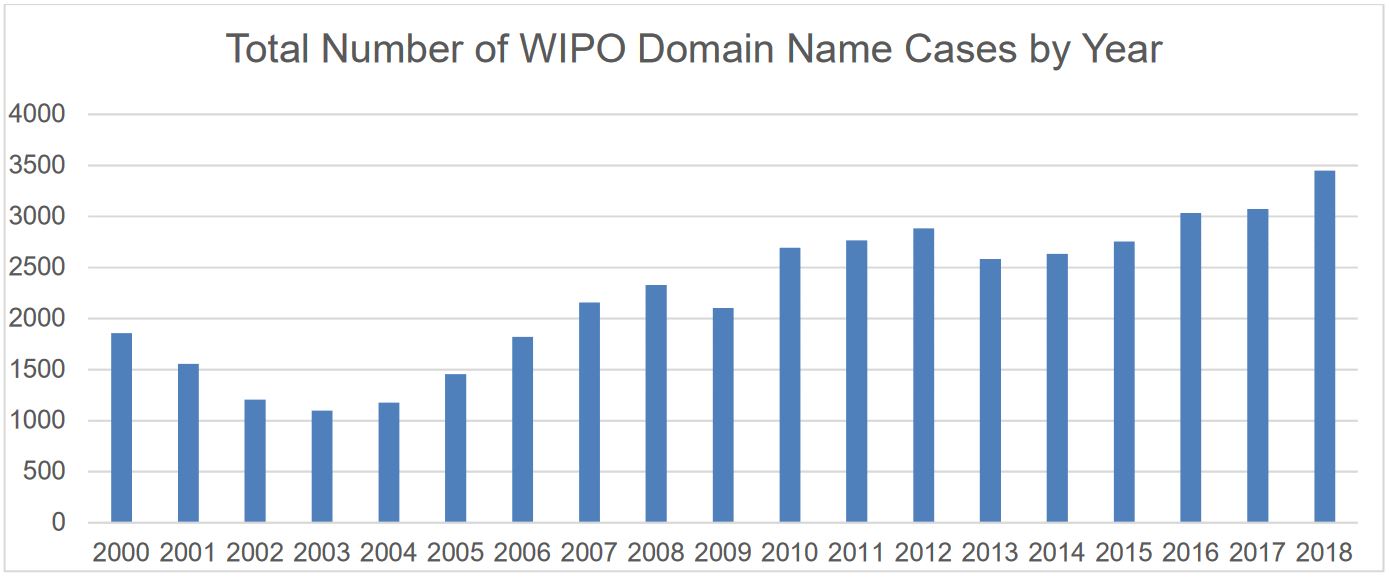
UDRP complaints filed with WIPO in 2018*
On March 15, 2019, the WIPO published its last annual report on domain names’ disputes.
In 2018, the WIPO’s Arbitration and Mediation Center received a record of 3447 UDRP cases filed by brands’ owners, i.e a rise of 12% compared to the previous year.
Source: WIPO Statistics Database
However these disputes concerned 5655 domain
names, a decrease comparing to 2017 which counted 6371 names.
The main gTLDs in the cases filed with WIPO are unsurprisingly, the .COM (far ahead with 72.88%), the .NET (4.62%), the .ORG (3.50%) and the .INFO (2.23%).
Regarding the disputes on the domain names registered in the new extensions, they represent nearly 13% of the disputes, mostly in .ONLINE, .LIFE and .APP domains.
And lastly, nearly 500 complaints regarding names registered in ccTLDs have been filed, nearly 15% of all the disputes administered by the WIPO in 2018.
The 3 main sectors of complainant activity are
the sectors of banking and finance, biotechnology and pharmaceuticals, and
Internet and IT.
Geographically, France is placed second with 553 cases filed with the WIPO, just behind the United States (976 complaints) and is one the most reactive countries on this subject.
Note that on all the UDRP cases filed in 2018, Nameshield ranks second in the filing world complaints with 343 cases filed and 66 represented customers**.
Our teams are of course at your disposal to inform you on the possibilities of contentious domain names recovery actions.
*Source: WIPO Statistics Database
**Source: Nameshield’s report on UDRP procedures, 2018
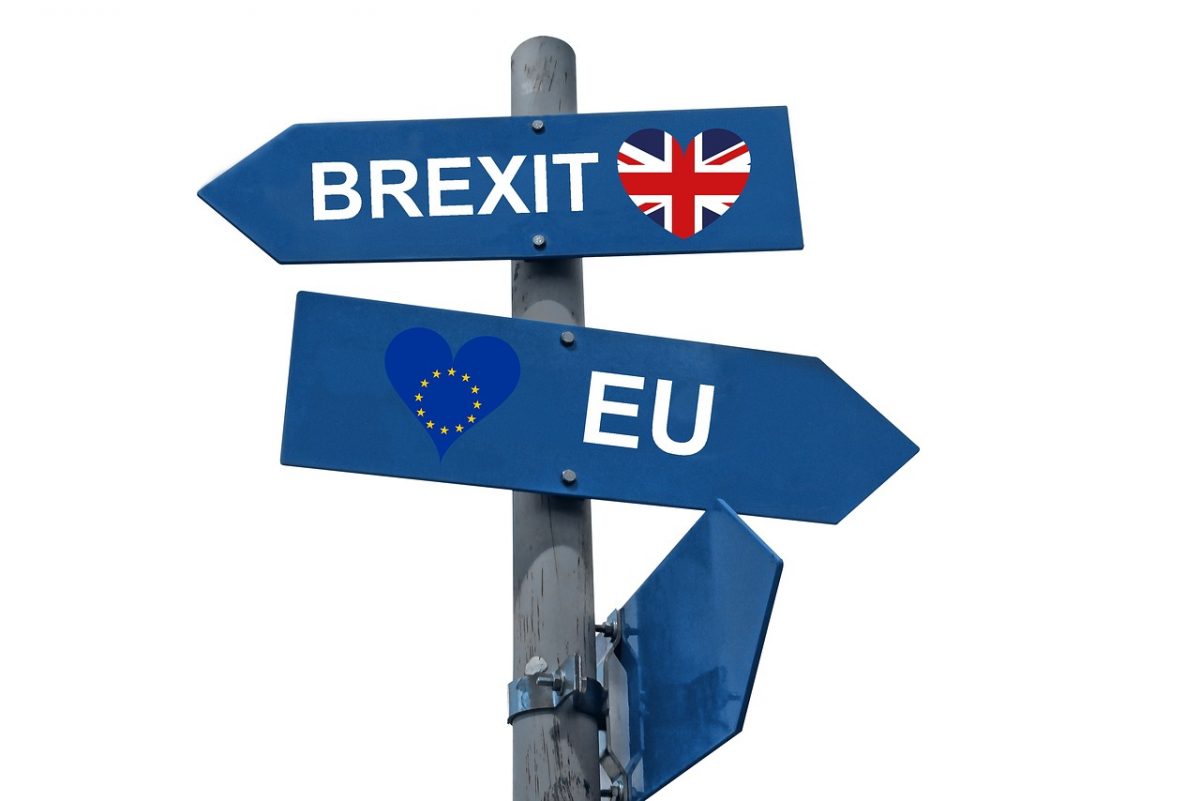
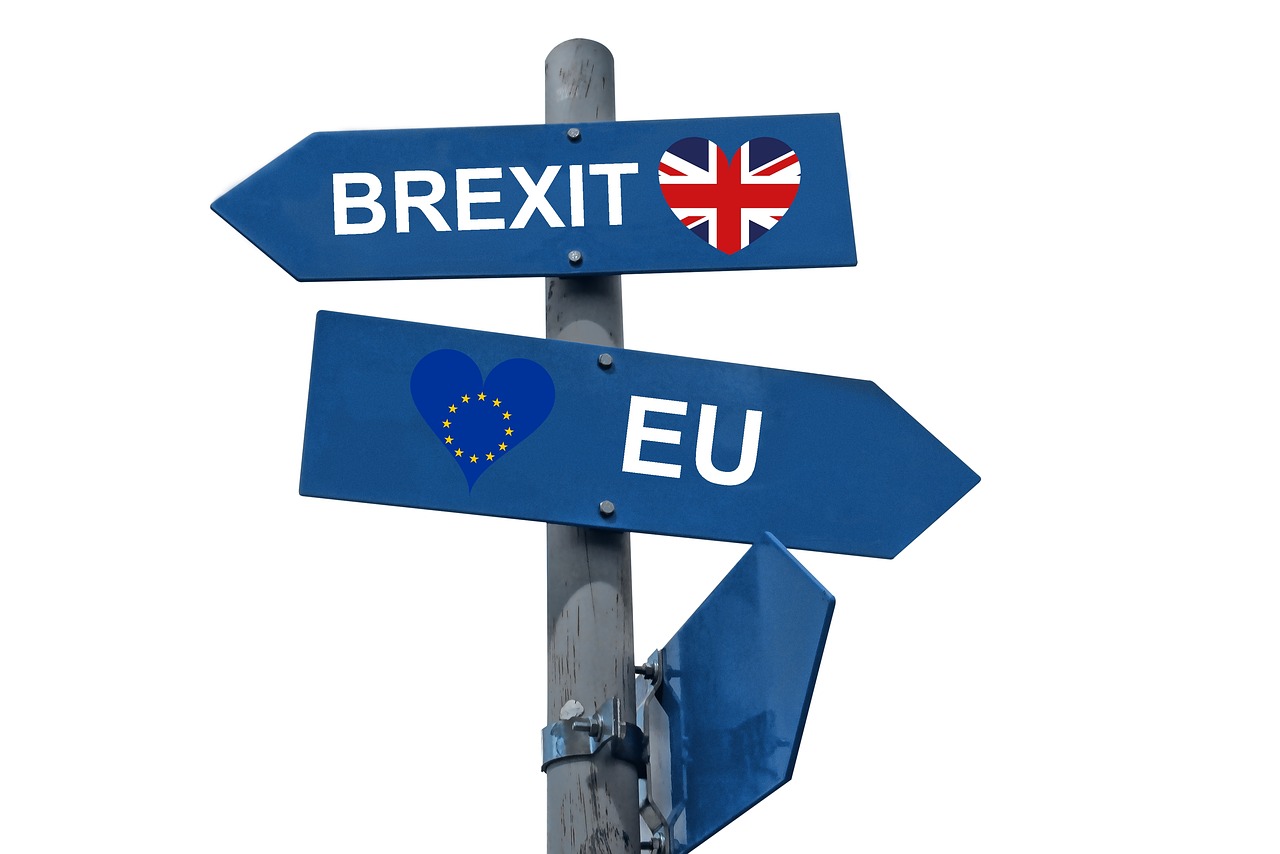
On the article dated from February 22, 2019, we discussed about the Brexit’s consequences on the .EU domain names and the publication of the action plan by EURid, the .EU registry, following two scenarios, in case of no deal or in case of a withdrawal agreement between the United Kingdom and the European Union.
In short, as a result of the Brexit, companies and individuals, holders
of a .EU will no longer be able to renew or register names in .EU if they are
not residing in the European Union.
In case of no deal, .EU domain names’ holders will have 2 months from March 30, 2019 to demonstrate their eligibility or to transfer their name to an
eligible registrant (whose country code isn’t either GB/GI). All registrants
who did not demonstrate their eligibility will be deemed ineligible and their
domain names will be withdrawn.
In case there is a withdrawal agreement, this plan of actions will be
implemented as of January
1, 2021.
Due to ongoing uncertainties over the United Kingdom’s withdrawal from the European Union, EURid announced on March 22, 2019, that this plan would be placed on hold while waiting for an official update from the European Commission.
Remember, in June 2014, Nominet, the registry of .CO.UK, launched the
opening of the .UK registrations. At the time of the extension’s launch, the
registry applied a 5 years restriction during which the .UK registration rights
were restricted to the holders of the corresponding names in .CO.UK, .ORG.UK,
.ME.UK, .NET.UK, .LTD.UK or .PLC.UK.
The 1st of July 2019 will mark the end of the period when .UK extensions were blocked from registration if the .CO.UK was not already registered. The names will then be opened to all! If you are already a .CO.UK domain name’s holder, don’t hesitate to contact your Nameshield’s consultant before the end of the priority period to reserve your corresponding name in .UK and thus prevent a third party to do it on the general availability period.
After the launches of the .APP and .PAGE,
Google launched .DEV on January 16, its new extension dedicated to developers
and technology, following the calendar below:
Sunrise period: from 2019/01/16 to 2019/02/19
EAP (Early Access
Program): from 2019/02/19 to 2019/02/28
General availability: from 2019/02/28
Since February 28, 2019, the .DEV is in general availability and already
has more than 64 000 domain names’ registrations according to Domain Name
Wire.
To promote this new extension and for the Google I/O 2019 , its annual event for developers (which will be held on May 7-9, 2019 at the Shoreline Amphitheatre in Mountain View), Google proposes the free registration for 1 year of a .DEV domain name for all ticket booked. But the registrations resulting of this promotional campaign only represent a small part of the 64 000 .DEV domain names registered.
During the last months, Google itself has launched or relaunched many of
its websites in .DEV: web.dev, opensource.dev, flutter.dev…
Other companies have also chosen to register their domain names in .DEV
like Mozilla with mdn.dev, Salesforce with crm.dev and Level Access with
accessibility.dev.
The HTTPS mandatory for all .DEV domain names
As mentioned in a previous article by Christophe GERARD, Nameshield’s Security Product Manager, as reminder, Google in its goal of a more secure Internet, makes HTTPS encryption mandatory for all its new extensions: .APP, .PAGE, .HOW, .DEV… (More details in this article).
Thus, .DEV extension is included on the HSTS pre-upload list, requiring
HTTPS protocol on all .DEV domain names.
Therefore, in order to use a .DEV domain name, you will need to acquire
a SSL certificate and deploy HTTPS.
From tools to platforms, programming languages to blogs, this extension
will allow you to present your projects. Don’t hesitate to contact a Nameshield’s
consultant for any questions regarding the conditions for the registration of
your .DEV.
Nameshield uses cookies
Nameshield wishes to use cookies to ensure the proper functioning of the site and, with our partners, to measure its audience🍪.
Nameshield wishes to use cookies to ensure the proper performance of the website and, with our partners, to monitor its audience. More information in our Cookie Policy 🍪.
Necessary cookies are absolutely essential for the website to function properly. These cookies ensure basic functionalities and security features of the website, anonymously.
Cookie
Duration
Description
cookielawinfo-checkbox-advertisement
1 year
Set by the GDPR Cookie Consent plugin, this cookie is used to record the user consent for the cookies in the "Advertisement" category .
cookielawinfo-checkbox-analytics
11 months
This cookie is set by GDPR Cookie Consent plugin. The cookie is used to store the user consent for the cookies in the category "Analytics".
cookielawinfo-checkbox-functional
11 months
The cookie is set by GDPR cookie consent to record the user consent for the cookies in the category "Functional".
cookielawinfo-checkbox-necessary
11 months
This cookie is set by GDPR Cookie Consent plugin. The cookies is used to store the user consent for the cookies in the category "Necessary".
cookielawinfo-checkbox-others
11 months
This cookie is set by GDPR Cookie Consent plugin. The cookie is used to store the user consent for the cookies in the category "Other.
cookielawinfo-checkbox-performance
11 months
This cookie is set by GDPR Cookie Consent plugin. The cookie is used to store the user consent for the cookies in the category "Performance".
CookieLawInfoConsent
1 year
Records the default button state of the corresponding category & the status of CCPA. It works only in coordination with the primary cookie.
viewed_cookie_policy
11 months
The cookie is set by the GDPR Cookie Consent plugin and is used to store whether or not user has consented to the use of cookies. It does not store any personal data.
Functional cookies help to perform certain functionalities like sharing the content of the website on social media platforms, collect feedbacks, and other third-party features.
Performance cookies are used to understand and analyze the key performance indexes of the website which helps in delivering a better user experience for the visitors.
Analytical cookies are used to understand how visitors interact with the website. These cookies help provide information on metrics the number of visitors, bounce rate, traffic source, etc.
Cookie
Duration
Description
_ga
2 years
The _ga cookie, installed by Google Analytics, calculates visitor, session and campaign data and also keeps track of site usage for the site's analytics report. The cookie stores information anonymously and assigns a randomly generated number to recognize unique visitors.
_gat_gtag_UA_25904574_14
1 minute
Set by Google to distinguish users.
_gid
1 day
Installed by Google Analytics, _gid cookie stores information on how visitors use a website, while also creating an analytics report of the website's performance. Some of the data that are collected include the number of visitors, their source, and the pages they visit anonymously.
Advertisement cookies are used to provide visitors with relevant ads and marketing campaigns. These cookies track visitors across websites and collect information to provide customized ads.
Cookie
Duration
Description
NID
6 months
NID cookie, set by Google, is used for advertising purposes; to limit the number of times the user sees an ad, to mute unwanted ads, and to measure the effectiveness of ads.