
Russia – Vladimir Putin signs the « Sovereign Internet » bill into law

Russia – Vladimir Putin signs the « Sovereign Internet » bill into law
Image source: essuera via Pixabay

In a previous article of Lucie Loos dated of the 21st of last February, the study by the Duma, the lower Chamber of the Russian Parliament, of a draft legislation with the aim to create a “sovereign Internet” in Russia was mentioned. With this law, the country would be able to function in total independence if Russia was cut from the major global servers, by creating Russia’s internal DNS system, which would ensure the link between web address and IP address of the corresponding web servers, without relying on the root servers of the global Internet.

On Wednesday, the 1st of May 2019, Vladimir Putin signed a bill to create Russia’s “Sovereign Internet” into law, its entry into force is planned for November 2019.

Sovereign Internet: IT security or control of Internet?

The bill thus plans to create an “infrastructure allowing to ensure the functioning of the Russian Internet resources in case of the impossibility for the Russian operators to connect to the foreign sources Internet servers”.

The Russian Internet service providers will have to implement technical means allowing a “centralized control of the traffic” on their networks in order to face potential cyberattacks from foreign powerful countries. A control that will be done by Roskomnadzor, the agency in charge of the monitoring of the Russian Telecom and Medias, which has been often accused of arbitrarily blocking web content, and by the Russian Federal Security Service (FSB).

Officially, the “sovereign Internet” was created for the purpose of IT security, but according to many experts, this might be an excuse. This bill is criticized and deemed by many militants as an attempt to control web contents and progressively isolate the Russian Internet in an environment of increasing pressure from the authorities regarding the freedom of expression on Internet.

Many rallies against this bill were organized in Moscow and gathered thousands of Russians last March. Several weeks later, in a joint statement, many international human rights and freedom of expression organizations, of which Reporters without borders and Human Rights Watch, had called on Vladimir Putin not to sign the bill that is “against Moscow’s international commitments in terms of respect for Human rights and particularly poses a threat to media freedom and the rights to freedom of information for people in Russia”. Despite this, the Russian president chose to ignore it and thus the bill was signed on the 1st of May 2019, and will enter into force starting this coming November.
Nameshield proposes a valuation model of a domain name’s value – CIFRE thesis of Clement Genty

Nameshield proposes a valuation model of a domain name’s value – CIFRE thesis of Clement Genty

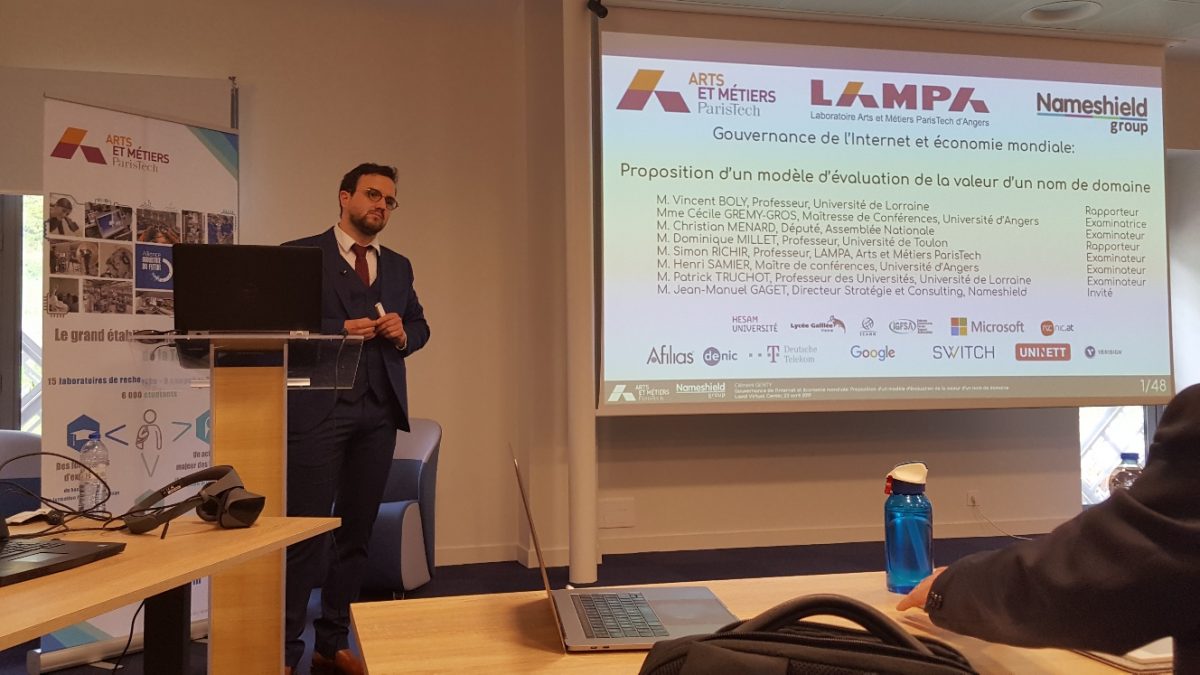
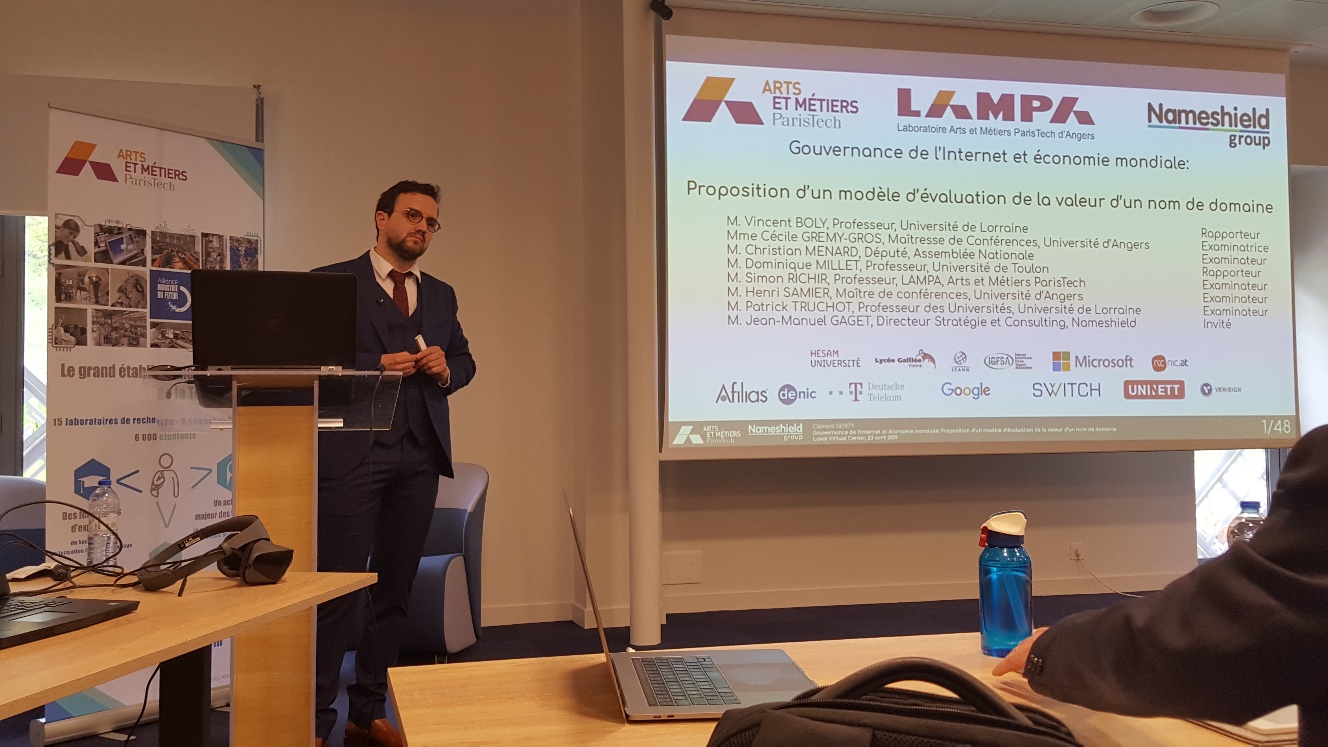
At a time of a growing awareness by companies that domain names have become strategic intangible assets, sometimes having a higher value than brands, Nameshield is happy to inform you that it has overseen and financed, during three years, the CIFRE thesis of Mr. Clement GENTY, who received his PhD, covering the subject: Internet governance and global economy: proposal of a valuation model of a domain name’s value as intangible asset.

Publicly defended on April, 23rd  2019, at Angers’ Laboratory of engineering, processes and innovation of the “Ecole Nationale Supérieure d’Arts et Métiers of Paris Tech”, first, the thesis compiles a state of the art and a historical overview of the domain name diffusion in the World since the Domain Name System’s creation (DNS) in 1983. It demonstrates the loss of the link between identification/trust by the abolition of the initial naming rules for the benefit of an unbridled and mercantile economic development from the registries.

The second part of the thesis is dedicated to an analysis of the technical and semantic parameters allowing to define the domain names’ average value.

The third part of the thesis presents a monetary valuation tool for domain names, developed by Nameshield as part of the research work, and based on a database of more than 1.4 million transactions passed.

This scientific research work, validated by this thesis, falls within a vast process initiated by Nameshield for many years in order to raise awareness of the value of the domain names’ strategic intangible assets, and to evaluate them. This work led by Jean-Manuel GAGET, Nameshield’s Strategy and Consulting Director, focuses in particular on:

  • A consulting activity regarding the optimization of a domain names’ portfolio management, through a naming and defense strategy adapted to the real issues;
  • A process of extra-financial rating and valuation of the capital domain name, integrated to the “Thesaurus Capital immatériel”, which measures intangible assets of all kinds, promoted by the “Institut de comptabilité de l’immatériel” (Intangible accounting Institute);
  • A method of domain names analysis and a domain names monetary valuation tool, scientifically validated today by this thesis.

The decision of the Council of State at the end of 2016, which focuses on the taxation applicable to the domain name ebay.fr has strengthened the obligation of the companies to monetarily valuate their domain names well, in order to account them as intangible assets under some conditions. As such, the tax experts are highly interested in the domain names’ issues in the constitution of the transfer price. This first world thesis on the economy of the domain names and their valuation will serve without a doubt as a useful material to the reflection of the financial world’s actors on this subject.

Nameshield proposes a valuation model of a domain name’s value – CIFRE thesis of Clement Genty

Game of Thrones: The return of the [MALWARES] white walkers by dozens

Game of Thrones: The return of the [MALWARES] white walkers by dozens
Image source: Irfan Rafiq via Pexels

As with each event where massive interest is expected, the launch of the final season of Game of Thrones is a golden opportunity for pirates.

According to a Kaspersky’ study, this series would be the favorite of the cybercriminals. It represented 17% of the infected contents last year, i.e. 20 934 web users! According to this same study, the most targeted episodes are logically the first and last episodes of the season.

For if the fans are many in France, without subscription, the only solution to watch the so awaited episodes is illegal downloading on torrent websites.

It is through this means that the cybercriminals infect the unsuspecting web users’ computers. First warning, do not install programs at the request of the torrent websites, they can contain a malware!

Indeed, two kinds of frauds are principally used:

  • Malwares: the malicious software are launched on torrent websites used by the fans of the series to access to the watching of the precious episodes.
  • Phishing: many phishing attempts have been counted, the pirates use the official image of Game of Thrones to try to retrieves your personal data.

This season, the cybercriminals are almost as creative as the scriptwriters of the successful series: many and various fake contests allow these hackers to collect email addresses and other bank details.

Counterfeiting is also in the game, with an observed increase of websites proposing many so-called “official” products but being nothing more than counterfeits.

Thus, Nameshield recommends to the fans to be highly vigilant!

For reminder, here are the basic principles to respect in order to serenely navigate and not be trapped by unscrupulous hackers:

  • Do not download any plugin of suspicious origin
  • Properly analyze the URLs before any purchase
  • Check the presence of the famous HTTPS
  • Check that the final address corresponds to the searched website

As always on the web, an extra vigilance is needed, because if spring wins our regions, don’t forget that on the web, winter is coming…

ANSSI annual report – The 5 cyber threats observed in 2018

ANSSI annual report – The 5 cyber threats observed in 2018
Image source: TheDigitalArtist via Pixabay

On April 15, 2019, ANSSI (the National Cybersecurity Agency of France), unveiled its annual report during a press conference. The agency identified 1869 alerts, 391 incidents without counting critical importance operators, 16 major incidents and 14 cyber defence operations for 2018. ANSSI also identified 5 major trends in terms of cyber threats observed in France and in Europe in 2018.

Analysis of cyber threat in 2018 – The 5 major trends

1.Cyber-espionage

Major concern for ANSSI in 2018, according to the agency, cyber-espionage represents the highest risk for the organizations.

Extremely discrete, benefiting from important financial resources, the attackers plan for many years highly targeted and highly sophisticated attacks. In 2018, it was noted that the cyber attackers are increasingly interested in vital activity sectors and specific critical infrastructures like the defence, health or research sectors.

2.Indirect attacks

According to ANSSI, indirect attacks have known an important increase in 2018. Indeed, to avoid the security measures implemented by big companies, which are more and more aware of the cyber risk, the attackers aim intermediaries, like providers, who are more vulnerable, to reach their final targets.

Compromising one partner is enough to reach many companies. So it is essential to choose partners that place their information system’s security at the top of their concerns.

3.Destabilization and influence operations

Because of the nature of the targets and the claims, these attacks though technically moderate, have often an important symbolic impact. An increase has been observed in 2018.

4.Cryptojacking

For reminder, cryptojacking is a cyberattack that consists in using the computer’s power of its victim to mine cryptocurrency.

In 2018, many attacks of this kind were observed. The more and more organized attackers benefit from the security flaws to compromise their victims’ equipment by placing cryptocurrencies’ miners without them knowing it.

5.Online frauds

Online frauds represent as much of a constant cyber threat for the companies and the big organizations as for the individuals. ANSSI noted an important growth of online frauds last year. Big operators are becoming more concerned about cybersecurity, so the attackers turn towards targets less exposed but more vulnerable, like territorial authorities or actors in the health sector which thus were the targets of many phishing attacks in 2018.

Conclusion

The multiplicity and the magnitude of the attacks observed during 2018, prove that it is essential to implement security measures to prevent these cyber threats, within big organizations, big groups as well as small companies.

“The conclusion is clear: 2018 proves once again that digital risk, far from being ethereal, must be at the heart of our concerns. Not only those of ANSSI! The cyberattacks affect all of society. That is why we must all seize the matter.” explains Guillaume Poupard, ANSSI’s General Director.

Status of ongoing projects after ICANN64

A month ago, ICANN held its first annual meeting with the Internet community in Kobe, Japan. At this summit, ICANN presented the major projects of the year and those of the coming years. Let’s look back at the main topics.

The implicitely constraint of the GDPR

While in May 2018, Europe adopted ambitious legislation to protect users’ personal data, ICANN imposed a regulatory framework on domain name players to bring the industry into line with the constraints of the GDPR.

In the absence of consensus, this framework was imposed when the GDPR came into force on May 25, 2018. It contains non-consensual provisions such as no longer publishing in the registry’s registration directory service, which currently operates via the Whois protocol, data that can be assimilated to personal data for contacts associated with domain names: registrant contacts, administrative contacts, technical contacts. Exit therefore the names, first names, postal addresses, telephone numbers and anonymization of email addresses or hidding via a contact form.

However, as provided for in the Bylaws, the rules governing the role and operation of ICANN, non-consensual rules may not be imposed beyond one year. ICANN therefore had the May 2019 deadline in mind throughout the Kobe meeting.

To build on this, last year ICANN initiated an expedited policy development process (ePDP) whose delicate mission was to develop consensus rules to replace the temporary provisions currently in place.

Shortly before ICANN64, this working group, in which Nameshield participates, submitted its proposals to the GNSO, the ICANN body that manages policy development for generic domain names. This report, which is currently open for comments, is expected to result in a final framework that will be submitted to the ICANN Board in early May for voting and promulgation.

The proposals outline a target date for implementation by 29 February 2020. ICANN has therefore focused its efforts on managing the transition period between May 2019 and this still distant deadline of February 2020. The prevailing approach is rather pragmatic as it consists in keeping the provisions currently in place such as the masking of personal data in the Whois until all the new provisions can be implemented by actors such as registrars and registries by the above-mentioned deadline.

Access to hidden data subject to tensions

Launched in 2012 during the last round of openings of new domain name extensions but quickly relegated to the boxes, the RDAP (Registration Data Access Protocol), an alternative to the aging Whois protocol, has resurfaced with the GDPR because of its modularity, which allows, unlike Whois, to filter access to certain data according to the user’s profile.

ICANN confirmed in Kobe that this protocol will be widely deployed by this summer. First, this protocol will coexist alongside the Whois protocol. Registrars will therefore provide access to domain name data through both protocols.

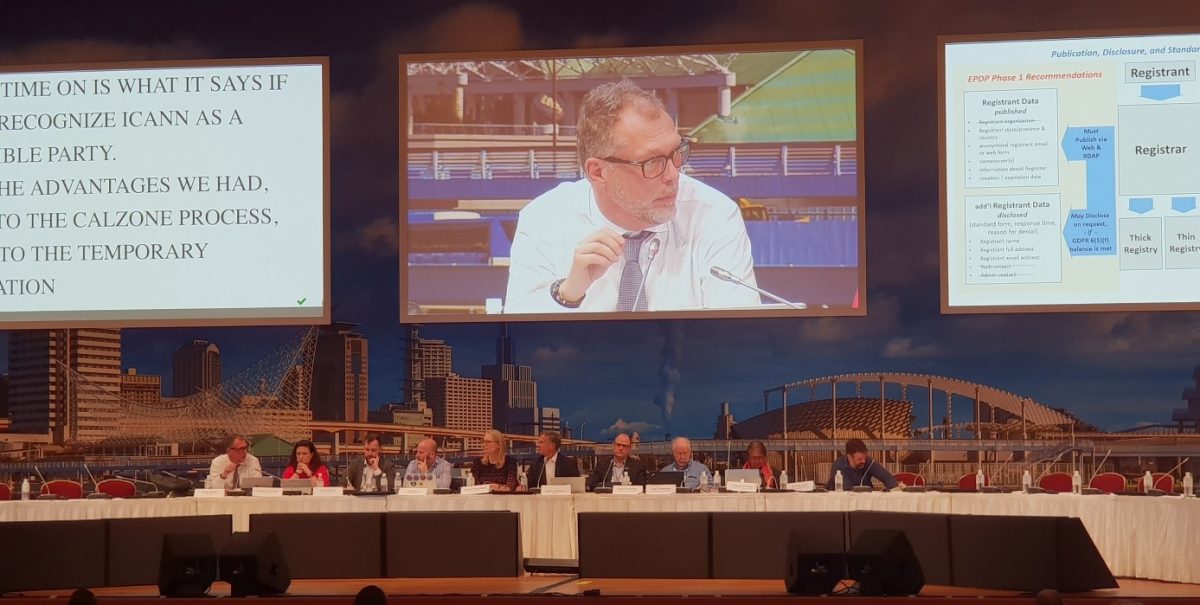
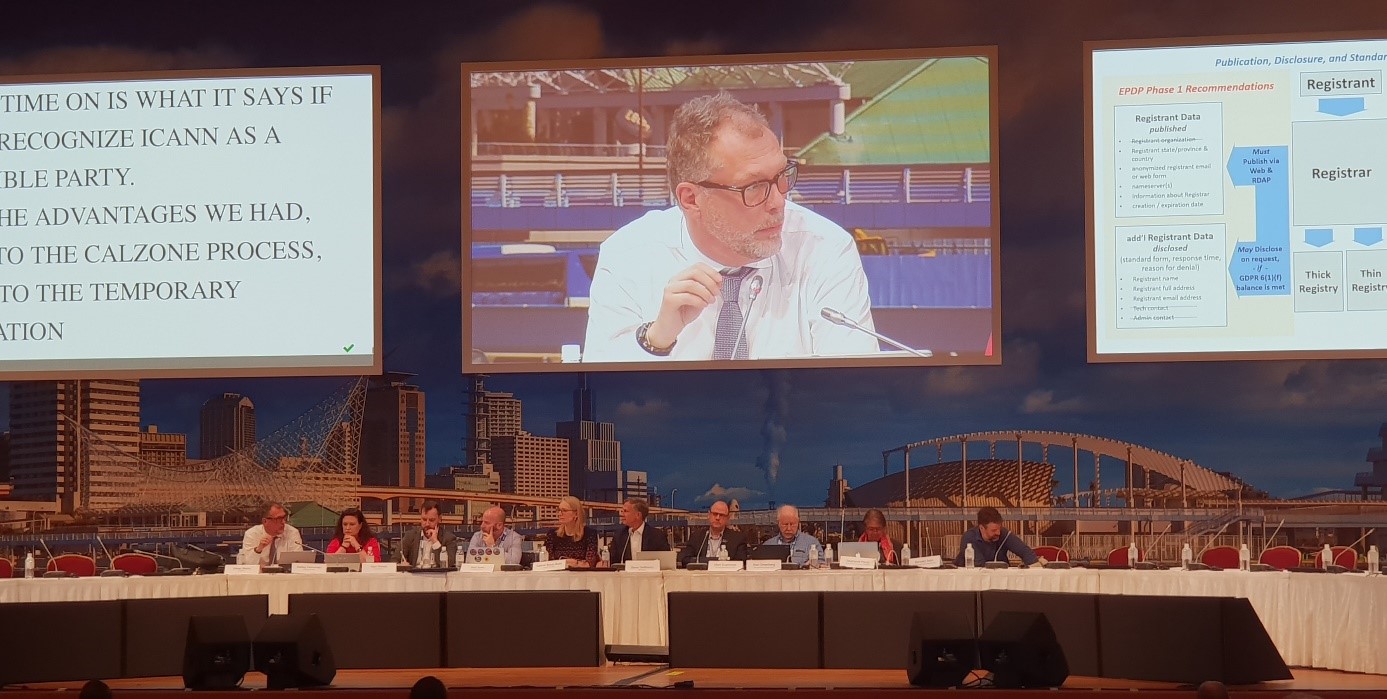
The stakeholders present at ICANN64 also learnt about the project submitted by a technical study group mandated by ICANN on the operational way envisaged through the RDAP protocol for access to hidden domain name data. It has been the subject of tensions because it is not the result of a consensual process and ICANN suggested it could play a central role in collecting all requests to validate their authorization, with authentication of requests being carried out upstream by agents accredited by data protection authorities. This topic is also part of the new mission of the Policy Development Working Group (ePDP) in the coming months. Things can therefore evolve on this subject in the future.

Status of ongoing projects after ICANN64
Goran Marby, ICANN CEO, speaking on the proposed functioning of access to hidden data for domain names through the future RDAP

A multi-year strategic plan

At ICANN64, ICANN also presented progress on the implementation of a strategic operating plan for the organization for the period 2021-2025.

The adoption of a five-year plan is new for this organization, which has always operated on an annual basis. This plan must determine the priorities for the coming years, which is also a novelty in a context where multiple projects have always been carried out simultaneously without any real prioritization.

We already know that DNS security is one of the major issues of the coming period. Among the priorities identified are the reinforced fight against malware and the increased security of the DNS, in particular through a faster deployment of DNSSEC.

For the next round of new domain names extensions openings also mentioned, ICANN has also indicated that it will take into account the lessons learned from the previous round. Among them, new extensions are ten times more targeted than historical generic extensions (like .COM,.NET,.ORG,.BIZ,.INFO) by malicious practices such as typosquatting and dotsquatting on which phishing and pharming practices proliferate.

Feel free to contact your Nameshield consultant, who is very knowledgeable on all these subjects.