

DNS on Blockchain: the next evolution of domain names?

DNS on Blockchain - Nameshield
Image source: TheDigitalArtist via Pixabay

Summary

The DNS, the Domain Name System, is a service at the heart of how the Internet operates. It is fundamental to the functioning of many services such as websites, mail servers, VoIP telephony and many others.

For more than 30 years, many extensions and functionalities have been added to the DNS, which technically translates into an increase in the complexity of the infrastructure.

The Blockchain technology could be a considerable evolution for DNS, bringing several advantages and new functionalities.

—

The DNS, a fundamental service

The DNS, the Domain Name System, is a service at the heart of how the Internet operates. It functions as a public directory that associates domain names with resources on the Internet, such as IP addresses. When a user enters an address in his browser, a DNS server translates this humanly understandable address into an IP address that is understandable by computers and networks. This is DNS resolution.
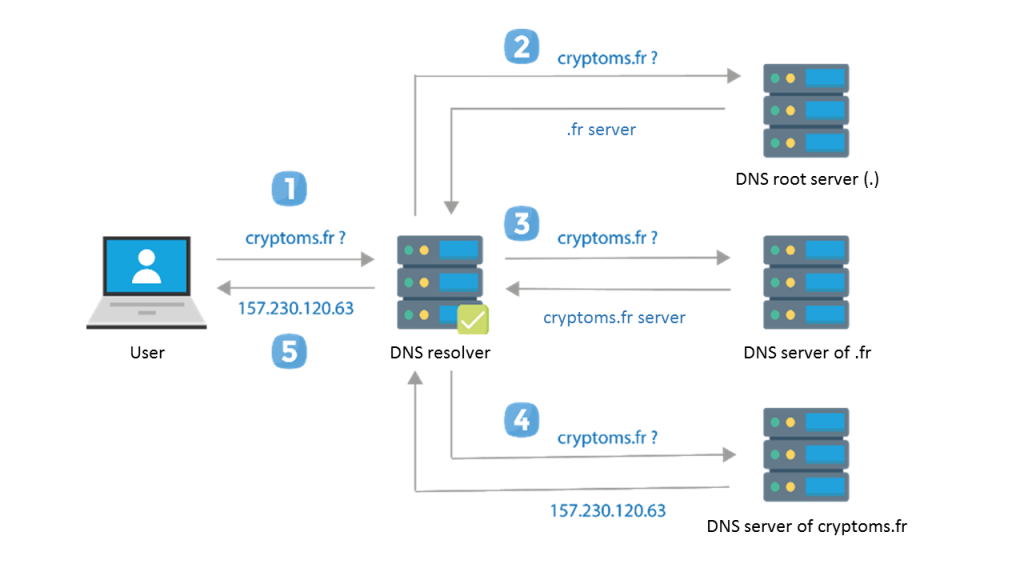
DNS - DNS on Blockchain - Nameshield

This system, created in 1983, is fundamental to the functioning of many services such as websites, mail servers, VoIP telephony and many others. It is constantly evolving to meet ever-increasing needs in terms of functionality and security. Indeed, the DNS must guarantee:

  • Availability: an unavailability of the DNS service would result in a service disruption.
  • Integrity: the data present on the DNS (associated with a domain name) must not be corrupted.
  • Confidentiality: to protect the privacy of users, the DNS implements various solutions that increase the confidentiality of DNS requests. If the requests are not confidential, it is possible to analyze users’ browsing information.

The domain name system is based on a centralized model of trust. It is distributed throughout the world and managed by different actors in a hierarchical manner, in several levels; a root level, a first level where extensions are managed by registries, then a second level managed by registrars. The whole thing is orchestrated by ICANN, the Internet’s regulatory authority.
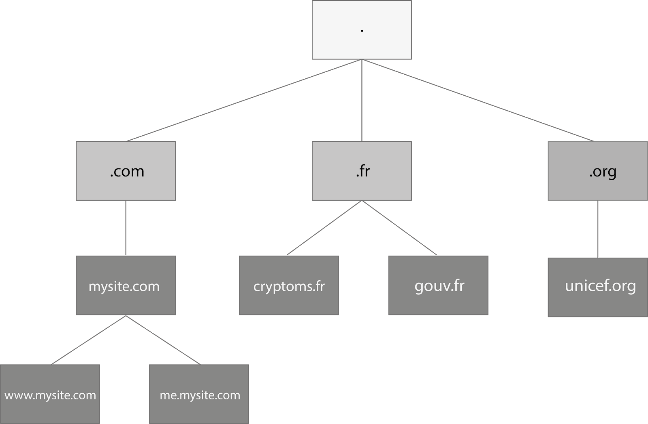
Domain names - DNS on Blockchain - Nameshield

For more than 30 years, many extensions and functionalities have been added to the DNS, which technically translates into an increase in the complexity of the infrastructure.

Blockchain technology could be a considerable evolution for DNS, bringing several advantages and new functionalities.

Blockchain and decentralized registry

A Blockchain is a data structure accessible to all and distributed over a decentralized network; the data is replicated on each node of the network, there is no central authority. Everyone has the possibility to read its contents, add data and even join the network. The concept was first implemented in 2009 with Bitcoin, but today there are many different Blockchain technologies, each with their own properties.

The data is entered on a Blockchain via transactions. The transactions are grouped into blocks, each block is then validated by the network and then brought together. Thus, a Blockchain contains the history of all the transactions carried out since its creation.

The validation rules are written in the Blockchain protocol, which each member of the network respects. To ensure compliance with its rules, the Blockchain protocols are based on consensus algorithms, the best known being the Proof of Work. These algorithms guarantee the integrity, immutability and security of the data on the Blockchain.
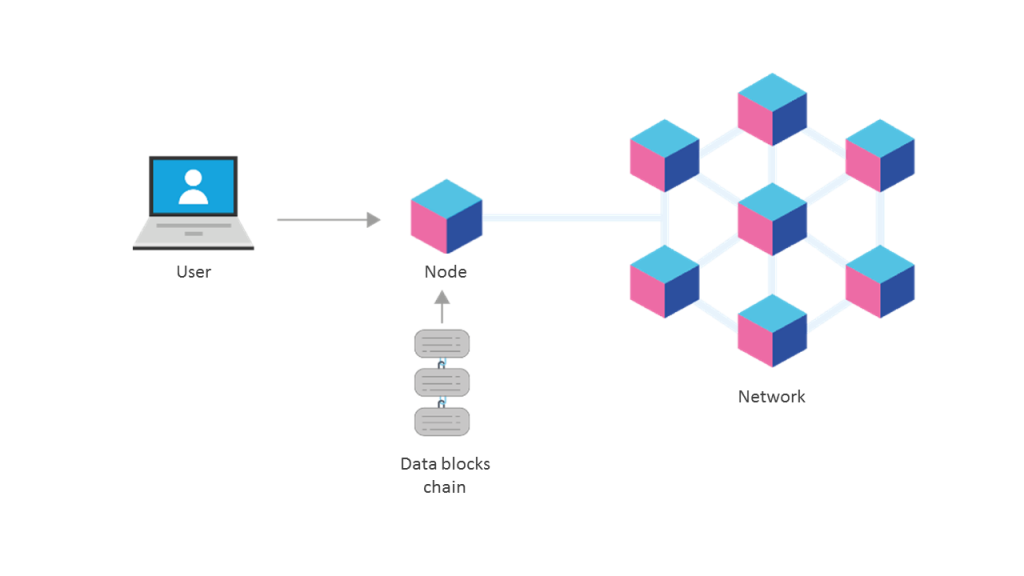
Blockchain - DNS on Blockchain - Nameshield

The Blockchain technology meets several DNS needs:

  • Availability: a decentralized, peer-to-peer network cannot be stopped. It could replace or complement Anycast infrastructures. 
  • Integrity: the consensus protocol of a Blockchain guarantees, by nature, the integrity of the data. Furthermore, the data cannot be modified. These properties would eliminate the need for DNSSEC and its famous key renewal ceremony.
  • Confidentiality: Requests made to read the Blockchain data can be encapsulated in an HTTPS channel in the same way as the DNS over HTTPS (DoH) protocol. There are few DoH resolvers today, so traffic is centralized around a limited number of actors. The use of a Blockchain would offer the possibility of querying any node on the network, thus limiting centralization and SPF (single point of failure).

The data included in the DNS zone files, i.e. the domain name configurations, could therefore be distributed on a Blockchain. Each player (registries, registrars) could directly interact with this Blockchain to manage the domain names. This is the idea of the DNS on Blockchain.

New needs

In recent years, with the emergence of Blockchain technologies, new means of values exchange have developed, particularly with tokenization, crypto-assets and decentralized applications (dapps); we talk about Web 3.0, or the Internet of Value.
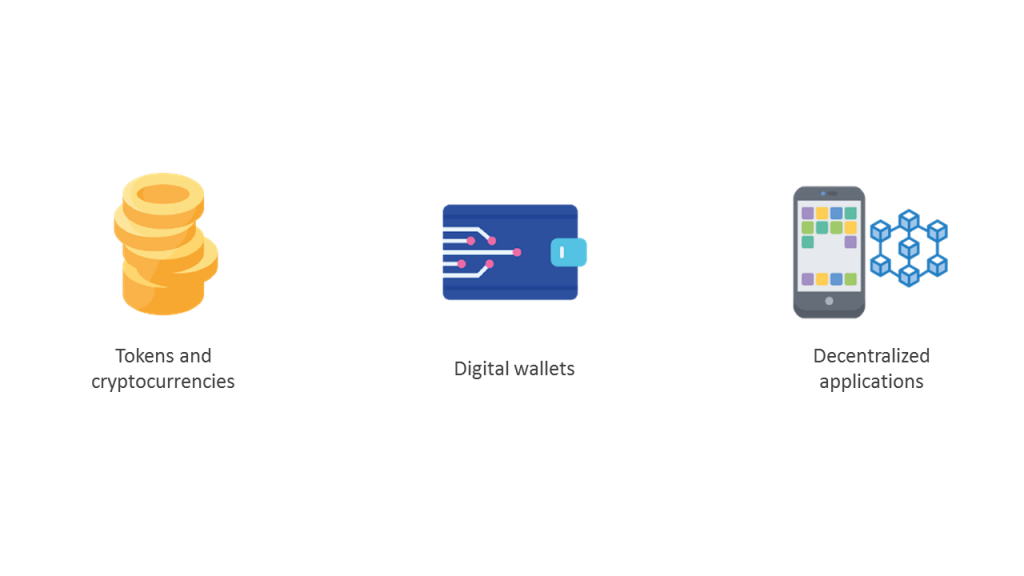
Values exchange - DNS on Blockchain - Nameshield

Digital wallets and decentralized applications work with identifiers that are difficult to read, e.g. 0x483add28edbd9f83fb5db0289c7ed48c83f55982 for a wallet address.

Being able to associate this type of address with domain names, within a universal naming system, could be of real interest for tomorrow’s Web applications. It would be possible to have a wallet of crypto-assets or a decentralized application configured directly behind a domain name. This could also be useful for the digital identity of companies and their brands.

DNS on Blockchain, today

Many naming system projects on Blockchain are currently under development, each with an implementation of its own.

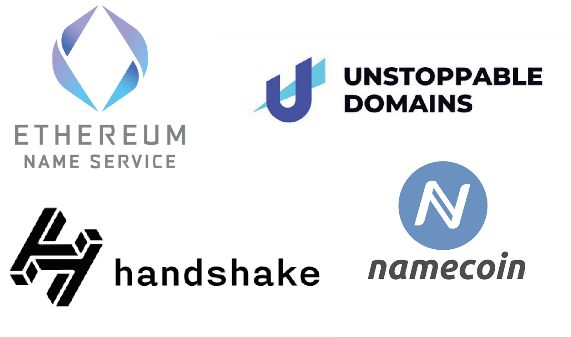
Some applications propose new domain names extensions (TLDs), such as .bit, .zil, .crypto, .eth, etc. This is particularly the case for Namecoin and UnstoppableDomains. These systems are completely independent of the traditional DNS and ICANN. Registration is managed directly by users, and names resolution is generally done through a browser extension. The Opera browser has recently natively integrated the resolution of these domain names.

These applications are functional and the names registration is not controlled. There are therefore many cases of cybersquatting. Users register names in the hope of reselling them and making a profit. This obviously poses a problem for trademark owners, and will certainly prevent the adoption of these solutions by companies.
DNS on Blockchain - Nameshield

Other projects propose complementary solutions to DNS. In particular, Ethereum Name Service (ENS) offers a names system on Blockchain that integrates with the traditional DNS. If you are the holder of a domain name and can prove it with a DNSSEC registration, you can then register this same name on the Blockchain service. This allows you to combine the advantages of traditional DNS and DNS on Blockchain.

The .kred, .xyz and .luxe extensions already support this integration on Blockchain, and ENS plans to propose it for all DNSSEC-compatible extensions. This project is quite promising, Ethereum Name Service has recently joined the DNS-OARC (DNS Operations, Analysis, and Research Center).

The Handshake project proposes a naming protocol to manage the root level of the DNS, and provide an alternative to certification authorities. It challenges the trust and governance model of the DNS to experiment with a more decentralized, secure and resilient system based on validation of DNS zones by participants in the network.

Conclusion

The DNS on Blockchain could be a considerable evolution of the DNS; it would bring several advantages and new functionalities thanks to the Blockchain technology, which would benefit the development of the decentralized web.

Today, however, there are still no technologies and applications on which there is unanimous agreement, even though many projects and PoC are under development. They are not yet mature enough to be used on a large scale. Improvements in terms of scalability, security and usability need to be made.

The collaboration of the Internet players (ICANN, DNS-OARC, registries) seems essential for a technology to reach consensus and be adopted, in particular to set common rules. This is a subject to be followed closely over the next few years.

Are you interested in blockchain and crypto-assets topics? Don’t hesitate to consult the website of our collaborator Steve Despres: https://cryptoms.fr/


FIC 2020 – Nameshield’s DNS Premium labelled France Cybersecurity once again

During the 12th edition of the International Cybersecurity Forum (FIC), the major event in terms of cybersecurity and digital confidence, which currently takes place from January 28 to 30 in Lille, Nameshield was given once again the France Cybersecurity Label for its DNS Premium solution.

Nameshield’s DNS Premium labelled France Cybersecurity
8th Edition of the France Cybersecurity Labels ceremony, January 29, 2020

Nameshield’s DNS Premium labelled France Cybersecurity

The DNS is at the heart of companies’ critical services: Internet, email, applications…

Exposed more and more frequently to attacks, like DDoS, Man in the Middle… it must remain available.

The Nameshield’s DNS Premium is the solution which meets DNS protection needs with a redundant, ultra-secure infrastructure with all the key DNS services (anycast, DDoS protection, DNSSEC, statistics…).

The DNS Premium solution labelled France Cybersecurity, thus allows its users to protect their digital assets from any attack and ensures a high availability of their Internet services.

France Cybersecurity Label, the guarantee of a certain level of quality in terms of cybersecurity

Nameshield’s DNS Premium labelled France Cybersecurity

For reminder, the France Cybersecurity label is the guarantee for users that the Nameshield’s products and services are French and possess clear and well defined functionalities, with a certain level of quality in terms of cybersecurity, verified by an independent jury.

It answers to several needs and objectives:

  • Raise awareness among users and international ordering parties regarding the importance of the French origin of a Cybersecurity offer and its intrinsic qualities ;
  • Certify to users and ordering parties the quality and functionalities of labelled products and services ;
  • Promote French cybersecurity solutions and increase their international visibility ;
  • Certify to users and ordering parties the quality and functionalities of labelled products and services ;
  • Increase their overall use and the users’ security level.

This label is governed by a committee composed of representatives gathered in 3 colleges:

  • College of officials: representatives from the “Direction Générale de l’Armement” (DGA, the French Government Defense procurement and technology agency), the “Direction Générale des Entreprises” (DGE, the French Directorate General for Enterprise within the Ministry of Economy, Industry and Digital), and the “Agence Nationale de la Sécurité des Systèmes d’Information” (ANSSI, the French National Cybersecurity Agency).
  • College of industrials: representatives from the “Alliance pour la Confiance Numérique” (ACN – Alliance for digital confidence) and HEXATRUST.
  • College of users: representatives from groups of users, such as: CIGREF, GITSIS, CESIN, CLUSIF ISSM space.

Nameshield, a 100% French company, certified ISO 27001 on all its registrar activity, was able to bring all the necessary guarantees to obtain the France Cybersecurity Label for its offer, the DNS Premium and illustrates its engagement to always provide the best services and standards regarding cybersecurity.

For more information on our labelled solution DNS Premium, please visit Nameshield’s website.

The financial industry, the target of more and more costly attacks on the DNS

The financial services industry, the target of more and more costly attacks on the DNS
Image source: JimBear via Pixabay

Financial services companies are particularly affected by cyberattacks. They possess a wealth of information on the customers, protect their money and provide essential services which must be available day and night. They are a lucrative target. Among the favored lines of attacks: the DNS.

The Efficient IP’s Global DNS threat annual report shows a constant growth of the DNS attacks’ number and the financial impacts, with an average financial loss of 1.2 million euros in 2019. This amount was estimated at 513 000€ in 2017 and 806 000€ in 2018.

If all the industries are affected by cyberattacks, 82% of the companies surveyed have been affected and 63% have suffered a traffic disruption, the financial industry pays a more important price with 88% of impact. Conducted with 900 persons from nine countries of North America, Europe and Asia, the study indicates that financial companies suffered 10 attacks in average during the 12 last months, i.e. an increase of 37% compared to last year.

The increase of the costs is only one of the DNS attacks’ consequences for the financial services industry. The most common impacts are the cloud services’ downtime, experienced by 45% of financial organizations, and internal applications downtime (68%). Furthermore, 47% of financial companies have been the victims of frauds by phishing attacks aiming the DNS.

The survey clearly shows the insufficient security measures implemented for the DNS securing. The delay in applying security patches is a major problem for the organizations of this industry. In 2018, 72% of the interviewed companies admitted that a 3 days’ delay was necessary to implement a security patch in their systems, 3 days during which they are exposed to attacks.

Only 65% of the financial institutions use or plan to integrate a trusted DNS architecture, they seem to be always late and not to be sufficiently aware of the risks associated to this central point of their infrastructure. The evolution of the threats on the DNS is constant, the attacks are many and complex. It is essential to quickly react to better protect yourself.

Industry, trade, media, telecom, health, education, government, service… many others sectors are affected by the attacks. Some solutions exist. ANSSI publishes every year the guide of good practices regarding the DNS resilience, which details many recommendations in order to be protected. Relying on an Anycast network; possessing a protection system against DDoS attacks; having a monitoring of DNS traffic and a team able to take action quickly; possessing an efficient security policy … As many measures essential to the resilience and efficiency of the DNS network against these damaging attacks in terms of financial and image impact.

Hoping to see at last better figures in the 2020 report.

50 years after Arpanet, the Internet’s ancestor

Arpanet - Internet’s ancestor - Nameshield Blog
Image source: geralt via Pixabay

On October 29, 1969 UCLA sends the very first e-message to Stanford Research Institute through Arpanet network (Advanced Research Projects Agency Network) laying the foundation for today’s networked world.

Arpanet, the Internet’s precursor 

Arpanet is the first data transfer network developed by the Advanced Research Projects Agency (ARPA) which belonged to the U.S. Defense Department.

The first Arpanet node was set up at UCLA on August 30, 1969, the second node, at the Stanford Research Institute, was set up on October 1st 1969. The first message was sent between the two institutions on October 29 1969 by the UCLA computer science professor Leonard Kleinrock who wished to send the word “login” but the system crashed so only two letters, “l” and “o”, were transmitted, the complete word will only be transmitted 1 hour later.

Arpanet connected some universities and research institutes: first, UCLA and Stanford Research Institute, followed by UC Santa Barbara and the University of Utah. At the end of 1969, Arpanet counted 4 nodes, in 1971, 23 nodes were created and 111 nodes in 1977.

In 1983, Arpanet has been divided in two networks: one military, the MILnet (Military Network) and the other academic, the NSFnet.

On January 1st 1983, the name “Internet” already in use to define all of Arpanet, became official.

World Wide Web turns 30 years old

In 1989, Tim Berners-Lee, a researcher working for the CERN, proposed a hypertext system working on the Internet. This system was originally developed for scientists working in universities and institutes around the world, so they could instantly share information. His vision of universal connectivity became the World Wide Web, which sent Internet usage skyrocketing.

In 1993, Mosaic, the first popular web browser was created by Marc Andreessen and Eric J.Bina, two students of the National Center for Supercomputing Applications (NCSA) of the University of Illinois. It was not the first graphical web browser but Mosaic was particularly fast and allowed the users to display images inside web pages instead of displaying images in a separate window, which has given it some popularity and contributed to increase the World Wide Web’s popularity.

Internet Protocol – From IPv4 to IPv6

The Internet Protocol (IP) is a set of communication protocols of IT networks developed to be used on the Internet. IP protocols allow a unique addressing service for all connected devices.

IPv4 the first major version was invented in the 70’s and introduced to the public in 1981. It is still the dominant protocol of the Internet today. Twenty years ago, the IETF (Internet Engineering Task Force) started predicting the depletion of IPv4 addresses and began working to create a new version of the Internet Protocol: IPv6.

IPv4 uses a 32-bit addressing scheme to support 4.3 billion devices, while IPv6 possesses a much larger address space. Indeed, IPv6 uses a 128-bit address allowing 3.4 x 1038 possible addresses.

DNS – Domain Name System

At the request of the Advanced Research Projects Agency of the U.S. Defense Department, the DNS (Domain Name System) was invented in 1983 by Jon Postel and Paul Mockapetris, in order to associate complex IP addresses with humanly understandable and easy-to-remember names. Thus a logical address, the domain name, is associated to a physical address, the IP address. The domain name and IP address are unique.

In 1998, is created ICANN (Internet Corporation for Assigned Names and Numbers), the regulatory authority of the Internet. Its main purpose is to allocate the Internet protocol addresses spaces, to attribute the protocol identifier (IP), to manage the domain name system of top level for generic codes (gTLD), to assign the country codes (ccTLD), and to carry out the functions of the root servers’ system management.

With 351.8 million domain names registrations in the first quarter of 2019, domain names registrations continue to climb, but with the increase of the number of threats aiming the DNS at the same time.

The emergence of cyber threats

Considered as one of the first cyberattacks and certainly the first to attract the media’s attention, the Morris Worm was launched in 1988 by a student of the Cornell University, Robert Tappan Morris. Originally, the malware developed by the student didn’t have for purpose to cause damage but simply to estimate the extent of the Internet. However this worm affected about 60 000 computers estimated connected to the Internet and the cost of the damages was about 100 000 to 10 million dollars. This event marks the turning point in the field of online security.

Today, cyberattacks are abundant, frequent and more and more sophisticated. The evolution of techniques and the arrival of new technologies make cyberattacks increasingly complex and offer new opportunities to attackers.

There are various types of cyberattack like attacks aiming the DNS: DDoS, DNS cache poisoning, DNS spoofing, Man in the Middle… (In 2019, according to IDC – International Data Corporation, 82% of companies worldwide have faced a DNS attack over the past year) or attacks directly aiming users and having for purpose to obtain confidential information to steal an identity (phishing).

The consequences for victimized companies can be significant. For example, today the cost of a data breach is 3.92 million dollars on average according to IBM Security, this cost has risen 12% over the past five years.

An IP traffic estimated in 2022 more important than the one generated from 1984 to 2016

With more than 5 billion Google searches made every day, e-commerce continuing to thrive, social media growing in popularity and the increasing number of connected objects, the traffic volume on the Internet has risen considerably.

Indeed, in 1974, daily traffic on the Internet surpassed 3 million packets per day. According to a Cisco’s research in 2017, the global IP traffic reached 122 exabytes per month, the company estimates that this volume should reach 396 exabytes by 2022.

“The size and complexity of the Internet continues to grow in ways that many could not have imagined. Since we first started the VNI Forecast in 2005, traffic has increased 56-fold, amassing a 36% CAGR (Compound Annual Growth Rate) with more people, devices and applications accessing IP networks” said Jonathan Davidson, senior vice president and general manager of Service Provider Business at Cisco.

Today, 50 years after the birth of the Internet’s ancestor, Arpanet, there are more Internet connected devices than people in the world. In 2022, the web users will represent 60% of the world’s population and more than 28 billion devices will connect to the Internet.

Attack on the domain name system: the priority is to protect your access

Cyberattack - DNS Hijacking - cyber espionage
Image source : Geralt via Pixabay

Last weekend, the media has widely communicated on the consequences of an unprecedented attack that targeted the domain names.

Indeed, during the night of 22-23 February ICANN reported the large-scale attacks on the domain names: it is DNS hijacking. These attacks consist in “replacing the authorized servers addresses” with “addresses of machines controlled by the attackers”, as explained by the organization, allowing the attackers to examine the data in order to find passwords, email addresses etc., even to completely capture the traffic towards their servers.

A wave of attacks that began in November 2018

Actually, this is not an attack but a wave of attacks that the domain names system has endured for several weeks now.

Since the end of November 2018, an attack has targeted Lebanon and the United Arab Emirates and affected .GOV domain names. In this attack, the cybercriminals have proceeded with DNS hijacking.

At the beginning of January 2019, the company FireEye reported in an article, a wave of DNS hijacking that has affected domain names belonging to government, telecommunications and internet infrastructure entities across the Middle East and North Africa, Europe and North America.

If the attackers were then not identified, the initial research suggested the attacks could be conducted by persons based in Iran.

Important fact regarding the attack of February 22: this time, it struck, sometimes successfully, important actors of the Internet.

What are these attacks?

The method used is the DNS hijacking deployed on a large scale. This is a malicious attack, also called DNS redirection. Its aim: overwrite the TCP/IP parameters of a computer in order to redirect it towards a fraudulent DNS server instead of the configured official DNS server. To do this, the attacker takes control of the targeted machine through different techniques to alter the DNS configurations.

The American government, among others, recently warned about these series of highly sophisticated attacks of which the aim would be to siphon a large volume of passwords. These attacks would target more specifically governments and private companies.

Between DNS hijacking and cyber espionage

According to Talos’ article of November 2018, the attackers behind these attacks would have collected emails and connection information (login credentials – passwords) by hijacking the DNS, so that the traffic of the emails and the VPN (Virtual Private Networking) of the targeted institutions would be redirected to a server controlled by the cybercriminals.

Once the connectors collected, other attacks can be launched for espionage purposes, like the Man-In-The-Middle.

Then how to effectively protect yourself?

You must be aware that if these attacks essentially aim the domain names system, we can never say it enough, the first entry point of your domain names portfolio for an attacker is your access to the management platform.

The first and utmost recommendation is to protect your access

For many years, Nameshield has developed securing measures for the access to the domain names management platform (IP filter, ACL, HTTPS) and in addition proposes the 2 factors authentication and the SSO.

If these complementary solutions are still not implemented, Nameshield strongly recommends to implement them, in particular the 2 factors authentication in order to fight against passwords thefts.

To implement the DNSSEC protocol

The implementation of DNSSEC, if it was more widely deployed, would prevent or at least lessen the impact of these attacks by limiting their consequences.

It’s becoming increasingly urgent that DNSSEC is adopted on a massive scale, for both resolvers and authoritative servers.

To protect your domain names

The implementation of a registry lock on your strategic names will prevent their fraudulent modifications.

Although no perfect solution exists today to fully protect the infrastructures from cyberattacks, it is the implementation of several preventive measures combined that will allow to reduce the vulnerabilities (so) easily exploited by the pirates.