
Can the DNS have an impact on the SEO?

Can the DNS have an impact on the SEO?
Image source : geralt via Pixabay

This is a recurrent question from our customers: does the use of the DNS, whether it is good or bad, have an impact on the websites’ SEO? We have already discussed about the impact of a HTTPS website on the SEO, this is now the occasion to focus on the side of the DNS.

The DNS is an invisible process, implemented in the background, it’s difficult to comprehend why it can help or affect a website’s performance and the ranking in search engines, more particularly on Google.

This article will approach the possible impact of the DNS in response to the following questions:

  • Does the modification of a DNS record affect the SEO?
  • Does the change of the DNS provider affect the SEO?
  • Which part of the DNS plays in a website’s migration?
  • Does the change of a website’s IP address affect the website’s SEO?
  • Quid of the DNSSEC implementation?
  • Can a DNS breakdown affect the SEO?
  • Can a faster DNS increase the SEO?

Does the change at the DNS level affect the SEO?

1. Modification of a DNS record, be careful of the TTL

The domain name’s redirection towards the corresponding web server often passes through the creation of a A type record (IPv4 address). The A record will then direct the traffic towards the IP address of the destination web server. The modification of this record can lead to performance problems.

Indeed, to optimize the response time, the DNS system allows the  information caching with the DNS resolver servers for a given time, the duration of the TTL (Time to live) defined by the technical manager of the domain name, during its configuration. The usual TTL, like the one recommended by ANSSI, is several hours for the usual uses of domain names (websites). In the case of a A record modification, this one could be taken into account only at the end of the TTL. Then web users could still access to the former record configurations for a few minutes or even several hours after the modifications.

Thus it’s important to reduce the TTL, even temporarily during these modifications.

But does that affect the SEO? Yes, it does and no, it doesn’t. In the case of users being sent towards a destination that no longer exists, Google will consider this as a 404 error. Beyond the negative user experience, this is not directly a SEO factor. However be careful of the possible existence of backlinks and the too high numbers of 404 errors. A low TTL allows to limit the impact during these modifications.

2. Modification of the DNS declared for a domain name

A domain name is associated to the name servers (NS/Name Servers) which allow the right DNS resolution. The DNS service searches the information on these NS. These NS can be modified during the change of the provider managing the domain name, or simply to pass from a DNS infrastructure to another. Will the change of the name server affect the SEO?

Depending on the provider and the chosen infrastructure, the resolution time could be more or less short with a possible impact of improvement or decrease regarding the SERP (Search Engine Result Page). Indeed, the resolution time is taken into account by Google (see after).

And like for a record change, it is recommended to reduce the lifespan of the records before modifying the name servers, so the DNS resolvers don’t keep in cache the former information.

3. Risk associated to the DNS during the website’s migration

This is the same principle discussed previously. The modifications of the DNS configurations don’t directly affect the SEO, but can lead to a bad user’s experience. The TTL should also be seen as a useful mean to take into consideration.

Which specific cases to consider?

  • Change of web hosting provider
  • Change of DNS hosting provider?
  • Move the traffic of www. towards a “nude domain” (without www.)
  • Move your domain towards a CDN (content diffusion network)

4. Change of the destination IP address

No. During the modification of a record pointing from a termination point to another, the SEO is not affected. The only (very rare) exception to this rule would be to point a domain towards a termination point that would have been already identified as a spam server (for example, the IP address of a shared server).

However, be careful of the IP address in question, one of the (many) rules of Google’s SEO is that an IP address used for a website should be located near the final user.

5. DNSSEC implementation

DNSSEC allows to authenticate the DNS resolution through a chain of trust between the different DNS servers of this resolution. Just like for the HTTPS, this is an additional security layer to implement. And like for the HTTPS, the pages’ loading time is affected, and therefore potentially the associated SEO. To put this into perspective, DNSSEC is essential to web users’ surfing and it is recommended to implement it.  Most companies that propose security audit regarding domain names consider DNSSEC as necessary and then as a notation criteria.

Do faster DNS increase the SEO?

Google admitted that the loading time of a web page has an impact on the SERP results. The times of the DNS research are in general less than a second, they can nevertheless affect the loading of a webpage in the following cases:

1. Recurring breakdowns on the DNS infrastructure

When a DNS cannot resolve or takes more time than usual, it can add many seconds to the time of a page loading. In case of lack of reliability and recurring unavailability, the impact on SEO is proved… Not mentioning the user experience in front of these repetitive failures (increase of the bounce rate, decrease of customers’ retention and impact on the trust in the brand, if not revenue loss). It is important to rely on a reliable and trustworthy infrastructure.

2. Quality of the network and points of presence

This is purely and simply physics, the nearest a names server is to the final user, the less time is needed to respond to its request. The DNS networks called “anycast” (optimized addressing and routing towards “the nearest” or the “more efficient” server) with many points of presence in the world, allow to optimize the response time depending on the geographical location.

Another important point is to have at least three names servers that are authority (SOA) for a domain name, ideally based on different domain names and TLDs, in order to reduce the risk of SPOF (Single Point of Failure) of an infrastructure. Indeed, if an infrastructure relies on the same domain name, an unavailability of this domain name, for whatever the reason, leads to the unavailability of the DNS infrastructure. Likewise, at the TLDs’ level and even if it is less likely, a problem of registry availability would affect all the DNS infrastructure.

3. Be careful of “extended” DNS configurations

It’s not unusual to have DNS configurations which send towards a final destination through several steps like in the example below.  As a consequence, the resolution time is affected and potentially, the performance in terms of SEO.

fr.wikipedia.org. IN CNAME text.wikimedia.org.

text.wikimedia.org. IN CNAME text.esams.wikimedia.org.

text.esams.wikimedia.org. IN A 91.198.174.232

Conclusion

The SEO is a science to consider as a whole. Thus, as we have seen through the impact of the HTTPS adoption of a website, this is a referencing factor among others and all things being equal, then this is particularly important in order to achieve a competitive edge on the first page of results.

The same applies to the impact of DNS on the SEO. Can the DNS have an impact? Yes, it clearly can in the case of incorrect configurations, or in the case that the DNS infrastructures do not allow response times fast enough. A DNS infrastructure called anycast is essential for any domain name carrying an important web traffic, even more at an international level. This is a data to integrate in a whole, and this thinking should be in a global approach of the SEO with the web marketing team.

DNS Flag Day: Are you ready?

DNS Flag Day - Blog Nameshield

Lately, the DNS keeps being talked about! After the first KSK rollover of October 2018, then the deactivation of the former KSK key on last January 11, here comes the time of the DNS Flag Day!

DNS Flag Day: What is it all about?

The Flag day is an expression used in IT to indicate the deadline and/or radical change.

Let us remember that when it was created, the weight of cybercrime threats affecting the DNS infrastructure didn’t exist. If the security was relegated to the background, the evolution of attacks have made it absolutely necessary: The DNS must be strengthened!

It’s in this context that the EDNS standard has been created in 1999 (updated in 2013 in the RFC6891). EDNS has particularly allowed the implementation of DNSSEC, the DNS’ geolocation and other measures aiming to strengthen the security.

This transition was not without difficulties. Abusive EDNS standard adoptions, lack of updates, bypasses have led to the creation of many patches and accommodations of the recursive servers’ code (particularly, in order to be able to differentiate DNS servers which cannot properly support EDNS from the ones unreachable for other reasons).

Two decades later, the maintenance of all these patched software has become more than difficult and leads to bugs that can compromise the DNS security. Obviously, the weight of these patches affects the speed of the response times.

It’s time for this standard to be implemented by all, or they will no longer be able to efficiently deal with new DNS attacks, like amplification or layer 7 attacks.

That’s why, major IT actors (Google, Cloudfare, Facebook, Cisco..), of which the developers of recursive servers decided as one to no longer support DNS servers that do not respect the EDNS standard as of February 1, 2019. The Flag Day arrives!

And concretely?

From the DNS Flag Day, on February 1, all the DNS servers not in compliance with the EDNS standard (or not functioning because of a firewall incompatible with EDNS), thus not responding to EDNS requests will be considered as unreachable; accommodations and other patches being removed from the new versions of the DNS software.

To simplify, not placed on compatible DNS, your domain name may no longer respond.

How to anticipate?

That is why it is important to ensure that DNS servers hosting your names‘ zones are compatible EDNS, in particular if they are not placed on Nameshield’s DNS infrastructure or if your company maintains its own infrastructure.

The DNS Flag Day website also allows to test the compliance of your name: https://dnsflagday.net/

Of course, our team is at your disposal for any question.

The DNS KSK-2010 security key revocation by ICANN, it’s this week!

Image source : TheDigitalArtist via Pixabay

After the first changing of the cryptographic key in last October, it is now, on January 11, that the old KSK key (Key Signing Key) of the root zone will be deactivated.

The process initiated in October 2018 to improve the security of the root zone, with the deployment of the Key Signing Key-2017, finds its achievement with the revoking of the root of the old key KSK-2010.

As indicated by Paul Hoffman, ICANN’s Principal Technologist, “The ICANN organization does not expect problems with the revocation. However, this is the first time a KSK in the Domain Name System (DNS) root has been revoked, so the ICANN org and the DNS technical community will be watching carefully for at least 48 hours after the publication of the revoked KSK-2010.”

To note, during the rollover on October, the negative impacts were extremely limited and it would seem that only two Internet services providers were impacted by interruptions during the process.

Of course, ICANN encourages solutions providers to no longer ship KSK-2010 in their products. ICANN should later publish a white paper about the full rollover process, including the lessons learned from this operation. ICANN communities will then be able to open discussions regarding upcoming rollovers that could happen.

DNS – the big forgotten of Internet

“DNS continues to be one of the most targeted Internet services, and it remains the Achilles heel of global Internet infrastructure. DNS was not only the most heavily abused protocol for reflection/amplification DDoS attacks this year, but an attack targeting a specific DNS provider was also the cause of the most widespread Internet outage of 2016 (Note: attack on the provider Dyn, which caused for about ten hours, the inaccessibility of a big part of Internet in the USA, particularly impacting Twitter, Ebay, Netflix, Amazon, Paypal… in October 2016).”

Arbor Network Infrastructure Security Report – June 2017

But what is the DNS?

DNS – the big forgotten of Internet

Because the human being is more apt to remember a name than a number, and because this is even more true for going on a website, between a domain name and an IP address, the human being, in order to simplify their life, have created the DNS: Domain Name System (or service).

For example: “I want to go on Google.com, my browser will ask the DNS what the IP address of the web server hosting google.com is, it will obtain it, then go on it and download the page.”

The DNS is a public database, decentralized and distributed, which associates domain names to IP addresses. It exists since 1985. It’s a part we can qualify as Internet infrastructure, essential to operate… and yet the DNS is invisible to the user.

The DNS has been massively adopted because it’s practical. It simplifies the user’s life and allows them to easily identify, differentiate, locate, memorize and transmit the domain name of a website associated to a brand. It has also been adopted on the other side of the mirror by its networks administrators to identify and differentiate servers, it is even more true with IPv6, with hosts multiplication and the arrival of the all connected. The DNS allows them, last but not least, to have the possibility to change servers and IP addresses in all transparency for the web user.

The DNS is omnipresent within the Internet. Everyone should be able to have access to it, if not, the Web would not operate anymore. This is what has happened in 2016 to our American compatriots, who had to do without Twitter or frenetically buying during almost 10 hours. The lost profit regarding revenue and impact on the brand image of the impacted companies have been significant.

But as it is invisible, everyone tends to forget it… and to realize it when it’s too late.

Strategic services relying on the DNS and the associated risks

Websites and email are two major services which systematically rely on DNS. Imagine that your website is unavailable for 1 minute, 10 minutes, 1 hour… and the consequences for your company, revenue, service discontinuity, image of the brand, customer’s loss. And what the consequences are for the absence of emails on this same period…

If these two services are the most potentially impacted, others can systematically rely on DNS:

VPN, VOIP, instant messenger… with the consequences smaller but equally regrettable for the operating of the company.

Attacks on DNS

Sadly, DNS servers are exposed to many potential attacks:

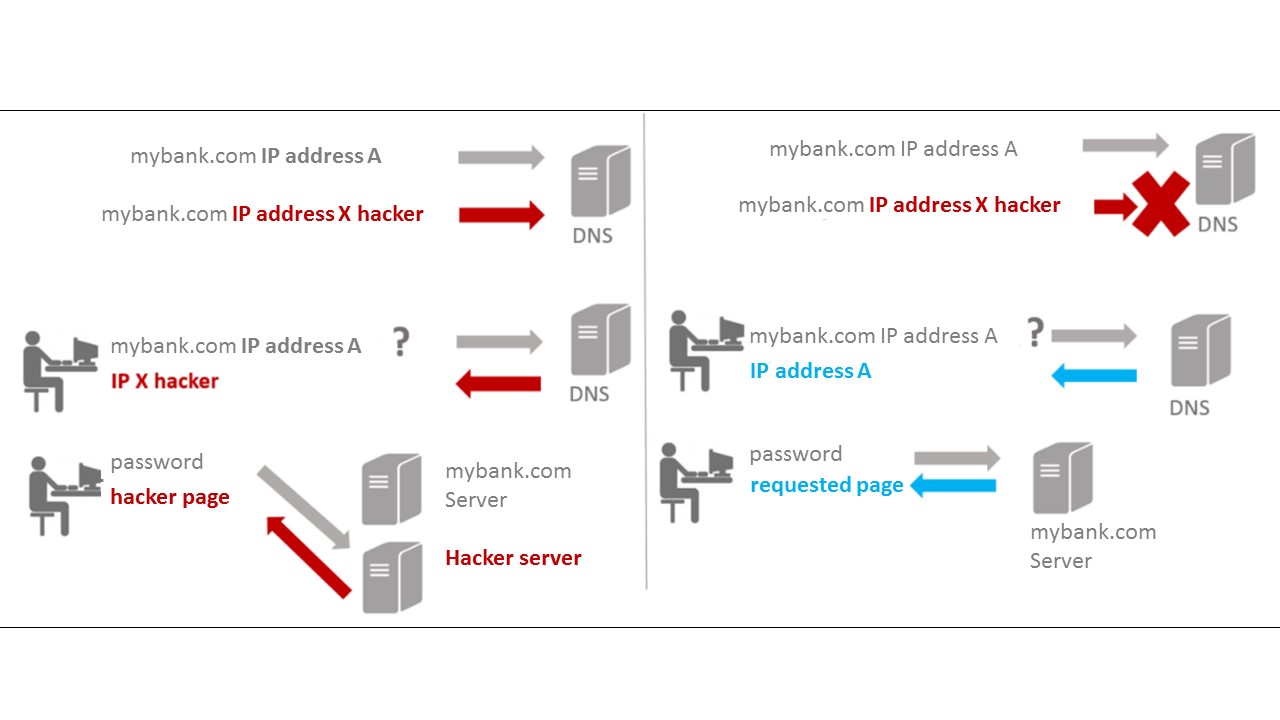
– Cache poisoning: make the DNS servers believe they receive a valid answer to their request while it is fraudulent. Once the DNS poisoned, the information in cache makes all the users vulnerable (send to a fake website).

– Man in the middle: The attacker alters the DNS server(s) of the parts in order to redirect their communication to them without the parts realizing it.

– DNS spoofing: redirect the web users without them knowing, towards hacked websites.

– DDoS: DNS are more and more targeted by DDoS attacks, in order to saturate them and prevent them to ensure the resolution of the company’s key services.

And all these attacks have the same consequences: hijack or stop the companies ‘traffic.

The big forgotten

From the user’s point of view, the DNS doesn’t exist, they use the naming system of domain names to navigate and send emails, they have only one need: that it works.

From the company’s side, the problem is different, it is usually a lack of information, a lack of conscience of the DNS importance and the consequences of a service breakdown.

In most of the cases, companies do not really pay attention. They will use an important budget to register and manage domain names, to rise their visibility and protect their brands, but will not linger on DNS servers’ strength at their disposal from their provider.

The good practices to implement: having first rate DNS infrastructure

DNS the big forgotten - DNS availability time

First of all, consider whether your strategic domain names already beneficiate from a particular attention from the DNS infrastructure. Are called strategic, all domain names on which rely the key services traffic of the company: web sites, email, VPN, instant messenger…

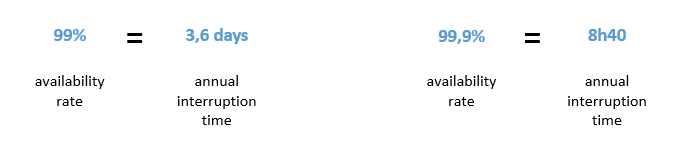
To gain its own DNS infrastructure is a solution which presents advantages of flexibility and control, but the acquisition cost, management and maintaining on one side, complexity and necessary knowledge on the other, are often crippling or badly evaluated. It’s usually easier to go for an extern DNS infrastructure, managed by a registrar, host or specialized provider. It is then appropriate to check which availability annual rate is ensured and how it relies on the good practice for a maximum availability.

To ensure a high availability to your Internet services, it’s essential to choose a DNS solution highly available which offers:

– Necessarily functionalities to a DNS intensive use;

– A network of anycast type to reduce the DNS resolution time and ensure an optimal access time to your websites.

– A DNS infrastructure secured and staying available even in case of attack.

– Key functionalities like : GeoIP, Failover, Registry lock, DNSSEC, anti-DDoS smart filter

Conclusion

The DNS is not visible but is everywhere, it ensures the access to our key services thanks to the resolution of your strategic domain names, it is potentially exposed to many attacks with disastrous consequences and it lacks too often attention from companies. So.. Don’t forget about it and if necessary, talk about it with your Nameshield partner.

Let’s talk about DNSSEC

DNSSEC has taken shape, and has become essential in security process recommended by ANSSI as well as the web in general. And yet, it’s a barbaric term that is often scary as we don’t know how it works and what it’s used for. This article will focus on clarifying this term.

The Domain Name System Security Extensions is a standardized protocol of communication allowing to resolve security problems related to DNS. We will begin by a reminder of what is the DNS.

What is the DNS?

Simply put, the Domain Name System is quite like an Internet directory. It’s a service translating a domain name into IP addresses. It relies on a data base distributed to millions of machines. Humans identify, memorize and differentiate more easily names than series of numbers. The DNS has been defined and implemented in the 80’s and has become an essential element of Internet.


How does the DNS work?

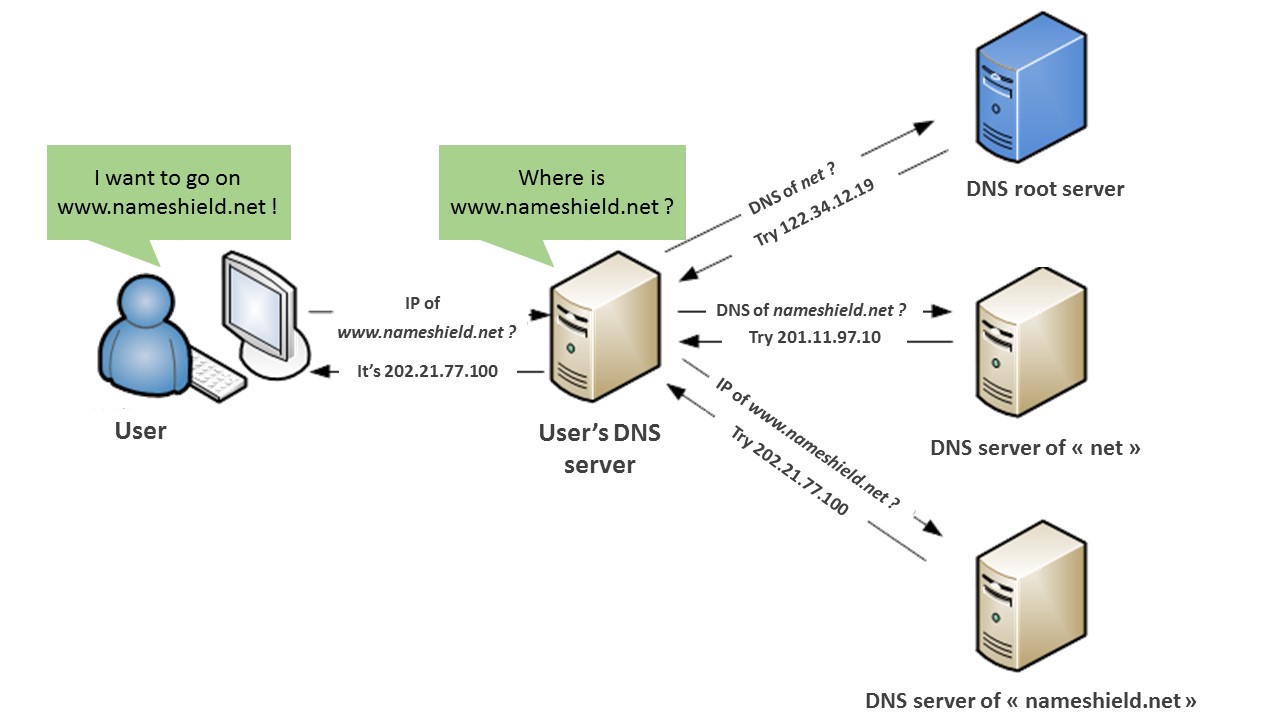
The DNS will allow web user to inform a domain name in his web browser to access a website. The browser will then “resolve” this domain name to obtain the IP address of the web server which hosts this website and displays it. We call this the “DNS resolution”.


DNS resolution 


What are the risks related to the DNS?

If the DNS goes down, your websites and emails are going to be unavailable, which is unthinkable nowadays. Other applications can be impacted in the companies: VPN access, intranet, cloud, VOIP… all that potentially needs a names resolution to IP addresses. DNS must be protected and stay highly available.

If the DNS protocol has been created with security in mind, many security flaws of the DNS protocol have been identified since its creation. The mainly flaws of DNS have been described in the RFC 3833 published in August 2004. Queries package interception, fake answer, data corruption, DNS cache poisoning and Denial of service.

To deal with this vulnerability, DNSSEC protocol has been created.


DNSSEC issues

DNSSEC prevents these different attacks, particularly cache poisoning, by securing the integrity of the DNS resolution. DNSSEC issues are:

  • How to secure the data integrity and authenticate DNS (resolver, server with authority) and keep backward compatibility with the DNS at the same time.
  • How to secure access security at the resource asked to billions web users?
  • How to find a solution light enough so it won’t surcharge names servers?


DNSSEC process

To secure the integrity of the DNS resolution, DNSSEC develops a chain of trust that goes back to the DNS root (refer to the DNS root server image above). Data security is done by keys mechanism (KSK for Key Signing Key & ZSK for Zone Signing Key) which signs DNS records in its own zone. Public keys are sent to the corresponding register to be archived; the register being linked by DNSSEC to the root server, the chain of trust is developed. Each DNS parent zone ensures the keys authenticity of its child zones by signing them.


Without DNSSEC                                  With DNSSEC

DNSSEC process

DNSSEC, Nameshield and you:

DNSSEC operates like an essential protection for your strategic names, which secures DNS’ answer authenticity. It would be advisable to identify names that need to be protected. All TLDs don’t propose DNSSEC yet. Here is a list of principal TLDs that does, it can change with many more coming:

TLDs supporting DNSSEC: .fr, .com, .be, .net, .eu, .pl, .re, .pm, .yt, .wf, .tf, .info, .li, .ch, .biz, .de, .sx, .org, .se, .nl, .in, .us, .at, .nu, .la, .ac, .cz, .me, .sh, .io, .uk, .co.uk, .me.uk, .org.uk.

All news gTLDs, like .paris, .club, .xyz, .wiki, .ink, support also DNSSEC.

DNSSEC is included without supplement in Nameshield DNS Premium offer. Nameshield supports you in this process to secure your immaterial assets and manages the integrality of the DNSSEC protocol for you, from keys creation, to storage and renewal.

It’s not the only answer to set, registry lock system, DNS Premium service, SSL certificates are complementary solutions to implement, we will have the opportunity to discuss it in other articles or in the next nameshield.cafe.