

Cybersquatting: Increase of UDRP complaints filed with WIPO in 2018

Cybersquatting: Increase of UDRP complaints filed with WIPO in 2018
Image source: janjf93 via Pixabay

In the domain names’ world, the rules applied by many registries of “first come, first served” often lead to many cases of abusive registrations and of cybersquatting in particular. This is a practice that consists in taking a domain name by registering it, using or mentioning a trademark, a business name, a patronym or any name on which the applicant has any right, in order to make material or moral profit from its current or future notoriety.

In order to fight against these fraudulent actions and to assert their rights, brands’ owners can implement a targeted action to recuperate or suppress the cybersquatted domain name, called UDRP procedure (Uniform Domain Name Dispute Resolution Policy). This procedure is administered by an Arbitration Center like the one of the WIPO, the World Intellectual Property Organization.

According to the WIPO’s General Director, Francis Gurry: “Domain names involving fraud and phishing or counterfeit goods pose the most obvious threats, but all forms of cybersquatting affect consumers. WIPO’s UDRP caseload reflects the continuing need for vigilance on the part of trademark owners around the world.”

UDRP complaints filed with WIPO in 2018*

On March 15, 2019, the WIPO published its last annual report on domain names’ disputes.

In 2018, the WIPO’s Arbitration and Mediation Center received a record of 3447 UDRP cases filed by brands’ owners, i.e a rise of 12% compared to the previous year.
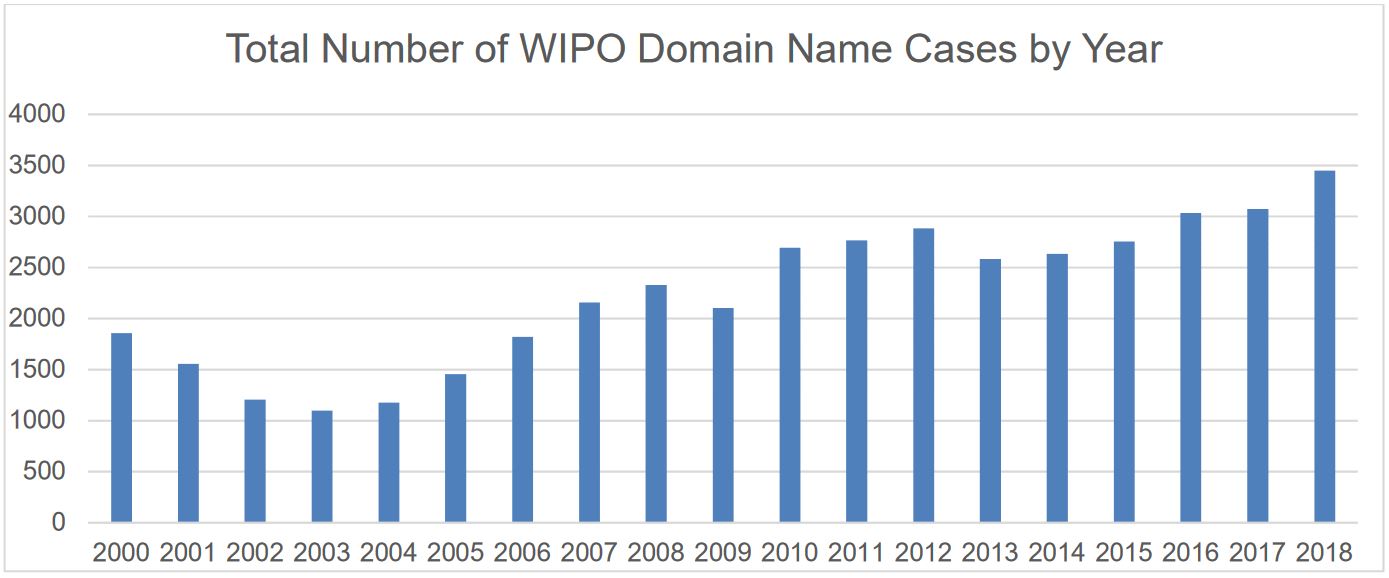
Cybersquatting: Increase of UDRP complaints filed with WIPO in 2018
Source: WIPO Statistics Database

However these disputes concerned 5655 domain names, a decrease comparing to 2017 which counted 6371 names.

The main gTLDs in the cases filed with WIPO are unsurprisingly, the .COM (far ahead with 72.88%), the .NET (4.62%), the .ORG (3.50%) and the .INFO (2.23%).

Regarding the disputes on the domain names registered in the new extensions, they represent nearly 13% of the disputes, mostly in .ONLINE, .LIFE and .APP domains.

And lastly, nearly 500 complaints regarding names registered in ccTLDs have been filed, nearly 15% of all the disputes administered by the WIPO in 2018.

The 3 main sectors of complainant activity are the sectors of banking and finance, biotechnology and pharmaceuticals, and Internet and IT.

Geographically, France is placed second with 553 cases filed with the WIPO, just behind the United States (976 complaints) and is one the most reactive countries on this subject.

Note that on all the UDRP cases filed in 2018, Nameshield ranks second in the filing world complaints with 343 cases filed and 66 represented customers**.

Our teams are of course at your disposal to inform you on the possibilities of contentious domain names recovery actions.


*Source: WIPO Statistics Database

**Source: Nameshield’s report on UDRP procedures, 2018

Brexit and .EU domain names: EURid’s action plan on hold

Brexit and .EU domain names: EURid’s action plan on hold
Image source : Tumisu via Pixabay

On the article dated from February 22, 2019, we discussed about the Brexit’s consequences on the .EU domain names and the publication of the action plan by EURid, the .EU registry, following two scenarios, in case of no deal or in case of a withdrawal agreement between the United Kingdom and the European Union.

In short, as a result of the Brexit, companies and individuals, holders of a .EU will no longer be able to renew or register names in .EU if they are not residing in the European Union.

In case of no deal, .EU domain names’ holders will have 2 months from March 30, 2019 to demonstrate their eligibility or to transfer their name to an eligible registrant (whose country code isn’t either GB/GI). All registrants who did not demonstrate their eligibility will be deemed ineligible and their domain names will be withdrawn.

In case there is a withdrawal agreement, this plan of actions will be implemented as of January 1, 2021.

Due to ongoing uncertainties over the United Kingdom’s withdrawal from the European Union, EURid announced on March 22, 2019, that this plan would be placed on hold while waiting for an official update from the European Commission.

To be continued.

The .UK soon available to all: .CO.UK’s holders, don’t miss the end of the priority period!

The .UK soon available to all: .CO.UK’s holders, don’t miss the end of the priority period!
Image source: 12019 via Pixabay

Remember, in June 2014, Nominet, the registry of .CO.UK, launched the opening of the .UK registrations. At the time of the extension’s launch, the registry applied a 5 years restriction during which the .UK registration rights were restricted to the holders of the corresponding names in .CO.UK, .ORG.UK, .ME.UK, .NET.UK, .LTD.UK or .PLC.UK.

The 1st of July 2019 will mark the end of the period when .UK extensions were blocked from registration if the .CO.UK was not already registered. The names will then be opened to all! If you are already a .CO.UK domain name’s holder, don’t hesitate to contact your Nameshield’s consultant before the end of the priority period to reserve your corresponding name in .UK and thus prevent a third party to do it on the general availability period.

The .DEV available to all

The .DEV available to all
Image source: mohamed_hassan via Pixabay

After the launches of the .APP and .PAGE, Google launched .DEV on January 16, its new extension dedicated to developers and technology, following the calendar below:

  • Sunrise period: from 2019/01/16 to 2019/02/19
  • EAP (Early Access Program): from 2019/02/19 to 2019/02/28
  • General availability: from 2019/02/28

Since February 28, 2019, the .DEV is in general availability and already has more than 64 000 domain names’ registrations according to Domain Name Wire.

To promote this new extension and for the Google I/O 2019 , its annual event for developers (which will be held on May 7-9, 2019 at the Shoreline Amphitheatre in Mountain View), Google proposes the free registration for 1 year of a .DEV domain name for all ticket booked. But the registrations resulting of this promotional campaign only represent a small part of the 64 000 .DEV domain names registered.

During the last months, Google itself has launched or relaunched many of its websites in .DEV: web.dev, opensource.dev, flutter.dev…

Other companies have also chosen to register their domain names in .DEV like Mozilla with mdn.dev, Salesforce with crm.dev and Level Access with accessibility.dev.

The HTTPS mandatory for all .DEV domain names

As mentioned in a previous article by Christophe GERARD, Nameshield’s Security Product Manager, as reminder, Google in its goal of a more secure Internet, makes HTTPS encryption mandatory for all its new extensions: .APP, .PAGE, .HOW, .DEV… (More details in this article).

Thus, .DEV extension is included on the HSTS pre-upload list, requiring HTTPS protocol on all .DEV domain names.

Therefore, in order to use a .DEV domain name, you will need to acquire a SSL certificate and deploy HTTPS.

From tools to platforms, programming languages to blogs, this extension will allow you to present your projects. Don’t hesitate to contact a Nameshield’s consultant for any questions regarding the conditions for the registration of your .DEV.

Attack on the domain name system: the priority is to protect your access

Cyberattack - DNS Hijacking - cyber espionage
Image source : Geralt via Pixabay

Last weekend, the media has widely communicated on the consequences of an unprecedented attack that targeted the domain names.

Indeed, during the night of 22-23 February ICANN reported the large-scale attacks on the domain names: it is DNS hijacking. These attacks consist in “replacing the authorized servers addresses” with “addresses of machines controlled by the attackers”, as explained by the organization, allowing the attackers to examine the data in order to find passwords, email addresses etc., even to completely capture the traffic towards their servers.

A wave of attacks that began in November 2018

Actually, this is not an attack but a wave of attacks that the domain names system has endured for several weeks now.

Since the end of November 2018, an attack has targeted Lebanon and the United Arab Emirates and affected .GOV domain names. In this attack, the cybercriminals have proceeded with DNS hijacking.

At the beginning of January 2019, the company FireEye reported in an article, a wave of DNS hijacking that has affected domain names belonging to government, telecommunications and internet infrastructure entities across the Middle East and North Africa, Europe and North America.

If the attackers were then not identified, the initial research suggested the attacks could be conducted by persons based in Iran.

Important fact regarding the attack of February 22: this time, it struck, sometimes successfully, important actors of the Internet.

What are these attacks?

The method used is the DNS hijacking deployed on a large scale. This is a malicious attack, also called DNS redirection. Its aim: overwrite the TCP/IP parameters of a computer in order to redirect it towards a fraudulent DNS server instead of the configured official DNS server. To do this, the attacker takes control of the targeted machine through different techniques to alter the DNS configurations.

The American government, among others, recently warned about these series of highly sophisticated attacks of which the aim would be to siphon a large volume of passwords. These attacks would target more specifically governments and private companies.

Between DNS hijacking and cyber espionage

According to Talos’ article of November 2018, the attackers behind these attacks would have collected emails and connection information (login credentials – passwords) by hijacking the DNS, so that the traffic of the emails and the VPN (Virtual Private Networking) of the targeted institutions would be redirected to a server controlled by the cybercriminals.

Once the connectors collected, other attacks can be launched for espionage purposes, like the Man-In-The-Middle.

Then how to effectively protect yourself?

You must be aware that if these attacks essentially aim the domain names system, we can never say it enough, the first entry point of your domain names portfolio for an attacker is your access to the management platform.

The first and utmost recommendation is to protect your access

For many years, Nameshield has developed securing measures for the access to the domain names management platform (IP filter, ACL, HTTPS) and in addition proposes the 2 factors authentication and the SSO.

If these complementary solutions are still not implemented, Nameshield strongly recommends to implement them, in particular the 2 factors authentication in order to fight against passwords thefts.

To implement the DNSSEC protocol

The implementation of DNSSEC, if it was more widely deployed, would prevent or at least lessen the impact of these attacks by limiting their consequences.

It’s becoming increasingly urgent that DNSSEC is adopted on a massive scale, for both resolvers and authoritative servers.

To protect your domain names

The implementation of a registry lock on your strategic names will prevent their fraudulent modifications.

Although no perfect solution exists today to fully protect the infrastructures from cyberattacks, it is the implementation of several preventive measures combined that will allow to reduce the vulnerabilities (so) easily exploited by the pirates.