How to account and value a domain name?

The domain name is an integral intangible asset©

The domain name has this unique particularity to be an intangible asset with four dimensions.

It is simultaneously:

  1. An IT object allowing to access services on the Internet by doing the link between the IP address (a suite of numbers) of a physical object [computer, server, smartphone…] and a literal name (role of the Domain Name Server or DNS);
  2. A communication tool allowing to establish its identity on the Internet and gain a digital territory;
  3. A legal element through a temporary contract with an Internet Registry;
  4. A financial asset, accountable as an intangible asset under certain conditions.

Today an essential key element to any dematerialized data flow exchange, the domain name became overtime a strategic intangible asset of great value regarding associated services (email, websites access).

Accounting principles applicable to domain names

The domain name is not to be considered as a simple technical tool, but as an intangible asset to write in the balance sheet of the companies and collectivities, if it allows to generate a lasting source of profit. In a decision of the French Council of State of December 7th, 2016 (ebay.fr case), the wise persons of the Palais-Royal thus remind that if the use of a domain name:

  • Represents a constant source of profits;
  • Has a sufficient sustainability (particularly if it can be regularly renewed);
  • Is likely to be transferred;

Then it is an intangible asset of the company and must follow the associated accounting and tax rules. As such, the domain names have to be accounted either at their creation cost, or at their acquisition value, or at their current value (market value) for the ones acquired free of charge.

Which financial valuation methods to use?

Inspired by the ISO 10668 standard regarding the monetary valuation of the brands, Nameshield has developed a reliable scientific corpus by financing the CIFRE thesis of Mr. Clement GENTY (2016-2019), covering the subject: Internet governance and global economy: proposal of a valuation model of a domain name’s value as intangible asset. It is in this context that three approaches regarding the monetary valuation of domain names have been studied:

  • A historical costs approach;
  • A market approach (on semantics);
  • A loss approach (replacement cost).

The market approach aims to measure the semantic value of a domain name by reference to the monetary transactions passed. To that end, Nameshield has developed a database of more than 1.4 million transactions passed (domain name, price, year). This approach allows to give a price value by comparable.

The strength of a domain names’ valuation method, scientific and practical

Supported by its regular work in the acquisition and/or sale of domain names for its clients’ companies and collectivities, Nameshield is able to propose an approach of monetary valuation of a domain name or a domain names’ portfolio, as part of the best current scientific practice.


.AU domain names soon available for registration

.AU domain names soon available for registration
Image source: kitkatty007 via Pixabay

Until now, Australian domain names were only available for registrations in second level extensions, in particular .COM.AU.

If the decision to open the .AU registration goes back to 2015, it took four years to set the rules!

It seems that starting October 1st, 2019, the holder of the existing .com.au domain name, for example forexample.com.au, will be able to apply for priority status to register the exact match of their existing name in .AU, forexample.au.

The detail of the priority allocation system are below:

  • 2 priority status (from 2019/10/01 to 2020/04/01)

–Category 1 : Third level domain names (com.au, net.au, org.au, asn.au, id.au, edu.au, qld.edu.au, nsw.edu.au, eq.edu.au, act.edu.au, vic.edu.au, sa.edu.au, wa.edu.au, nt.edu.au, catholic.edu.au, schools.nsw.edu.au, education.tas.edu.au, sa.au, wa.au, nt.au, qld.au, nsw.au, vic.au, tas.au and act.au) registered on February 4th 2018 at the latest will be assigned to priority category 1 for the registration of the same name in .AU.

–Category 2: Third level domain names registered after February 4th 2018 will be assigned to priority category 2 for the registration of the same name in .AU.

  • The date of the general availability is not announced yet.

The registry indicates that more information will be published in the next weeks, we will keep you informed.

The new .AU licensing rules might also come into effect at the fourth quarter of 2019 (for all the extensions: .au, .com.au, .net.au, .org.au, .asn.au, .id.au).

Lastly, we can note that the general availability will allow the registration to individuals/companies which respect the Australian registry’s conditions (local presence in Australia).

For any questions, Nameshield’s teams are at your disposal.

Voice.com domain name sold for $30 million

Voice.com domain name sold for $30 million
Voice.com website

Block.one (EOS), the startup behind the EOS cryptocurrency acquires the voice.com domain name for the amount of $30 million.

This is how the Chief Marketing Officer of MicroStrategy explains this acquiring at a high price: “Block.one has made a smart strategic decision in choosing Voice.com to be the internet domain name for its new social media platform. The word “voice” is simple and universally understood. It’s also ubiquitous ― as a search term […]. An ultra-premium domain name like Voice.com can help a company achieve instant brand recognition, ignite a business, and massively accelerate value creation”.

It places this sale in the top 5 of the biggest domain names’ sales:

Lasvegas.com $90 million in 2005.

CarInsurance.com $49.7 million in 2010.

Insurance.com $35.6 million in 2010.

PrivateJet.com $30.18 million in 2012.

Voice.com $30 million in 2019.

After having raised more than $4 billion through a fundraising in cryptocurrencies (ICO), the startup Block.one plans to use the domain name with the aim to compete with the social media platform Facebook.

The social media platform VOICE is opened since June, 1st 2019.

At a keynote, EOS’ CEO Brendan Blumer and Dan Larimer Block.one’s CTO, presented VOICE as an absolute alternative to everything that represents Facebook.

“Our content. Our data. Our attention. These are all incredibly valuable things. But right now, it’s the platform, not the user that reaps the reward. By design, they run by auctioning our information to advertisers, pocketing the profit, and flooding our feeds with hidden agendas dictated by the highest bidder. Voice changes that.”

In order to differentiate from Facebook, VOICE will function on the following basis:

  • VOICE will operate on EOS blockchain, which is upgrading to a faster version 2 for the occasion;
  • An anti-bot policy and other trolls will be implemented, without more details disclosed on the technology approach;
  • The blockchain will be public;
  • The arbiter of what must be seen or not, will not be the algorithm but the consensus;
  • Regarding security, a partnership with Yubico, makers of the Yubikey was announced. EOS seems to aim for an integration with WebAuthn, a standard for authentication without password recently approved by the W3C.

In other words, EOS wants to propose a model opposite to Facebook: the control by everyone of their personal data and their possible monetization.

Nameshield proposes a valuation model of a domain name’s value – CIFRE thesis of Clement Genty

Nameshield proposes a valuation model of a domain name’s value – CIFRE thesis of Clement Genty

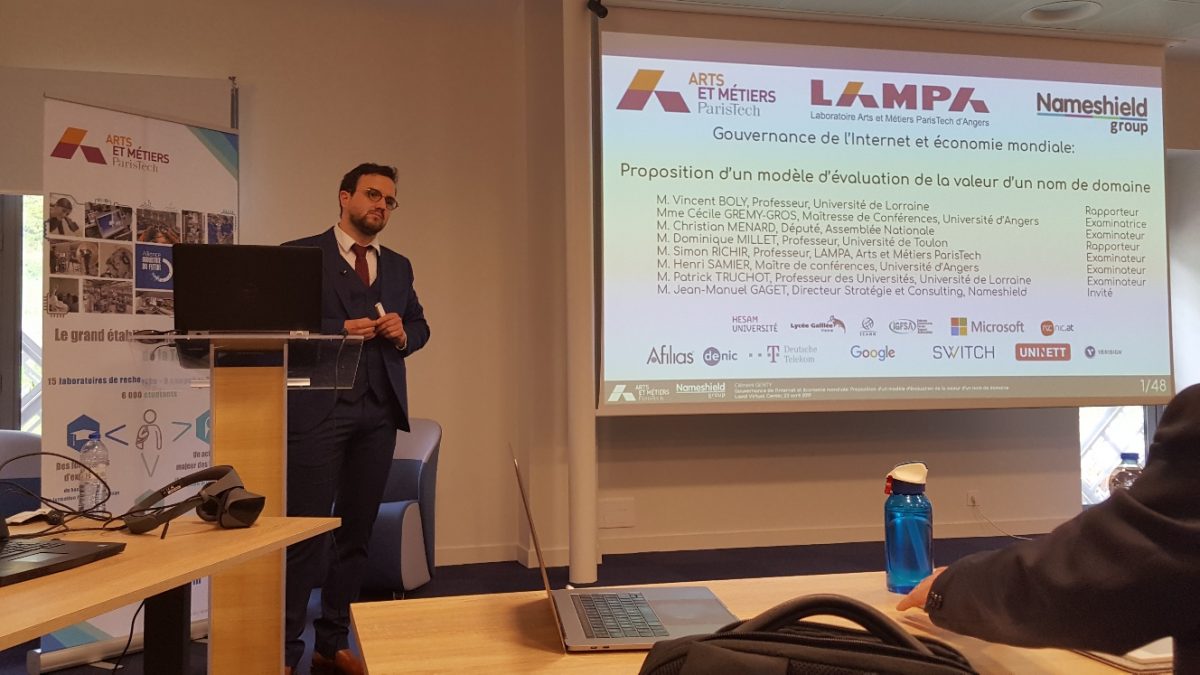
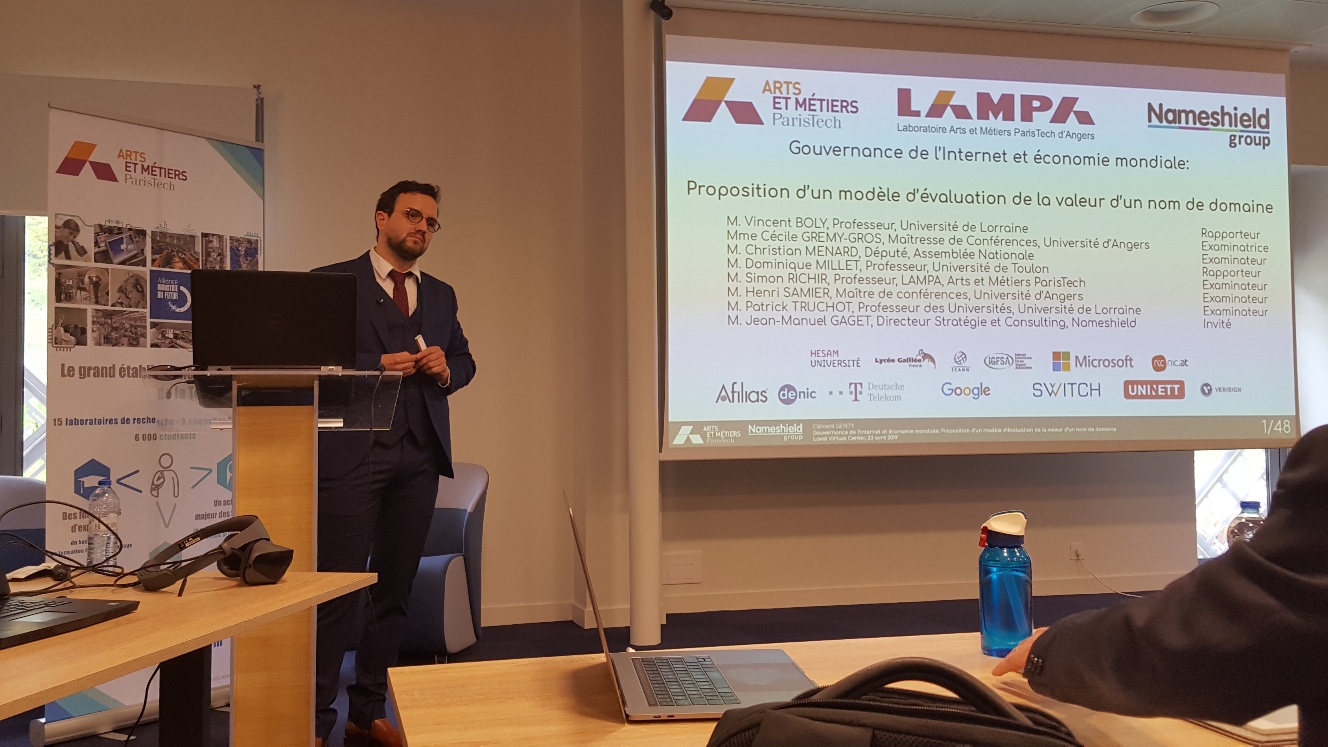
At a time of a growing awareness by companies that domain names have become strategic intangible assets, sometimes having a higher value than brands, Nameshield is happy to inform you that it has overseen and financed, during three years, the CIFRE thesis of Mr. Clement GENTY, who received his PhD, covering the subject: Internet governance and global economy: proposal of a valuation model of a domain name’s value as intangible asset.

Publicly defended on April, 23rd  2019, at Angers’ Laboratory of engineering, processes and innovation of the “Ecole Nationale Supérieure d’Arts et Métiers of Paris Tech”, first, the thesis compiles a state of the art and a historical overview of the domain name diffusion in the World since the Domain Name System’s creation (DNS) in 1983. It demonstrates the loss of the link between identification/trust by the abolition of the initial naming rules for the benefit of an unbridled and mercantile economic development from the registries.

The second part of the thesis is dedicated to an analysis of the technical and semantic parameters allowing to define the domain names’ average value.

The third part of the thesis presents a monetary valuation tool for domain names, developed by Nameshield as part of the research work, and based on a database of more than 1.4 million transactions passed.

This scientific research work, validated by this thesis, falls within a vast process initiated by Nameshield for many years in order to raise awareness of the value of the domain names’ strategic intangible assets, and to evaluate them. This work led by Jean-Manuel GAGET, Nameshield’s Strategy and Consulting Director, focuses in particular on:

  • A consulting activity regarding the optimization of a domain names’ portfolio management, through a naming and defense strategy adapted to the real issues;
  • A process of extra-financial rating and valuation of the capital domain name, integrated to the “Thesaurus Capital immatériel”, which measures intangible assets of all kinds, promoted by the “Institut de comptabilité de l’immatériel” (Intangible accounting Institute);
  • A method of domain names analysis and a domain names monetary valuation tool, scientifically validated today by this thesis.

The decision of the Council of State at the end of 2016, which focuses on the taxation applicable to the domain name ebay.fr has strengthened the obligation of the companies to monetarily valuate their domain names well, in order to account them as intangible assets under some conditions. As such, the tax experts are highly interested in the domain names’ issues in the constitution of the transfer price. This first world thesis on the economy of the domain names and their valuation will serve without a doubt as a useful material to the reflection of the financial world’s actors on this subject.

Nameshield proposes a valuation model of a domain name’s value – CIFRE thesis of Clement Genty

Status of ongoing projects after ICANN64

A month ago, ICANN held its first annual meeting with the Internet community in Kobe, Japan. At this summit, ICANN presented the major projects of the year and those of the coming years. Let’s look back at the main topics.

The implicitely constraint of the GDPR

While in May 2018, Europe adopted ambitious legislation to protect users’ personal data, ICANN imposed a regulatory framework on domain name players to bring the industry into line with the constraints of the GDPR.

In the absence of consensus, this framework was imposed when the GDPR came into force on May 25, 2018. It contains non-consensual provisions such as no longer publishing in the registry’s registration directory service, which currently operates via the Whois protocol, data that can be assimilated to personal data for contacts associated with domain names: registrant contacts, administrative contacts, technical contacts. Exit therefore the names, first names, postal addresses, telephone numbers and anonymization of email addresses or hidding via a contact form.

However, as provided for in the Bylaws, the rules governing the role and operation of ICANN, non-consensual rules may not be imposed beyond one year. ICANN therefore had the May 2019 deadline in mind throughout the Kobe meeting.

To build on this, last year ICANN initiated an expedited policy development process (ePDP) whose delicate mission was to develop consensus rules to replace the temporary provisions currently in place.

Shortly before ICANN64, this working group, in which Nameshield participates, submitted its proposals to the GNSO, the ICANN body that manages policy development for generic domain names. This report, which is currently open for comments, is expected to result in a final framework that will be submitted to the ICANN Board in early May for voting and promulgation.

The proposals outline a target date for implementation by 29 February 2020. ICANN has therefore focused its efforts on managing the transition period between May 2019 and this still distant deadline of February 2020. The prevailing approach is rather pragmatic as it consists in keeping the provisions currently in place such as the masking of personal data in the Whois until all the new provisions can be implemented by actors such as registrars and registries by the above-mentioned deadline.

Access to hidden data subject to tensions

Launched in 2012 during the last round of openings of new domain name extensions but quickly relegated to the boxes, the RDAP (Registration Data Access Protocol), an alternative to the aging Whois protocol, has resurfaced with the GDPR because of its modularity, which allows, unlike Whois, to filter access to certain data according to the user’s profile.

ICANN confirmed in Kobe that this protocol will be widely deployed by this summer. First, this protocol will coexist alongside the Whois protocol. Registrars will therefore provide access to domain name data through both protocols.

The stakeholders present at ICANN64 also learnt about the project submitted by a technical study group mandated by ICANN on the operational way envisaged through the RDAP protocol for access to hidden domain name data. It has been the subject of tensions because it is not the result of a consensual process and ICANN suggested it could play a central role in collecting all requests to validate their authorization, with authentication of requests being carried out upstream by agents accredited by data protection authorities. This topic is also part of the new mission of the Policy Development Working Group (ePDP) in the coming months. Things can therefore evolve on this subject in the future.

Status of ongoing projects after ICANN64
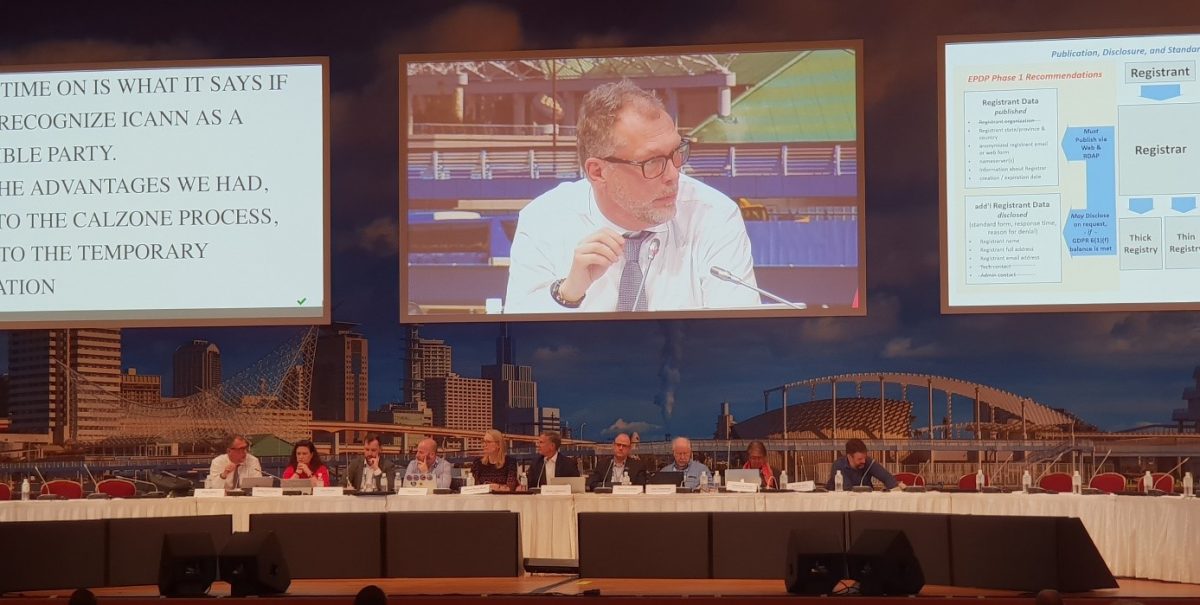
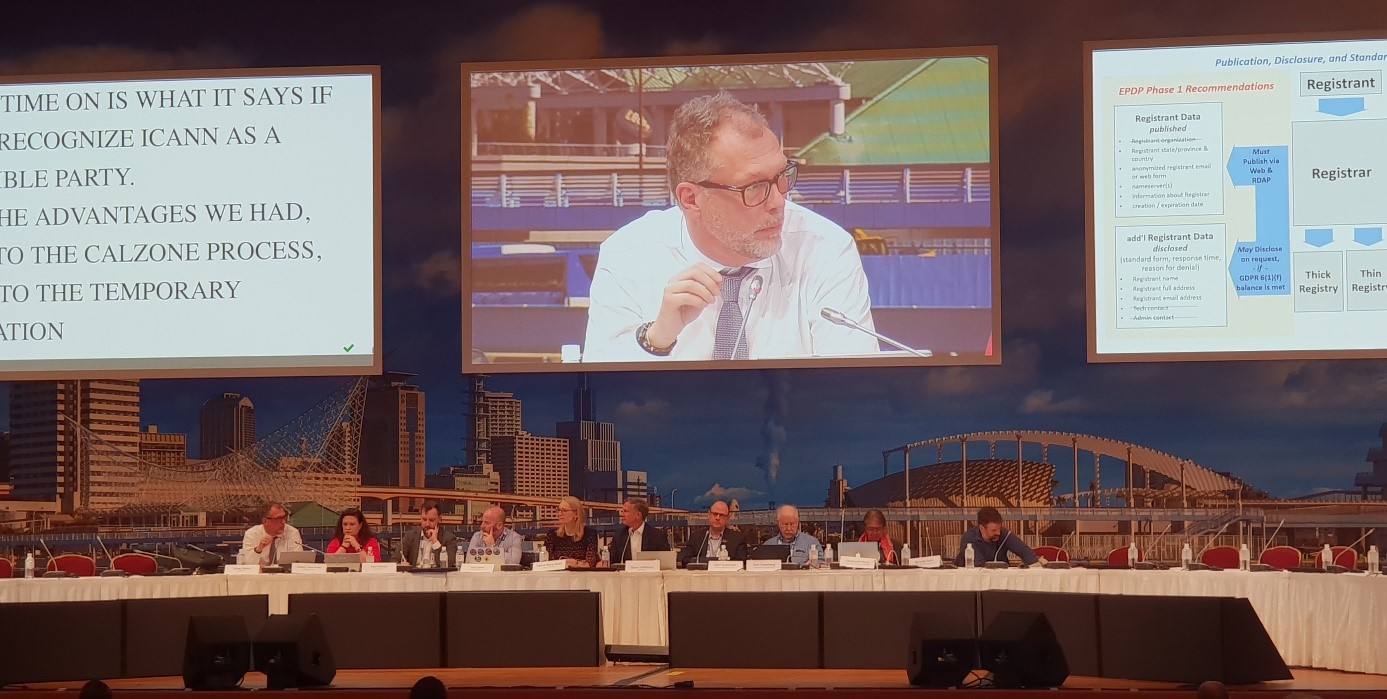
Goran Marby, ICANN CEO, speaking on the proposed functioning of access to hidden data for domain names through the future RDAP

A multi-year strategic plan

At ICANN64, ICANN also presented progress on the implementation of a strategic operating plan for the organization for the period 2021-2025.

The adoption of a five-year plan is new for this organization, which has always operated on an annual basis. This plan must determine the priorities for the coming years, which is also a novelty in a context where multiple projects have always been carried out simultaneously without any real prioritization.

We already know that DNS security is one of the major issues of the coming period. Among the priorities identified are the reinforced fight against malware and the increased security of the DNS, in particular through a faster deployment of DNSSEC.

For the next round of new domain names extensions openings also mentioned, ICANN has also indicated that it will take into account the lessons learned from the previous round. Among them, new extensions are ten times more targeted than historical generic extensions (like .COM,.NET,.ORG,.BIZ,.INFO) by malicious practices such as typosquatting and dotsquatting on which phishing and pharming practices proliferate.

Feel free to contact your Nameshield consultant, who is very knowledgeable on all these subjects.