

Cyberattacks, the companies more and more efficient

Cyber resilience- Cyberattacks, the companies more and more efficient
Image source : VISHNU_KV via pixabay

Last September, Accenture published the research “Gaining Ground On the Cyber Attacker 2018 State of Cyber Resilience” and highlighted the doubling of the cyberattacks number suffered by the companies (232 on average in 2018 versus 106 in 2017 at international level), but also the improvement of the companies’ ability to identify and counter these attacks.

The attacks number has more than doubled between 2017 and 2018…

This research deserves attention as it differentiates from many very alarmist reports. If everything is not perfect, in particular due to the ingenuity and increasing complexity of the attacks, the companies continue to improve their defense capacity, were able to strengthen their cyber resilience and stood efficient despite the threats. The companies are able to defend themselves better, particularly by detecting the attacks much earlier.

… But where a third of the attacks were successful in 2017, the part of successful attacks decreased to 1 on 8 (12,5%) in 2018.

A report that blows hot and cold

Security teams have made great progress but there is still more work to be done. Companies now prevent 87% of all targeted attacks, but are still facing two to three security breaches per month on average.

Companies might be cyber resilient in two to three years, but the pressure and the threats’ complexity increase every day. If 90% of the respondents expect the investment in cybersecurity to increase in the next 3 years, only 31% think that it will be sufficient.

The new technologies are essential, but the investments are lagging behind. If 83% of the respondents agreed that new technologies are essential, only two out of five are investing in AI, machine learning and automation technologies.

Confidence around cybersecurity measures remains high, but a more proactive approach of the cybersecurity is needed. If more than 80% of the respondents are confident in their capacity to monitor breaches, on the other hand 71% said that cyberattacks are still a bit of a black box, they do not know how or when they will affect their organization.

The board of directors and management are more engaged with cybersecurity. 27% of cybersecurity budgets are authorized by the board of directors and 32% by the CEO. The role and responsibilities of the CISO must improve towards more transversality in the company.

5 steps to cyber resilience

Accenture highlights five steps to optimize the companies’ defense and move towards the ultimate aim of cyber resilience in a world that continues to change towards new threats territories (artificial intelligence, omnipresence of the cloud, social networks, smartphones, internet of things) for more and more complex threats difficult to counter and a need becoming strategic: the data protection.

  • Build a strong foundation by identifying high value assets, in order to better protect them including from internal risks. It is necessary to ensure that controls are implemented throughout the value chain of the company.
  • Test the IT security by training cybersecurity teams to the best hackers’ techniques. The role plays staging an attack and defense team with training coaches can allow to bring out the improvement points.
  • Employ new technologies. For a company, it is recommended to invest in technologies able to automate cyber defense and in particular to use the new generation of identity management which relies on multi-factor authentication and the user behavior monitoring.
  • Be proactive and anticipate threats by developing a strategic team (“threat intelligence”) in charge of evolving an intelligent security operation center (SOC) relying on a collect and mass analysis of the data (“data-driven approach”).
  • Evolve the role of the CISO (Chief information security officer). The CISO is closer to professions, they find the right balance between security and risk taking and they communicate more and more with the executive management, which now holds 59% of the security budget versus 33% a year ago.

Conclusion

The Accenture study highlights a real growing awareness on cyber threats by companies, and the implementation of investment to better protect themselves. The race is now launched to tend to cyber resilience, between more and more organized attackers and more and more sophisticated defense system. See you at the end of the year to make an assessment of the forces involved.

Communication, governance and opening: what we can wish for 2019

Communication, governance and opening: what we can wish for 2019

As 2019 begins, we make three wishes corresponding to an eventful year.

1.A better awareness of the Internet governance.

The main project at the time of international relations, fake news and voluntary disconnection from the Internet: the Internet governance should be at the table of the diplomats, political decision makers and strategic decision makers. France, which shines in the embassies’ world, should be able to take part in the digital decisions. The appointment of Henri Verdier as Digital Ambassador is a good thing, hoping that his knowledge in the private sector will be an absolute strength in his projects for France. France should be interested in the functioning of ICANN, the authority of world regulation of the IP addresses and the domain names. ICANN is recently the subject of strong criticisms regarding potential insider trading. The American desire to entirely privatize ICANN by suppressing its links with NTIA needs everyone’s attention.

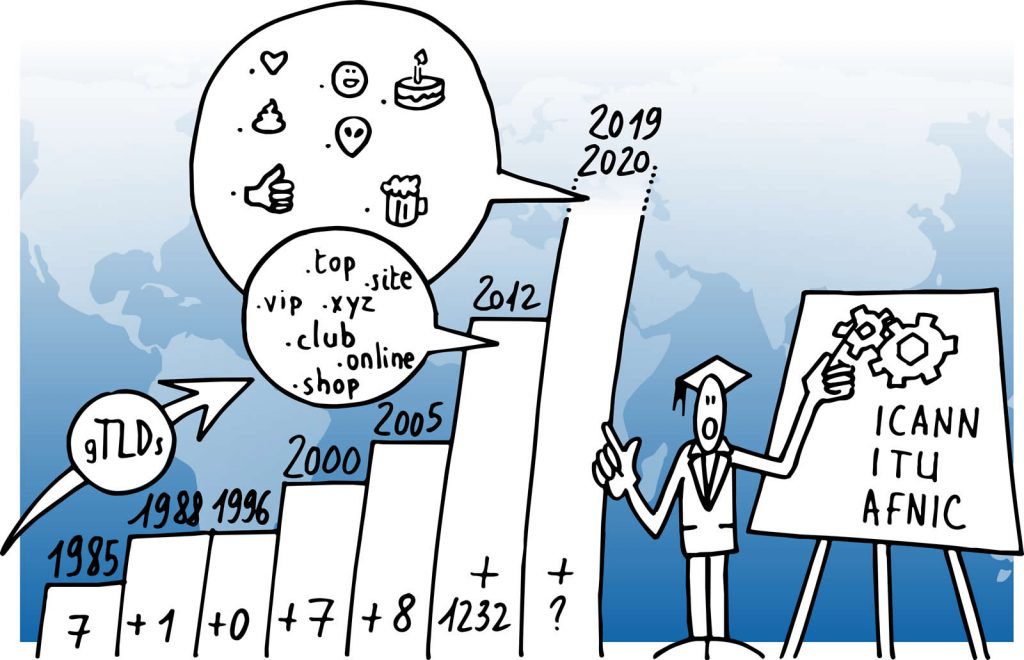
2. ICANN decided it: a new opening of the root will soon be done. What temporality? That is a mystery. In the meantime, and so as to prevent that the list of the abandoned extensions does not cease to develop, new uses of the new extensions, whether they are opened (.PARIS, .FOOTBALL, .ICU…) or closed (.MMA, .LECLERC, .BCG…) should be found. Today (and tomorrow) the brand protection through a TLD’s possession is a definite advantage in front of the large number of opened extensions.  A TLD’s possession can also allow the opening of the scope of possibilities, like .BEST will announce at Namescon at the end of the month (surprise!).

3. The third and last wish, to anticipate the new uses of domain names. While the progress curve of the domain names’ volume increases less than previously, the focus should be on the issue of communication on the Internet. It appears as necessary to propose the registration of all possible domain names one can imagine. This is the consortium Unicode, an American entity which decides which character can be integrated in the IT standards. Let’s follow the evolution of the integration of the characters integrated in the Unicode to identify the future domain names trends. The internationalized domain names were a real positive evolution for web users around the world, myself the first concerned, having an accented first name.

Thus it’s very likely that emojis and other special characters will become the stars of the upcoming extensions. Soon the .♥.

These three wishes are part of our work at this time.

For example, our participation in the updating of the methods regarding intangible assets’ financial and extra-financial valuation of the Thesaurus Capital Immatériel by the “Institut de comptabilité de l’immatériel” (Intangible accounting Institute), aims to answer to the need to acknowledge the domain names’ value by financial managers.

Domain names are the first assets held by web users. We are fully aware of the responsibility associated to their management, and our recent developments in terms of operational excellence (ISO 27100) are the new guarantors.

The DNS KSK-2010 security key revocation by ICANN, it’s this week!

Image source : TheDigitalArtist via Pixabay

After the first changing of the cryptographic key in last October, it is now, on January 11, that the old KSK key (Key Signing Key) of the root zone will be deactivated.

The process initiated in October 2018 to improve the security of the root zone, with the deployment of the Key Signing Key-2017, finds its achievement with the revoking of the root of the old key KSK-2010.

As indicated by Paul Hoffman, ICANN’s Principal Technologist, “The ICANN organization does not expect problems with the revocation. However, this is the first time a KSK in the Domain Name System (DNS) root has been revoked, so the ICANN org and the DNS technical community will be watching carefully for at least 48 hours after the publication of the revoked KSK-2010.”

To note, during the rollover on October, the negative impacts were extremely limited and it would seem that only two Internet services providers were impacted by interruptions during the process.

Of course, ICANN encourages solutions providers to no longer ship KSK-2010 in their products. ICANN should later publish a white paper about the full rollover process, including the lessons learned from this operation. ICANN communities will then be able to open discussions regarding upcoming rollovers that could happen.

The shutting down of Incels.me, the “involuntary single” website

The shutting down of Incels.me, the “involuntary single” website
Image source: geralt via Pixabay

As a result of the violation of the anti-abuse policy, the .me registry decided to suspend the Incels.me website for an indefinite period. For reminder, the website possesses a forum that regroups members claiming to be single despite themselves, or “incels”, and who exchange on their daily lives through this mean.

Disturbing comments, the source of the suspension

It is not without surprise that the administrators of the incels.me website saw their forum become inaccessible. The investigations done by the registry have allowed to discover hate speeches, threats of rape and even murder in the comments exchanged between the participants. The decision to shut down the website was promptly made on October 15th, 2018, due to the content that violated the anti-abuse policy. According to the registry, this measure was taken to force the Incels.me administrators to take down the inappropriate contents and to prevent hate speech from appearing on the forum again.

Incels.me website associated to attacks?

Last April, Toronto was the scene of a bloody attack, where a man murdered 10 persons by a vehicle-ramming attack. Before attacking, the man posted a message on social networks, where he declared himself “incel”. This is only after the investigation that the police discovered that the murderer was inspired by some violent contents from the forum of Incels.me. The link is quickly made between the individual and the content inciting hatred, but also rape, exchanged on the forum.

Incels.me financed by a Chinese giant with suspicious activities

The inquiries launched on the website allow to trace back to its main financier. Thanks to these investigations, we know today that the incels.me website is financially supported by a big Chinese entity that in parallel owns more than 54 000 other domain names. The investigators were shocked by the potential of illicit nature of this company’s activities, ZhuHai NaiSiNike Information Technology Co. Indeed, on the thousands of domain names registered, the major part is involved in websites hosting of prescription drugs’ illegal sale.

Despite the suppression requests of the abusive comments present on the incels.me forum, the Chinese company didn’t proceed to the removing. The website will thus remain suspended until the removing of the litigious contents.

DNS Belgium will now take offline fraudulent websites within 24 hours

DNS Belgium will now take offline fraudulent websites within 24 hours
Source of the picture: Kreutzfelder via Pixabay

In the context of the fight against insecurity on the web, DNS Belgium, the .BE registry, decided to intensify its action by cooperating with the FPS Economy [The FPS Economy, SMEs, Middle Classes and Energy is a Federal Public Service of Belgium which is responsible for contributing to the development, competitiveness and sustainability of the goods and services market in Belgium] in order to shut down fraudulent websites within 24 hours.

Philip Du Bois, general manager of DNS Belgium indicates: “This protocol will enable us to take even more targeted action, together with the FPS Economy, against possible abuses where .be domain names are involved. It underscores our ambition for a high quality and safe .be zone which serves as suitable environment for the further development of the Internet.”

The aim: to ensure consumers a completely safe Internet browsing on .BE websites.

This procedure will ensure a much higher reactivity. Indeed, until now, FPS Economy couldn’t request a blocking from the registry regarding the content, moreover fraudulent websites with correct identification data (at least of which the forgery couldn’t be proven), were untouchable. The blocking required a request from the Prosecution, i.e. a two weeks long procedure, which left plenty of time for the fraudulent website to create important damages to the consumers. Several hundreds of such websites per year were concerned!

From December, the 1st 2018, the protocol will then allow at the request of FPS Economy, the DNS Belgium registry to block .BE domain names which:

  • Are used for fraudulent websites
  • Host phishing websites

Of course, this procedure will be applied in the case of serious crimes.

The blocked domain name’s owner will have two weeks to react against the blocking. Without action of their part within 6 months, the blocked name will expire.

This still too rare initiative is to be welcomed in a context of the fierce fight against cybercriminality!