Status of ongoing projects after ICANN64

A month ago, ICANN held its first annual meeting with the Internet community in Kobe, Japan. At this summit, ICANN presented the major projects of the year and those of the coming years. Let’s look back at the main topics.

The implicitely constraint of the GDPR

While in May 2018, Europe adopted ambitious legislation to protect users’ personal data, ICANN imposed a regulatory framework on domain name players to bring the industry into line with the constraints of the GDPR.

In the absence of consensus, this framework was imposed when the GDPR came into force on May 25, 2018. It contains non-consensual provisions such as no longer publishing in the registry’s registration directory service, which currently operates via the Whois protocol, data that can be assimilated to personal data for contacts associated with domain names: registrant contacts, administrative contacts, technical contacts. Exit therefore the names, first names, postal addresses, telephone numbers and anonymization of email addresses or hidding via a contact form.

However, as provided for in the Bylaws, the rules governing the role and operation of ICANN, non-consensual rules may not be imposed beyond one year. ICANN therefore had the May 2019 deadline in mind throughout the Kobe meeting.

To build on this, last year ICANN initiated an expedited policy development process (ePDP) whose delicate mission was to develop consensus rules to replace the temporary provisions currently in place.

Shortly before ICANN64, this working group, in which Nameshield participates, submitted its proposals to the GNSO, the ICANN body that manages policy development for generic domain names. This report, which is currently open for comments, is expected to result in a final framework that will be submitted to the ICANN Board in early May for voting and promulgation.

The proposals outline a target date for implementation by 29 February 2020. ICANN has therefore focused its efforts on managing the transition period between May 2019 and this still distant deadline of February 2020. The prevailing approach is rather pragmatic as it consists in keeping the provisions currently in place such as the masking of personal data in the Whois until all the new provisions can be implemented by actors such as registrars and registries by the above-mentioned deadline.

Access to hidden data subject to tensions

Launched in 2012 during the last round of openings of new domain name extensions but quickly relegated to the boxes, the RDAP (Registration Data Access Protocol), an alternative to the aging Whois protocol, has resurfaced with the GDPR because of its modularity, which allows, unlike Whois, to filter access to certain data according to the user’s profile.

ICANN confirmed in Kobe that this protocol will be widely deployed by this summer. First, this protocol will coexist alongside the Whois protocol. Registrars will therefore provide access to domain name data through both protocols.

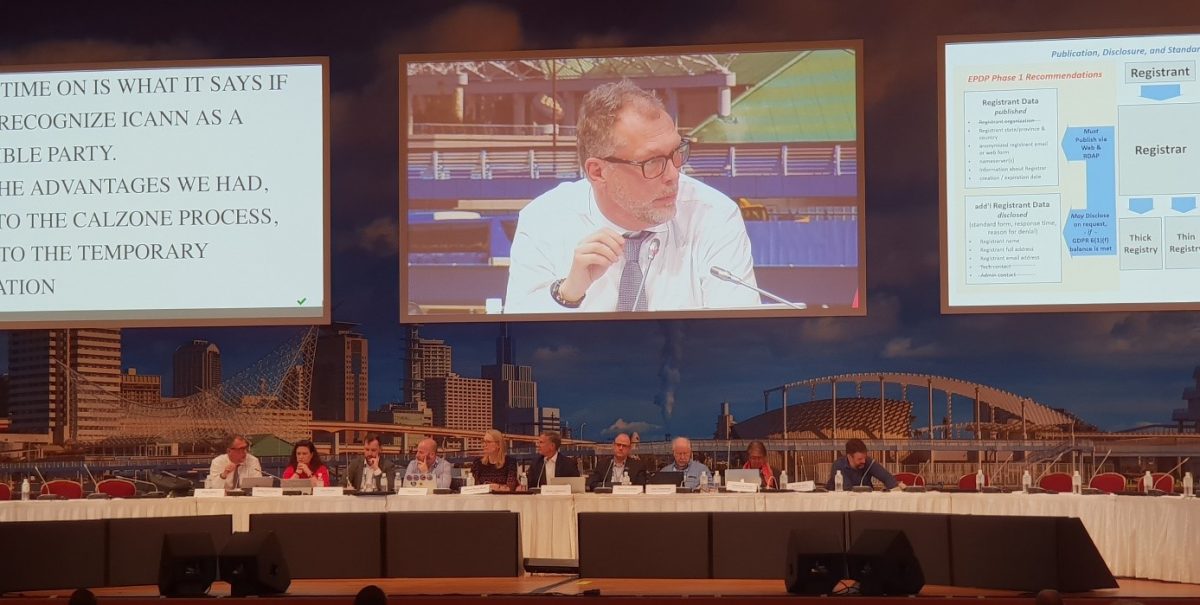
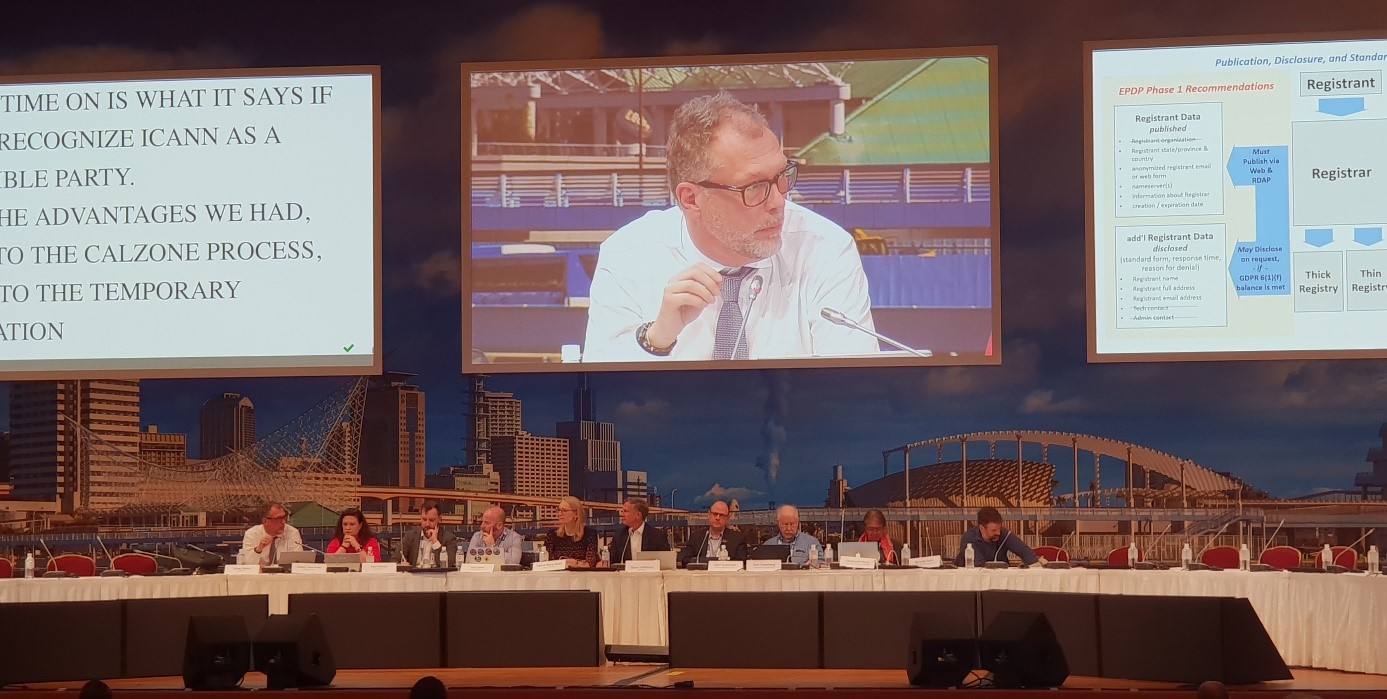
The stakeholders present at ICANN64 also learnt about the project submitted by a technical study group mandated by ICANN on the operational way envisaged through the RDAP protocol for access to hidden domain name data. It has been the subject of tensions because it is not the result of a consensual process and ICANN suggested it could play a central role in collecting all requests to validate their authorization, with authentication of requests being carried out upstream by agents accredited by data protection authorities. This topic is also part of the new mission of the Policy Development Working Group (ePDP) in the coming months. Things can therefore evolve on this subject in the future.
Status of ongoing projects after ICANN64
Goran Marby, ICANN CEO, speaking on the proposed functioning of access to hidden data for domain names through the future RDAP

A multi-year strategic plan

At ICANN64, ICANN also presented progress on the implementation of a strategic operating plan for the organization for the period 2021-2025.

The adoption of a five-year plan is new for this organization, which has always operated on an annual basis. This plan must determine the priorities for the coming years, which is also a novelty in a context where multiple projects have always been carried out simultaneously without any real prioritization.

We already know that DNS security is one of the major issues of the coming period. Among the priorities identified are the reinforced fight against malware and the increased security of the DNS, in particular through a faster deployment of DNSSEC.

For the next round of new domain names extensions openings also mentioned, ICANN has also indicated that it will take into account the lessons learned from the previous round. Among them, new extensions are ten times more targeted than historical generic extensions (like .COM,.NET,.ORG,.BIZ,.INFO) by malicious practices such as typosquatting and dotsquatting on which phishing and pharming practices proliferate.

Feel free to contact your Nameshield consultant, who is very knowledgeable on all these subjects.


15 websites proposing DDoS attacks closed by the FBI

15 websites proposing DDoS attacks closed by the FBI
Image source: typographyimages via Pixabay

In its last quarterly report, Nexusguard stated that after the FBI closed 15 websites providing cyberattacks services, a decrease of 85% of the DDoS attacks’ scale and 24% of big attacks were observed.

In the same way, these closings would lead to the decrease of 11% of the attacks’ volume comparing to the same period in 2018 and at an international level.

Indeed, it was in December 2018 that the FBI successfully shut down 15 websites proposing DDoS attacks services, called “booters” or “booters services” in the business.

To achieve their goals, these booters use IP stresser, which originally are tools allowing to test the server or the network’s resilience. The cybercriminals hijack these IP stresser and send through them a large volume of requests towards the servers until they are overloaded and unable to respond anymore.

The Nexusguard report also indicates that the 15 websites closed by the FBI would be the technical source of about 11% of the global DDoS attacks of various sizes since 2014. Of course, this decrease might only be temporary, the multiplication of bot networks being the real plague of our decade in terms of cybercriminality.

Cybersquatting: Increase of UDRP complaints filed with WIPO in 2018

Cybersquatting: Increase of UDRP complaints filed with WIPO in 2018
Image source: janjf93 via Pixabay

In the domain names’ world, the rules applied by many registries of “first come, first served” often lead to many cases of abusive registrations and of cybersquatting in particular. This is a practice that consists in taking a domain name by registering it, using or mentioning a trademark, a business name, a patronym or any name on which the applicant has any right, in order to make material or moral profit from its current or future notoriety.

In order to fight against these fraudulent actions and to assert their rights, brands’ owners can implement a targeted action to recuperate or suppress the cybersquatted domain name, called UDRP procedure (Uniform Domain Name Dispute Resolution Policy). This procedure is administered by an Arbitration Center like the one of the WIPO, the World Intellectual Property Organization.

According to the WIPO’s General Director, Francis Gurry: “Domain names involving fraud and phishing or counterfeit goods pose the most obvious threats, but all forms of cybersquatting affect consumers. WIPO’s UDRP caseload reflects the continuing need for vigilance on the part of trademark owners around the world.”

UDRP complaints filed with WIPO in 2018*

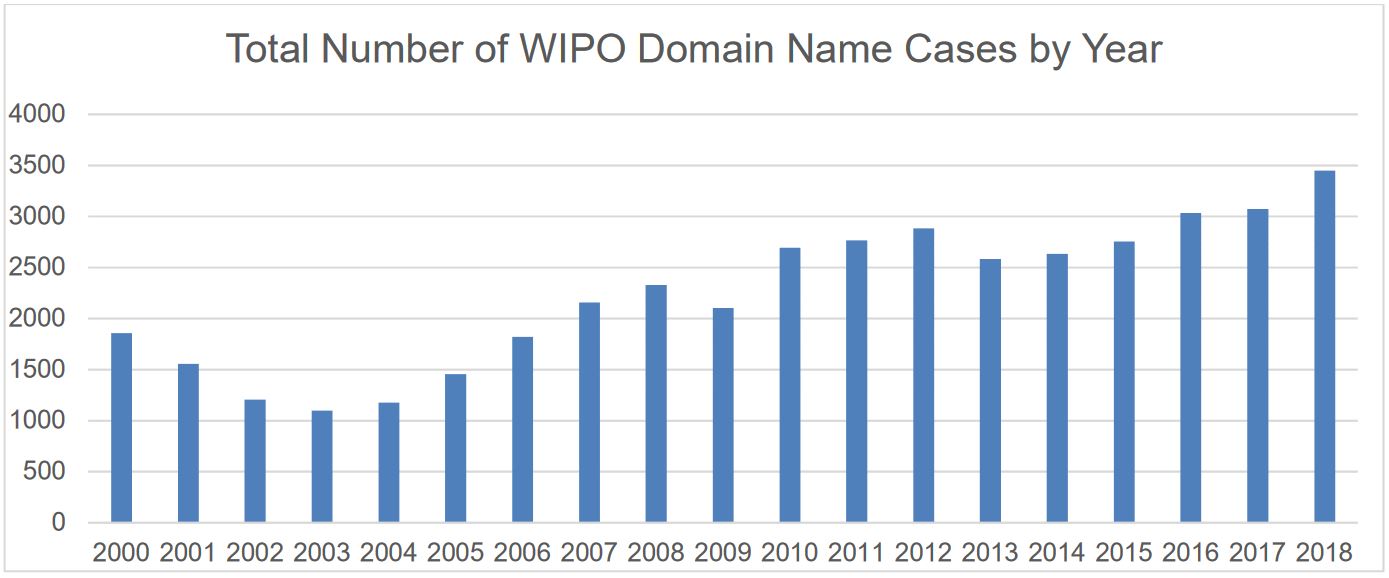
On March 15, 2019, the WIPO published its last annual report on domain names’ disputes.

In 2018, the WIPO’s Arbitration and Mediation Center received a record of 3447 UDRP cases filed by brands’ owners, i.e a rise of 12% compared to the previous year.

Cybersquatting: Increase of UDRP complaints filed with WIPO in 2018
Source: WIPO Statistics Database

However these disputes concerned 5655 domain names, a decrease comparing to 2017 which counted 6371 names.

The main gTLDs in the cases filed with WIPO are unsurprisingly, the .COM (far ahead with 72.88%), the .NET (4.62%), the .ORG (3.50%) and the .INFO (2.23%).

Regarding the disputes on the domain names registered in the new extensions, they represent nearly 13% of the disputes, mostly in .ONLINE, .LIFE and .APP domains.

And lastly, nearly 500 complaints regarding names registered in ccTLDs have been filed, nearly 15% of all the disputes administered by the WIPO in 2018.

The 3 main sectors of complainant activity are the sectors of banking and finance, biotechnology and pharmaceuticals, and Internet and IT.

Geographically, France is placed second with 553 cases filed with the WIPO, just behind the United States (976 complaints) and is one the most reactive countries on this subject.

Note that on all the UDRP cases filed in 2018, Nameshield ranks second in the filing world complaints with 343 cases filed and 66 represented customers**.

Our teams are of course at your disposal to inform you on the possibilities of contentious domain names recovery actions.


*Source: WIPO Statistics Database

**Source: Nameshield’s report on UDRP procedures, 2018

Brexit and .EU domain names: EURid’s action plan on hold

Brexit and .EU domain names: EURid’s action plan on hold
Image source : Tumisu via Pixabay

On the article dated from February 22, 2019, we discussed about the Brexit’s consequences on the .EU domain names and the publication of the action plan by EURid, the .EU registry, following two scenarios, in case of no deal or in case of a withdrawal agreement between the United Kingdom and the European Union.

In short, as a result of the Brexit, companies and individuals, holders of a .EU will no longer be able to renew or register names in .EU if they are not residing in the European Union.

In case of no deal, .EU domain names’ holders will have 2 months from March 30, 2019 to demonstrate their eligibility or to transfer their name to an eligible registrant (whose country code isn’t either GB/GI). All registrants who did not demonstrate their eligibility will be deemed ineligible and their domain names will be withdrawn.

In case there is a withdrawal agreement, this plan of actions will be implemented as of January 1, 2021.

Due to ongoing uncertainties over the United Kingdom’s withdrawal from the European Union, EURid announced on March 22, 2019, that this plan would be placed on hold while waiting for an official update from the European Commission.

To be continued.

The .UK soon available to all: .CO.UK’s holders, don’t miss the end of the priority period!

The .UK soon available to all: .CO.UK’s holders, don’t miss the end of the priority period!
Image source: 12019 via Pixabay

Remember, in June 2014, Nominet, the registry of .CO.UK, launched the opening of the .UK registrations. At the time of the extension’s launch, the registry applied a 5 years restriction during which the .UK registration rights were restricted to the holders of the corresponding names in .CO.UK, .ORG.UK, .ME.UK, .NET.UK, .LTD.UK or .PLC.UK.

The 1st of July 2019 will mark the end of the period when .UK extensions were blocked from registration if the .CO.UK was not already registered. The names will then be opened to all! If you are already a .CO.UK domain name’s holder, don’t hesitate to contact your Nameshield’s consultant before the end of the priority period to reserve your corresponding name in .UK and thus prevent a third party to do it on the general availability period.