
DNS on Blockchain: the next evolution of domain names?

DNS on Blockchain - Nameshield
Image source: TheDigitalArtist via Pixabay

Summary

The DNS, the Domain Name System, is a service at the heart of how the Internet operates. It is fundamental to the functioning of many services such as websites, mail servers, VoIP telephony and many others.

For more than 30 years, many extensions and functionalities have been added to the DNS, which technically translates into an increase in the complexity of the infrastructure.

The Blockchain technology could be a considerable evolution for DNS, bringing several advantages and new functionalities.

—

The DNS, a fundamental service

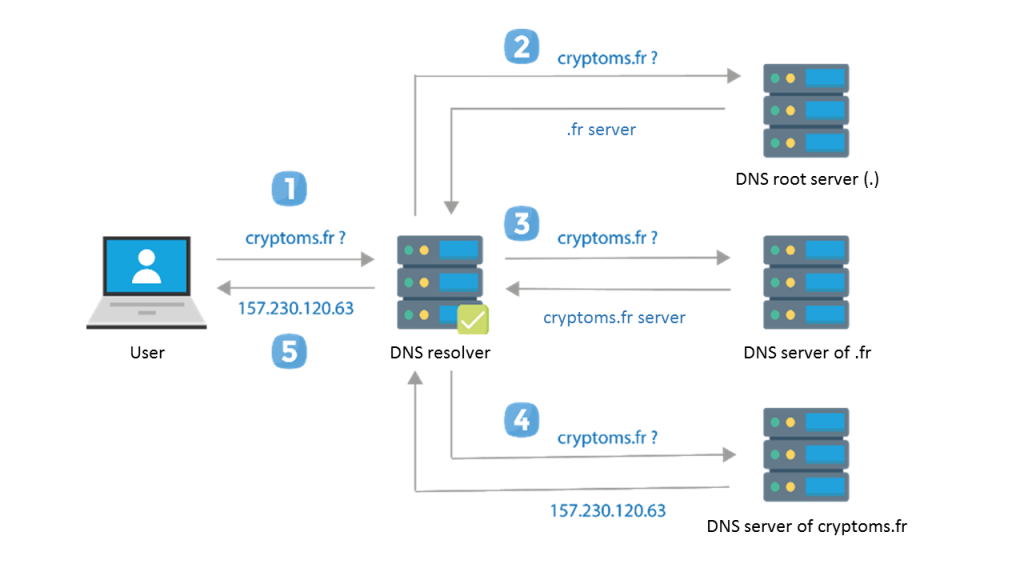
The DNS, the Domain Name System, is a service at the heart of how the Internet operates. It functions as a public directory that associates domain names with resources on the Internet, such as IP addresses. When a user enters an address in his browser, a DNS server translates this humanly understandable address into an IP address that is understandable by computers and networks. This is DNS resolution.
DNS - DNS on Blockchain - Nameshield

This system, created in 1983, is fundamental to the functioning of many services such as websites, mail servers, VoIP telephony and many others. It is constantly evolving to meet ever-increasing needs in terms of functionality and security. Indeed, the DNS must guarantee:

  • Availability: an unavailability of the DNS service would result in a service disruption.
  • Integrity: the data present on the DNS (associated with a domain name) must not be corrupted.
  • Confidentiality: to protect the privacy of users, the DNS implements various solutions that increase the confidentiality of DNS requests. If the requests are not confidential, it is possible to analyze users’ browsing information.

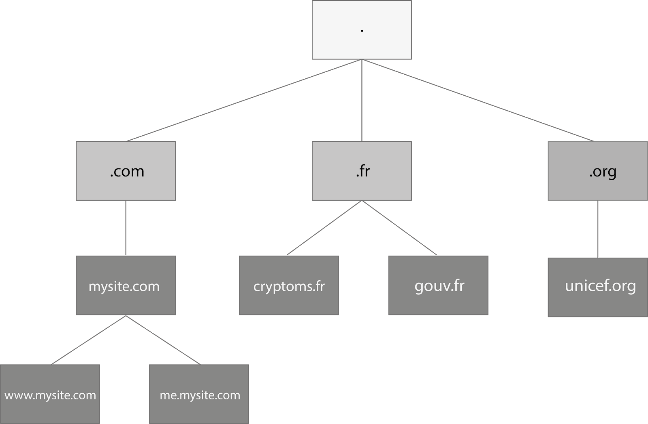
The domain name system is based on a centralized model of trust. It is distributed throughout the world and managed by different actors in a hierarchical manner, in several levels; a root level, a first level where extensions are managed by registries, then a second level managed by registrars. The whole thing is orchestrated by ICANN, the Internet’s regulatory authority.
Domain names - DNS on Blockchain - Nameshield

For more than 30 years, many extensions and functionalities have been added to the DNS, which technically translates into an increase in the complexity of the infrastructure.

Blockchain technology could be a considerable evolution for DNS, bringing several advantages and new functionalities.

Blockchain and decentralized registry

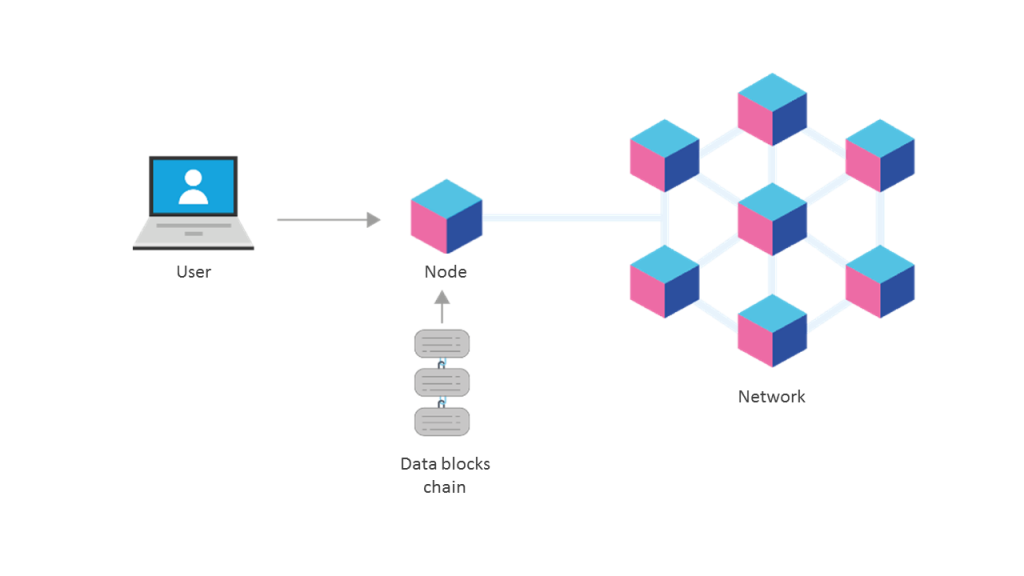
A Blockchain is a data structure accessible to all and distributed over a decentralized network; the data is replicated on each node of the network, there is no central authority. Everyone has the possibility to read its contents, add data and even join the network. The concept was first implemented in 2009 with Bitcoin, but today there are many different Blockchain technologies, each with their own properties.

The data is entered on a Blockchain via transactions. The transactions are grouped into blocks, each block is then validated by the network and then brought together. Thus, a Blockchain contains the history of all the transactions carried out since its creation.

The validation rules are written in the Blockchain protocol, which each member of the network respects. To ensure compliance with its rules, the Blockchain protocols are based on consensus algorithms, the best known being the Proof of Work. These algorithms guarantee the integrity, immutability and security of the data on the Blockchain.
Blockchain - DNS on Blockchain - Nameshield

The Blockchain technology meets several DNS needs:

  • Availability: a decentralized, peer-to-peer network cannot be stopped. It could replace or complement Anycast infrastructures. 
  • Integrity: the consensus protocol of a Blockchain guarantees, by nature, the integrity of the data. Furthermore, the data cannot be modified. These properties would eliminate the need for DNSSEC and its famous key renewal ceremony.
  • Confidentiality: Requests made to read the Blockchain data can be encapsulated in an HTTPS channel in the same way as the DNS over HTTPS (DoH) protocol. There are few DoH resolvers today, so traffic is centralized around a limited number of actors. The use of a Blockchain would offer the possibility of querying any node on the network, thus limiting centralization and SPF (single point of failure).

The data included in the DNS zone files, i.e. the domain name configurations, could therefore be distributed on a Blockchain. Each player (registries, registrars) could directly interact with this Blockchain to manage the domain names. This is the idea of the DNS on Blockchain.

New needs

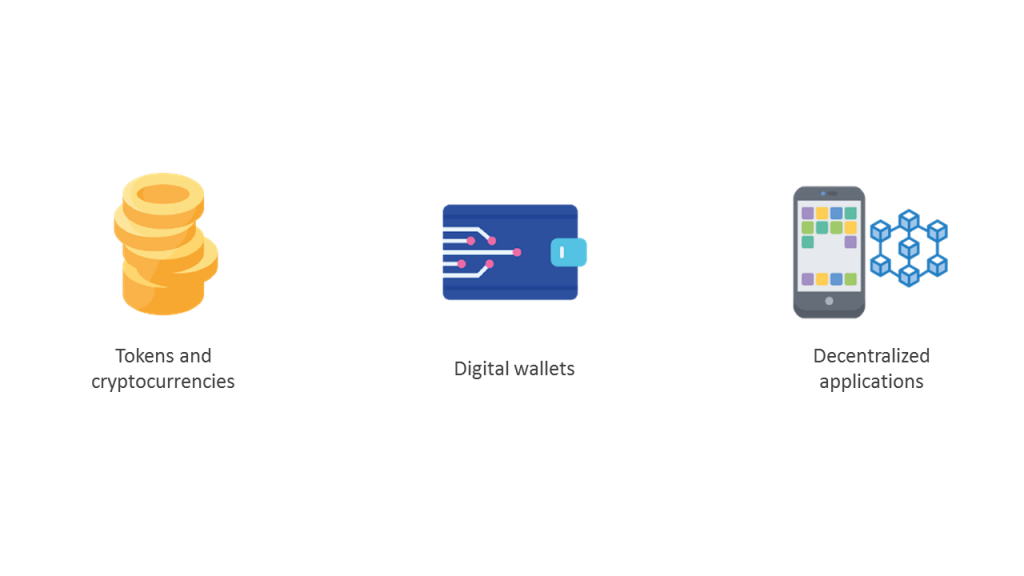
In recent years, with the emergence of Blockchain technologies, new means of values exchange have developed, particularly with tokenization, crypto-assets and decentralized applications (dapps); we talk about Web 3.0, or the Internet of Value.
Values exchange - DNS on Blockchain - Nameshield

Digital wallets and decentralized applications work with identifiers that are difficult to read, e.g. 0x483add28edbd9f83fb5db0289c7ed48c83f55982 for a wallet address.

Being able to associate this type of address with domain names, within a universal naming system, could be of real interest for tomorrow’s Web applications. It would be possible to have a wallet of crypto-assets or a decentralized application configured directly behind a domain name. This could also be useful for the digital identity of companies and their brands.

DNS on Blockchain, today

Many naming system projects on Blockchain are currently under development, each with an implementation of its own.

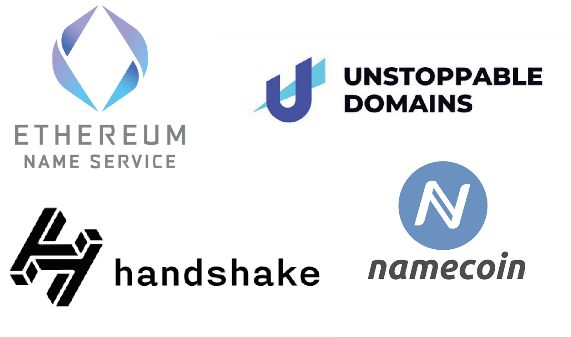
Some applications propose new domain names extensions (TLDs), such as .bit, .zil, .crypto, .eth, etc. This is particularly the case for Namecoin and UnstoppableDomains. These systems are completely independent of the traditional DNS and ICANN. Registration is managed directly by users, and names resolution is generally done through a browser extension. The Opera browser has recently natively integrated the resolution of these domain names.

These applications are functional and the names registration is not controlled. There are therefore many cases of cybersquatting. Users register names in the hope of reselling them and making a profit. This obviously poses a problem for trademark owners, and will certainly prevent the adoption of these solutions by companies.
DNS on Blockchain - Nameshield

Other projects propose complementary solutions to DNS. In particular, Ethereum Name Service (ENS) offers a names system on Blockchain that integrates with the traditional DNS. If you are the holder of a domain name and can prove it with a DNSSEC registration, you can then register this same name on the Blockchain service. This allows you to combine the advantages of traditional DNS and DNS on Blockchain.

The .kred, .xyz and .luxe extensions already support this integration on Blockchain, and ENS plans to propose it for all DNSSEC-compatible extensions. This project is quite promising, Ethereum Name Service has recently joined the DNS-OARC (DNS Operations, Analysis, and Research Center).

The Handshake project proposes a naming protocol to manage the root level of the DNS, and provide an alternative to certification authorities. It challenges the trust and governance model of the DNS to experiment with a more decentralized, secure and resilient system based on validation of DNS zones by participants in the network.

Conclusion

The DNS on Blockchain could be a considerable evolution of the DNS; it would bring several advantages and new functionalities thanks to the Blockchain technology, which would benefit the development of the decentralized web.

Today, however, there are still no technologies and applications on which there is unanimous agreement, even though many projects and PoC are under development. They are not yet mature enough to be used on a large scale. Improvements in terms of scalability, security and usability need to be made.

The collaboration of the Internet players (ICANN, DNS-OARC, registries) seems essential for a technology to reach consensus and be adopted, in particular to set common rules. This is a subject to be followed closely over the next few years.

Are you interested in blockchain and crypto-assets topics? Don’t hesitate to consult the website of our collaborator Steve Despres: https://cryptoms.fr/


Companies’ cybersecurity – 5th edition of CESIN’s annual barometer

Companies’ cybersecurity - CESIN barometer - Blog Nameshield
Image source: TheDigitalArtist via Pixabay

Every year, the Club of Experts in Information and Digital Security (CESIN) publishes its barometer of companies’ cybersecurity in order to better understand the perception and concrete reality of cybersecurity and its issues within CESIN member companies.

Last January, CESIN unveiled the results of its OpinionWay survey, carried out from the 2nd of December 2019 to the 7th of January 2020 among its 253 members, Chief Information Security Officer (CISO) of major French groups.

Cyberattacks: Fewer companies affected but still heavily impacted

First of all, the study highlights a positive figure: the decline in the number of companies that suffered at least one cyberattack in 2019, i.e. 65% of the companies surveyed compared to 80% in 2018 (note, however, that this difference in results is nuanced by the addition of the definition of cyberattack in the survey conducted in January 2020).

On the other hand, the impact of these cyberattacks remains significant since 57% of these attacks have consequences on business such as disruption of production (27%), website unavailability (17%) and revenue loss (9%).

The targeted companies were the targets of 4 types of cyberattacks on average in 12 months. Among the attacks vectors, phishing remains the most frequent attack with 79% of companies affected in 2019, followed by the scam on the President (47%), the exploitation of a vulnerability (43%) and fraudulent login attempts (40%).

The main consequences of these attacks are identity theft (35%), malware infection (34%), personal data theft (26%), ransomware infection (25%) and denial of service (19%).

Cloud, IoT and AI, issues of concern

With the digital transformation, the use of the Cloud is important within companies: 89% of companies surveyed store their data in a Cloud, including 55% in public Clouds.

A massive use of the Cloud which still represents a high risk due to a lack of control over the hosting provider’s subcontracting chain (for 50% of CISOs), the difficulty of conducting audits (46%) and the lack of control over the use of the Cloud by employees (46%). For 91% of respondents, the tools implemented by Cloud hosting providers are not sufficient to secure the data stored, and specific additional tools or measures are necessary.

Connected objects are also a growing concern, increasing the attack surface and creating new types of threats. The CISOs surveyed are concerned about the security breaches present in this equipment (43%) and the uncertainty in the assessment of potential risks (28%).

The study also shows that the embedded AI at the heart of cybersecurity solutions has yet to prove its worth since 53% of CISOs do not trust it.

An awareness of cyber-risks

To prevent the risk of attacks, companies implement an average of a dozen protection solutions, in addition to antivirus and firewalls. Among them, the mail security gateway (85%), the VPN/SSL gateway (85%), proxy and URL filtering (83%), and multi-factor authentication. The latter, adopted by 72% of companies, has increased by 13% compared to 2018.

More aware of cyber risks, 91% of the companies surveyed are implementing a cyber-resilience program in parallel with protection solutions or are considering doing so, that’s 12 points higher than last year.

Awareness of cyber risks is also reflected in the steady increase over the last three years in the number of companies having subscribed to cyber-insurance (60%).

Despite this, only 4 out of 10 companies say they are prepared in case of a large-scale cyberattack.

Employees Awareness

In addition to the external threat, for 43% of companies, employees’ negligence is the most common cyber risk.

Shadow IT, i.e. the deployment and use of applications and services beyond the control of IT teams, is mentioned by 98% of the CISOs surveyed and remains a significant threat to be dealt with.

Yet even though they are aware of cyber risks (according to 74% of respondents), only half of employees comply with the recommendations, according to CISOs.

Issues for the future of cybersecurity

Governance is the first issue mentioned by CISOs (70%) for the future of cybersecurity, followed by users’ training and awareness raising on cybersecurity issues (57%).

Increasing the budget is another major issue for 50% of respondents. The proportion of the IT budget allocated to cybersecurity has increased in companies compared to last year. 62% of them plan to increase it further in the next 12 months and 83% want to acquire new technical solutions.

In terms of human resources, one out of two companies (51%) would like to increase the number of staff dedicated to cybersecurity, but 90% face a shortage of Information Systems Security profiles, leading to recruitment difficulties.

COVID19.com – The domain name registered by a third party redirects to the website of the World Health Organization (WHO)

COVID19 domain name
Image source: geralt via Pixabay

“Domainers” are always a step ahead when it comes to taking advantage of a good or bad situation. For example, some will anticipate elections by registering the names of political figures, others by taking advantage of a sport or cultural event. Consequently, regarding domain names, there will be opportunities for speculative registrations.

In the case of “COVID19.com“, it seems clear that at the time of this domain name registration on February 11, 2020, the holder obviously wants to speculate on the “COVID 19” virus, a term that can generate multiple requests in any language. The name is available for sale for $10,000 USD.

However, instead of simply redirecting the domain name to commercial links, the holder chose to redirect this strategic name to the World Health Organization (WHO) website. Is this a citizen’s initiative? Unlikely, because given the current context, using such a name to make a direct profit through commercial links could lead to a violation of the Registrar’s registration conditions.

If the holder does not immediately benefit from this domain name, he will at least have the merit to draw our attention to him for the time of an article.

.ZA websites will have to propose a link towards the COVID-19 official website implemented by the government

South Africa - .ZA domain names - dot ZA
Image source: 12019 via Pixabay

Since last Thursday, the South African government has imposed to all websites using domain names in .ZA to propose a link that redirects towards the official Covid-19 information website implemented by the government:  www.sacoronavirus.co.za

This new rule applies to all .ZA websites, regardless of their content.

The two other extensions managed by ZADNA registry, JOBURG and .CAPETOWN are also affected by this rule.

In the same logic, the registry also invites Internet services providers to block any websites which spread fake news.

Lastly, it is interesting to note that the government’s COVID information website is not www.coronavirus.co.za but www.sacoronavirus.co.za. This is because the domain name www.coronavirus.co.za has been registered by a domainer who proposes on his website to resell the name in question.

Like all crisis or news, COVID-19 led to a massive registration of domain names containing the associated terms, some unscrupulous players seeking to take advantage of the situation.

Unsurprisingly, during this unprecedented and complicated period, there has been a high increase in the number of cybercriminal attacks of all kinds.

Let’s Encrypt, do not confuse confidentiality and security

Let’s Encrypt was recently the subject of discussions in the small world of TLS certificates, by suddenly revoking 3 048 289 certificates which should not have been issued. A bug in its validation software prevented CAA registrations controls, and the certificates in question should not have been initially issued. These significant disruptions resulted from this mass revocation, but it is difficult to complain about a free service.

I am often asked what I think of Let’s Encrypt, and I always have this same answer: Let’s Encrypt has done a lot to encrypt the web, but is undermining the security of the web. Encryption allows to ensure confidentiality (no one can spy on) and integrity (no one can modify) of exchanges. But encryption alone is not enough if I do not have any guarantee of the identity of the one I am exchanging with (legitimate or fraudulent?)… And that is the whole problem.

Let's Encrypt - SSL TLS certificates - Nameshield

In 2015, the Let’s Encrypt initiative supported by leading players of the Internet (EFF, Mozilla, Cisco, Akamaï…) was created with the purpose of massively and freely spreading SSL certificates to the whole world. More than five years later, the organization secures 190 million websites and has just announced that it has issued a billion certificates. The milestone was reached on February 27, 2020. This is undoubtedly a great performance.

96% of the web encrypted in January 2020

In 2015, less than half of the web traffic was encrypted, to reach 96% in January 2020. Of course, Let’s Encrypt is not the only player responsible for this rise. Edward Snowden launched the first alert, Google has largely stepped into the breach, between referencing policy and changes in web security indicators. But by providing to all, free certificates based on a largely automated system, Let’s Encrypt has democratized encryption… and put the concept of identity into oblivion.

No identity, no security

Let's Encrypt - SSL TLS certificates - Nameshield

Let’s Encrypt’s credo is simplicity, to “simplify to the extreme HTTPS deployment and put an end to its horribly complex bureaucracy” (says EFF in the launch campaign). The horribly complex bureaucracy has however a meaning: high authentication, which guarantees the identity of the certificate’s holder. Maybe not the absolute guarantee of legitimacy, not a guarantee of content either, but the guarantee of a registered company, legitimately owner of the concerned domain name and with a certificate validated according to a drastic procedure.

Let’s encrypt merely verifies the domain name’s control (DV, Domain Validation). One only has to click on a link in an email or to fill in a TXT record on the domain name’s DNS zone. Yet domain names registration in most TLDs is purely declarative. It is quite easy to register a domain name, to request a certificate from Let’s Encrypt and to publish a website in HTTPS://.

The results?

In five years, all phishing and fraudulent websites have switched to HTTPS://. Since 2016, Vincent Lynch alerted on this problem, 15 270 certificates with the term “Paypal” had been issued by Let’s Encrypt, 14 766 of these certificates were fraudulent.

The market has been brought down in terms of authentication level. Let’s Encrypt is far from being the only one responsible, Google and Mozilla, with their 70% of market shares, have largely supported the initiative, the big Cloud hosting providers followed, as well as the Certification Authorities, challenged on the prices. Today we have a secure web with 77% (November 2019) of certificates whose proprietary’s legitimacy is not verified.

High authentication changes the game

The web has become encrypted by default. Does that make it more secure? Nothing is certain. The web user educated for twenty years to check the presence of the padlock in the address bar, trusts a web where all the fraudulent websites display the security padlock. Today, Internet is confidential but that does not make it safe.

It is urgent to return to high authentication. High authentication ensures a set of compulsory, drastic and controlled steps in order to obtain certificates. The procedures are enacted by CA/B Forum, regularly strengthened, and followed by audit from Certification Authorities.

23% of the certificates are still issued on the basis of high authentication, mostly in the corporate world, where CISO are pushing to preserve it. We all have to rely on them and support initiatives supporting OV (Organization Validation) and EV (Extended Validation) certificates, especially EV to guarantee the identity of the websites visited by web users. While identity on the Internet seems to have been somewhat forgotten for some time in favor of confidentiality, it is likely to come back to the spotlight again soon, driven in particular by web users and the need of personal data protection.