
Soon a maximum duration of one year for SSL certificates?

Soon a maximum duration of one year for SSL/TLS certificates?

What is happening?

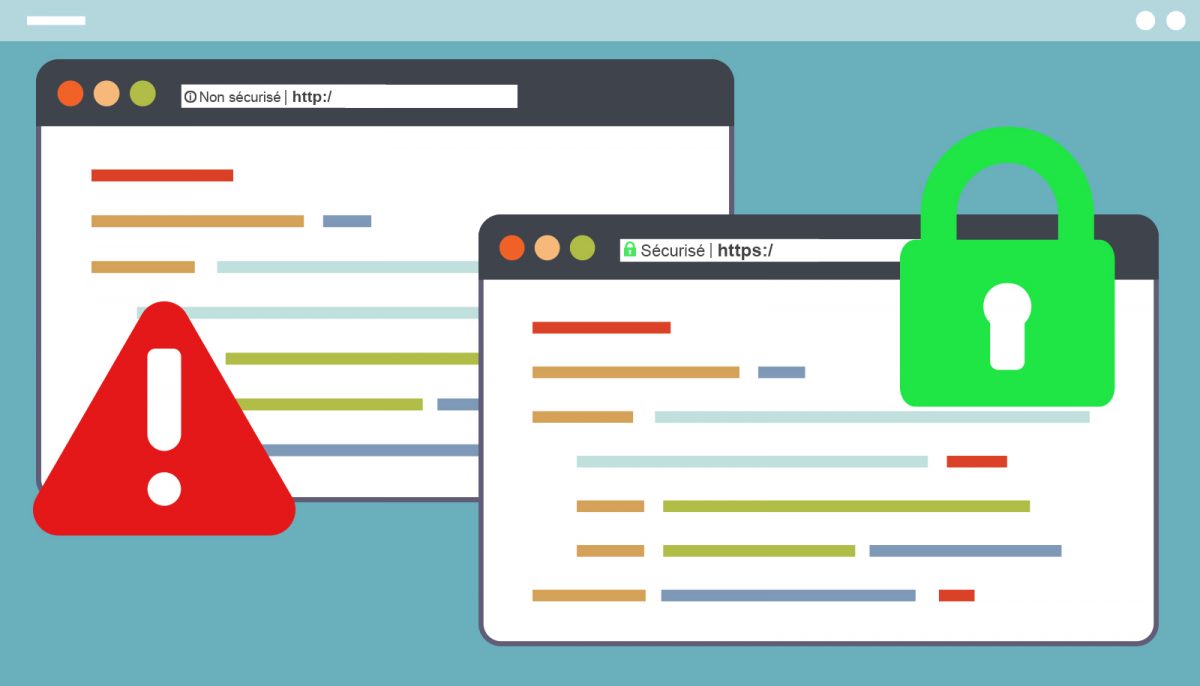
The industry actors plan to reduce the lifetime of SSL/TLS certificates, allowing the HTTPS display in browsers, to 13 months, i.e. almost half of the present lifetime of 27 months, in order to improve security.

Google through the CA/Browser Forum has indeed proposed this modification, approved by Apple and a Certification Authority, making it eligible to vote. During the next CA/B Forum meetings, if the vote is accepted, the modification of the requirements will come into effect in March 2020. Any certificate issued after the entry into force date will have to respect the requirements of the shortened validity period.

The aim for this reduction is to complicate things for cyber attackers by reducing the duration of the use of the potentially stolen certificates. It could also force companies to use the most recent and the most secured available encrypting algorithms.

If the vote fails, it’s not to be excluded that browsers supporting this requirement, unilaterally implement it in their root program, thus forcing the change to the Certification Authorities. It’s likely that this could be the case, this change follows Google’s precedent initiative that aimed to reduce the lifespan from three years to two years in 2018, period during which Google already wished to reduce it to 13 months or even less.

Who is impacted?

The changes proposed by Google would have an impact on all the users of TLS certificates of public trust, regardless of the Certification Authority that issued the certificate. If the vote passes, all certificates issued or reissued after March 2020 will have a maximum validity of 13 months. The companies using certificates with a validity period superior to 13 months will be encouraged to reconsider their systems and evaluate the impact of the proposed modifications on their implementation and their use.

The TLS certificates issued before March 2020 with a validity period superior to 13 months will stay operational. The public non-TLS certificate, for the code signing, the TLS private code and clients’ certificates, etc. are not concerned.  It will not be necessary to revoke an existing certificate following the implementation of the new standard. The reduction will have to be applied during the renewal.

What do the market players think about this?

It would be a global change for the industry with impacts on all the Certification Authorities. They view this proposition in a negative light. We can see an economic interest above all, but not solely…

The main argument is that the market is not ready in terms of automation system of orders and certificates implementations. Indeed, there would be more human interventions with the risks associated with poor handling, or simply a higher risk of forgetting a certificate renewal.

For Certification Authorities, reducing the certificates’ lifespan to such a short term mainly presents an increase of the human costs related to the certificate portfolio management. If they are not fundamentally against this decision, they would particularly like more time to study what users and companies think.

The position of browsers makers

Be it Google or Mozilla, the spearheads of the native HTTPS massive adoption for all websites and the supporters of the Let’sEncrypt initiative, what is important is the encrypting of all web traffic. A reduction of the certificates lifespan reduces the risk of certificates theft on a long period and encourages the massive adoption of automated management systems. For these two actors, an ideal world would have certificate of maximum 3 months. If they are attentive to the market as to not impose their views too quickly, it is more than likely that in the long term the certificates’ lifespan will continue to decrease.

Nameshield’s opinion 

The market continues its evolution towards shorter and shorter certificates’ validity, as a continual decrease of the authentication levels and consequently a need for management automated solutions that will increase. We will align on these requirements and advise our customers to prepare themselves for this reduction which will, without a doubt, arrive. Our Certification Authorities partners will also follow this evolution and will allow to provide all systems of required permanent inventory and automation.

To be heard

The CA/Browser Forum accepts comments of external participants and all discussions are public. You can directly enter your comments to the Forum distribution list:  https://cabforum.org/working-groups/ (at the bottom of the page). Nameshield is in contact with CA/Browser Forum participants and will inform you of the future decisions.
The Nameshield SSL interface has had a complete makeover

The Nameshield SSL interface has had a complete makeover

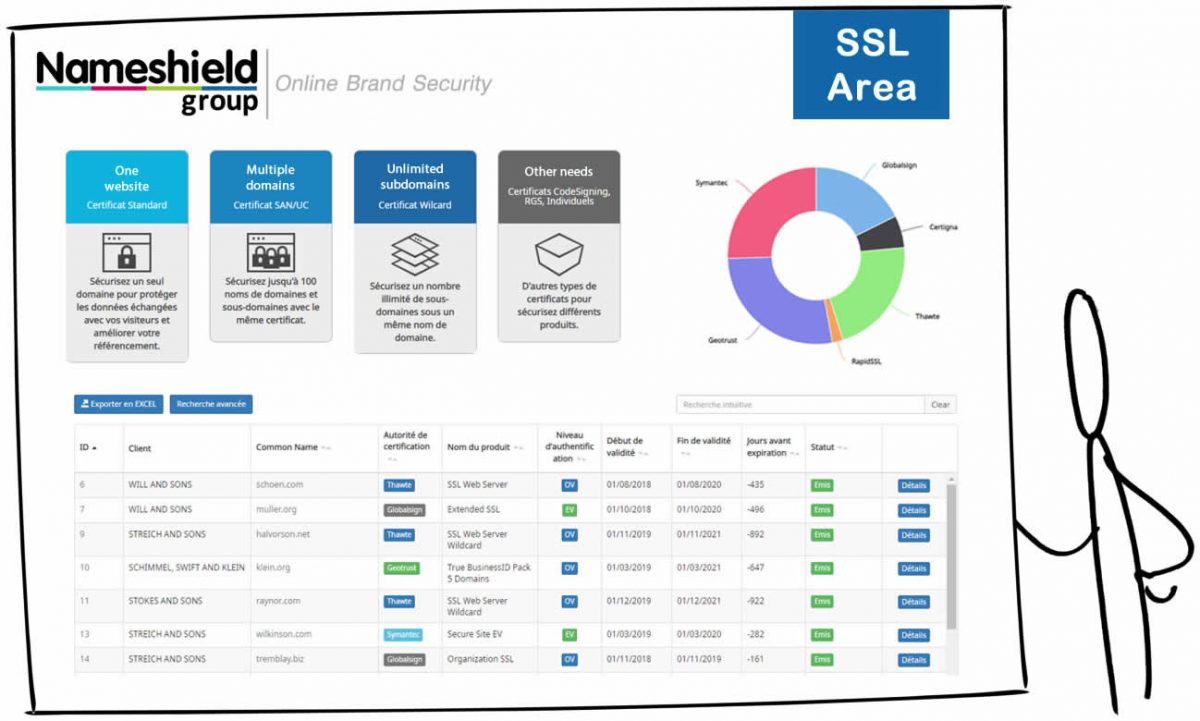
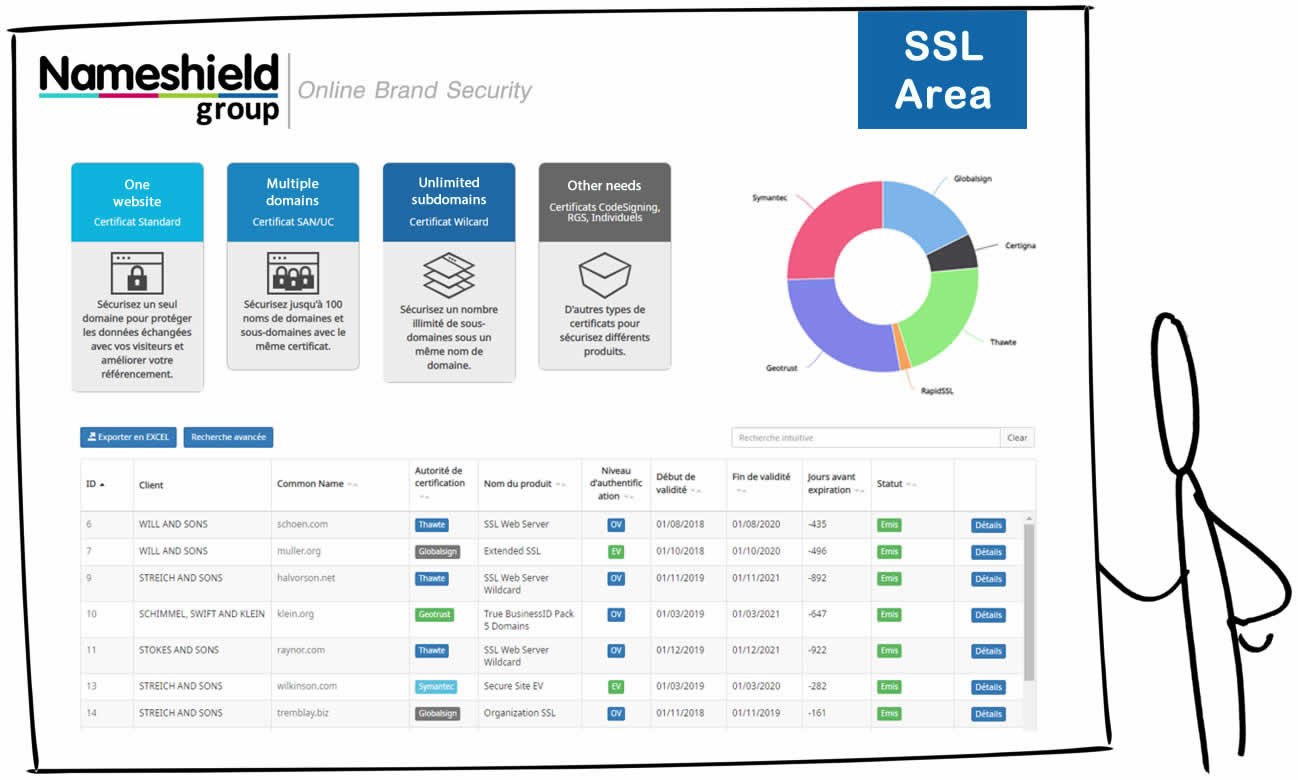
More user-friendly, more comprehensive, more attractive… our brand new and improved Nameshield SSL interface is being launched on Thursday, June 13th allowing you to manage all of your certificates.

You will now have access to key metrics on your certificate portfolio, to different certificate lookup views (such as complete portfolio, detailed overview, certificates nearing expiry, pending orders, expired or revoked certificates), to an Organization and Contact management tool and a redesigned ordering system.

Lastly, a decision support tool has been included in the interface to help you choose the certificate that’s right for your needs.

The certificate range has been updated to cover all types of certificates, SSL, RGS, Code Signing, Individual certificates and with all levels of authentication.

The SSL team remains at your disposal for a demonstration and a complete user guide is available covering all possible operations and actions.

Contact us directly at certificates@nameshield.net.

The CAA becomes mandatory in the small SSL’s world

Or how to benefit from it to implement a certification strategy specific to your company?

The CAA becomes mandatory in the small SSL’s world

In January 2013, a new type of DNS Resource Record has appeared to improve the control chain in the SSL certificates issuing. This record, called CAA for Certificate Authority Authorization, allows to specify for a given domain name which Certification Authorities are authorized to issue certificates.

It’s an extremely interesting creation, in particular for big companies and groups, which technical teams are scattered in the World and for which it’s often difficult to require a global certification strategy. It’s not unusual for companies to accidentally discover the existence of certificates requested by teams not knowing the processes, by external consultants, issued by Certification Authorities with a bad image, or for certificates of low level of authentication (DV). The implementation of CAA record on your domain names is a good solution to control what the teams are doing and the news on SSL’s world will help you do that.

Indeed, if the CAA has been detailed in the RFC-6844 from 2013, it was not mandatory until today, for a Certification Authority to check if it was authorized or not to issue a certificate on a given domain name, hence a certain uselessness of this and a very low adoption.

September 8th, 2017 – The CAA checking becomes mandatory

We had to wait until March 2017, and a positive vote of the CAB/forum (ballot 187) to make this verification mandatory. Since the 8 September, the Certification Authorities have the duty to do this verification at the risk of sanctions from CAB/forum and browsers, the recent news regarding Google and Symantec has shown us how it’s not in their interests.

Three scenarios occur during this verification on a given domain name:

  • A CAA record is set and indicates the Certification Authority name, this one can issue the certificate.
  • A CAA record is set and indicates a Certification Authority’s name different, this one CANNOT issue the certificate.
  • No CAA record is set, any Certification Authority can issue a SSL certificate.

The CAA becomes mandatory in the small SSL’s world

It’s important to note that for a given domain name, many CAA records can be declared. A simple tool (among many others) to test your domain name, is available online: https://caatest.co.uk/

How to benefit from CAA for my company?

If it’s not already done, the establishment of the CAA checking is the opportunity for your company to define a certification strategy and to be able to ensure that it is complied with.

Define one (or multiple) Certification Authority corresponding to your values and to your expectations in term of service quality is a first step.

It will require to put around the table the marketing stakeholders to validate the impact on websites display and the technical services to ensure of the chosen provider’s quality. It will then be necessary to declare these CAA records in the different zones of your domain names.

It’s then important to communicate with all the operational staff so they become aware of the rules imposed within the company, in order not to block them in obtaining a certificate.

Indeed, Nameshield’s experience shows that SSL certificates are often requested in a hurry; moreover the browser’s last versions are not kind towards certificates’ errors by ostensibly displaying “not secure”. In consequence, blocking the issuing of a certificate because the communication didn’t get through can be damaging.

Such strategy presents real advantages in the control of certificates, in marketing, technical, risks control and costs associated to certificates. It’s necessary to conduct it with full knowledge and in order to do it, our SSL experts’ team can assist you.

Some movement in the SSL’s world: Digicert acquires Symantec’s certificates activity

Digicert acquires Symantec’s certificates activity

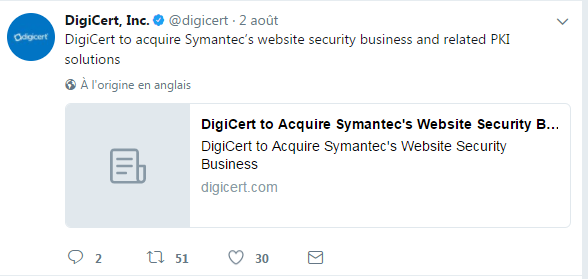
On Wednesday, August 2nd, Digicert announced the acquisition of Symantec’s Website Security Business branch (including SSL business, and some other services). It’s the direct consequence of the conflict opposing Symantec to Google for a few months.

Digicert acquires Symantec’s certificates activity
DigiCert’s Twitter account

You have certainly already heard about this disagreement opposing two companies on a certain number of certificates issued by Symantec and the possible loss of trust towards these certificates in the next versions of Chrome. Many information and dates have been flowing on this subject, sometimes contradictory, it can be sensitive to evaluate the impact on your own certificates.

Nameshield as a Symantec’s Platinum partner, has followed very closely the development of this case to ensure that its customers and partners don’t risk to be impacted and suffer from a loss of trust within their browsers. The very latest developments of this case lead us to communicate the following important information:

What happened?

Google and Symantec had a dispute in 2015, Symantec’s teams taking for example certificates often based on the CN google.com, by really issuing them to delete them afterwards. It was objectively a mistake and Google has sanctioned Symantec by making compulsory the subscription of all certificates within the Certificate Transparency base, which since became the market standard and a mandatory for all Certification Authorities. This decision was effective on June 1st, 2016.

At the beginning of 2017, Google and Mozilla announced the discovery of 127 Symantec certificates with irregularities, leading to a thorough investigation from Google, which would have found nearly 30 000 impacted certificates. Google decided to severely sanction Symantec by reducing the certificates’ duration to 9 months and by deleting the EV status for Symantec certificates in a very short period. Symantec has immediately reacted by sanctioning 4 partners who were at the roots of the errors. Many discussions between the two groups, and with many important actors of the industry, took place since March 2017. A part of these publications, proposals and counter-proposals has created confusion.

These different discussions have led Google and Symantec to an agreement on a method and a transition calendar towards a new PKI infrastructure for Symantec. Google officially communicated on this subject on Friday, July 28th. This communication can be consulted here.

Symantec is committed to create a new PKI infrastructure in collaboration with a third party to prove its good faith, answer to the transparency requirements of Google and maintain the high degree of trust which has always benefited the group from the web users. This infrastructure change will take place on December 1st, 2017 and will require the replacement (or if any, the renewal) of all the existing certificates for Symantec brands, Thawte, Geotrust and RapidSSL. This extended deadline will allow a smooth transition, without impact on web users.

Since August 2nd, we know that this trusted third party will thus be Digicert.

What Calendar?

Google distinguishes Symantec certificates issued before June 1st, 2016 from those issued after this date (Mandatory subscription in Certificate Transparency). The loss of trust in these two categories of certificates will arrive through two different versions of Chrome, hence the following calendar:

– Category 1: Certificates issued before June 1st, 2016, will have to be replaced (or renewed*) between December 1st, 2017 and March 15th, 2018 (arrival of the beta Chrome 66)

– Category 2: Certificates issued between June 1st, 2016 and November 30th, 2017, will have to be replaced (or renewed*) between December 1st, 2017 and September 13th, 2018 (beta Chrome 70 arrival).

The eventual emergency communicated by the different market actors is therefore not relevant.

*anticipated renewal: a renewal can be done until 90 days before the expiration date of a certificate, without penalizing the duration of the new issued certificate.

Are you impacted?

Yes you are, if you dispose of certificates issued with one of Symantec brands (Symantec, Thawte, Geotrust, RapidSSL) through Nameshield or other providers with whom you would be working. All that remains is to distribute them in the two mentioned categories. We could help you identify the eventual impacted certificates and their distribution in the right categories, in order to plan the actions to carry out from December 1st, 2017.

And Digicert in all this?

Digicert is an American company, of which the actual market share represents 2.2% of the world market, based on the last report of W3tech. It’s a company renowned for the work quality of its authentication team and its conformity with the CAB forum’s Baseline Requirements. Digicert is regularly growing for several years on serious values and manages certificates portfolios of very important companies and websites around the World.

Digicert will become a major actor of the certificates market, by taking the 14% of the global market shares of Symantec. More interesting, the 40% of market shares on EV certificates and 30% on OV certificates which represents Symantec.

On paper, this acquisition is good news for all the Symantec customers. It’s a guarantee of continuity in the quality of provided services. It’s the guarantee of a successful transition towards a new PKI infrastructure requested by Google. It remains to monitor Digicert capacity to respect the calendar imposed by Google, we will closely monitor this.

What does Nameshield think of this?

Nameshield trusts Symantec and its teams for several years. On one hand, for its quality of service, which allows us to provide you a service of first level and on the other hand for the brand image and the trust created by this group to the web users. The management of this Google/Symantec crisis doesn’t question the trust we have in this partner, and whose support remains irreproachable.

Furthermore, we were for a few months, in relation with Digicert to extend our solutions portfolio, we welcome this acquisition announcement like a positive news for our customers and partners, by being confident on the continuity of the services we could offer you. It means that the trust you place in us is primordial and if you want to move in a different direction, Nameshield remains at your service to propose alternatives to you.