After the launches of the .APP and .PAGE,
Google launched .DEV on January 16, its new extension dedicated to developers
and technology, following the calendar below:
Sunrise period: from 2019/01/16 to 2019/02/19
EAP (Early Access
Program): from 2019/02/19 to 2019/02/28
General availability: from 2019/02/28
Since February 28, 2019, the .DEV is in general availability and already
has more than 64 000 domain names’ registrations according to Domain Name
Wire.
To promote this new extension and for the Google I/O 2019 , its annual event for developers (which will be held on May 7-9, 2019 at the Shoreline Amphitheatre in Mountain View), Google proposes the free registration for 1 year of a .DEV domain name for all ticket booked. But the registrations resulting of this promotional campaign only represent a small part of the 64 000 .DEV domain names registered.
During the last months, Google itself has launched or relaunched many of
its websites in .DEV: web.dev, opensource.dev, flutter.dev…
Other companies have also chosen to register their domain names in .DEV
like Mozilla with mdn.dev, Salesforce with crm.dev and Level Access with
accessibility.dev.
The HTTPS mandatory for all .DEV domain names
As mentioned in a previous article by Christophe GERARD, Nameshield’s Security Product Manager, as reminder, Google in its goal of a more secure Internet, makes HTTPS encryption mandatory for all its new extensions: .APP, .PAGE, .HOW, .DEV… (More details in this article).
Thus, .DEV extension is included on the HSTS pre-upload list, requiring
HTTPS protocol on all .DEV domain names.
Therefore, in order to use a .DEV domain name, you will need to acquire
a SSL certificate and deploy HTTPS.
From tools to platforms, programming languages to blogs, this extension
will allow you to present your projects. Don’t hesitate to contact a Nameshield’s
consultant for any questions regarding the conditions for the registration of
your .DEV.
In a previous article, we discussed the Brexit’s consequences on .EU domain names, the European Commission announced on 28 March 2018 that companies and individuals, holders of a .EU will no longer be able to renew or register names in .EU if they are not residing in the European Union.
With the Brexit’s date approaching, EURid, .EU registry, has recently published its action plan that has two scenarios depending on the case there is no deal or the case there is a withdrawal agreement between the United Kingdom and the European Union. In the second case, it will be the same actions but they will be implemented on different dates (from December 2020).
Scenario 1: The United
Kingdom leaves the European Union with no deal on 30 March 2019
New registrations
From 30 March 2019: EURid will not allow the
registration of any new domain name from registrant declaring an address in Great
Britain (country code GB) or in Gibraltar (country code GI).
.EU domain names that have GB/GI as the registrant country code within WHOIS, at the time of UK withdrawal
On 23 March 2019: EURid will notify by email both
GB/GI registrants and their registrars about the forthcoming non-compliance of
the data associated to their domain name within the .EU regulatory framework.
On 30 March 2019: EURid will again notify by email
both GB/GI registrants and their registrars that their domain name is not in compliance
with the .EU regulatory framework.
Before 30 May 2019: Registrants will be given the
possibility to demonstrate their compliance with the .EU regulatory framework
by updating their contact data.
During this two months period, the domain names in question will remain active and the following actions are possible:
-Contact data changes including updates to existing contact details pertaining to phone number, email address, postal address and country code;
-Updating a contact or linking a new contact;
-Name server and DNSSEC changes;
-Transfer the domain name to a non GB/GI registrant.
During this two months period, the following actions arenot possible:
-Transfer the domain name to a GB/GI registrant;
-Term extension, unless accompanied by a transfer request to an eligible registrant;
-Automatic renewal for domain names that expire in the period between 30 March 2019 and 30 May 2019.
As of 30 May 2019: All registrants who did not
demonstrate their eligibility will be deemed ineligible and their domain names
will be withdrawn.
On 30 March 2020, i.e. twelve months after the UK
withdrawal: All the affected domain names will become available for general registration.
For. EU domain names that are in the ON-HOLD status at the time of UK withdrawal: They will remain registered until there is an outcome of the court case. However, they will be suspended and will cease to function as of 30 May 2019.
-If a court ruling establishes a transfer to an eligible party, that decision will be implemented in the usual way.
-If the domain name stays with the GB/GI registrant, the domain name will be withdrawn.
For .EU domain names that are in the
SUSPENDED status at the time of UK withdrawal: Evaluation by the registry on a case-by-case
basis, moving forward if appropriate, with the withdrawal of the domain name.
For .EU domain names that are in the QUARANTINE status at the time of UK withdrawal:
-No transfer to GB/GI registrants from quarantine will be possible during the two months period.
-Transfer to a non-GB/GI registrant will be possible.
Scenario 2: The United
Kingdom leaves the European Union with a planned transitional period on 31
December 2020
It will be the same actions but they will be
implemented on different dates.
New registrations
From 1 January 2021: EURid will not allow the
registration of any new domain name from registrant whose country code is
either GB/GI.
.EU domain names that have GB/GI as the registrant country code within WHOIS, at the time of UK withdrawal
23 December 2020: First email sent about the
non-compliance of the data associated to the domain name.
1 January 2021: Second email sent about the
non-compliance.
Before 2 March 2021: Possibility for the registrants to
demonstrate their compliance with the .EU regulatory framework by updating
their contact data.
As of 2 March 2021: All registrants who did not
demonstrate their eligibility will be deemed ineligible and their domain names
will be withdrawn.
On 1 January 2022: All the affected domain names will
become available for general registration.
The actions planned in the first scenario
regarding the different status « ON HOLD », « SUSPENDED » and « QUARANTINE »,
will also be applied in the second scenario.
The Brexit’s consequences thus force the
British to rethink their domain names strategy. Indeed, the loss of their .EU domain
names will be an opportunity for cybersquatters who reside in the E.U. and meet
the eligibility criteria, they would then have the rights to register these .EU
domain names.
Nameshield’s team is at your disposal to reply
to all your questions and to propose you the best recommendations regarding
your domain names’ portfolio management.
As 2019 begins, we make three wishes corresponding to an eventful year.
1.A better awareness of the Internet governance.
The main project at the time of
international relations, fake news and voluntary disconnection from the
Internet: the Internet governance should be at the table of the diplomats,
political decision makers and strategic decision makers. France, which shines
in the embassies’ world, should be able to take part in the digital decisions. The
appointment of Henri Verdier as Digital Ambassador is a good thing, hoping that
his knowledge in the private sector will be an absolute strength in his
projects for France. France should be interested in the functioning of ICANN,
the authority of world regulation of the IP addresses and the domain names.
ICANN is recently the subject of strong criticisms regarding potential insider
trading. The American desire to entirely privatize ICANN by suppressing its
links with NTIA needs everyone’s attention.
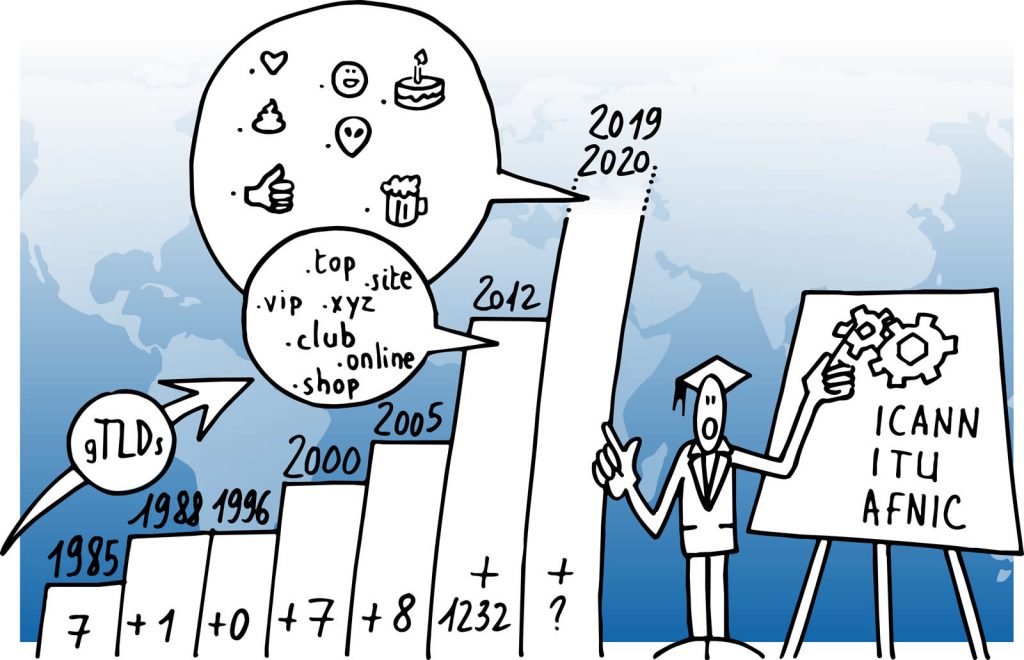
2. ICANN decided it: a new opening of the root will soon be done. What temporality? That is a mystery. In the meantime, and so as to prevent that the list of the abandoned extensions does not cease to develop, new uses of the new extensions, whether they are opened (.PARIS, .FOOTBALL, .ICU…) or closed (.MMA, .LECLERC, .BCG…) should be found. Today (and tomorrow) the brand protection through a TLD’s possession is a definite advantage in front of the large number of opened extensions. A TLD’s possession can also allow the opening of the scope of possibilities, like .BEST will announce at Namescon at the end of the month (surprise!).
3. The third and last wish, to anticipate the new uses of domain names. While the progress curve of the domain names’ volume increases less than previously, the focus should be on the issue of communication on the Internet. It appears as necessary to propose the registration of all possible domain names one can imagine. This is the consortium Unicode, an American entity which decides which character can be integrated in the IT standards. Let’s follow the evolution of the integration of the characters integrated in the Unicode to identify the future domain names trends. The internationalized domain names were a real positive evolution for web users around the world, myself the first concerned, having an accented first name.
Thus it’s very likely that emojis and other
special characters will become the stars of the upcoming extensions. Soon the .♥.
These three wishes are part of our work at this time.
For example, our participation in the updating of the
methods regarding intangible assets’ financial and extra-financial valuation of
the Thesaurus Capital Immatériel by
the “Institut de comptabilité de l’immatériel”
(Intangible accounting Institute), aims to answer to the need to acknowledge
the domain names’ value by financial managers.
Domain names are the first assets held by web
users. We are fully aware of the responsibility associated to their management,
and our recent developments in terms of operational excellence (ISO 27100) are the
new guarantors.
In the context of the fight against insecurity on the web, DNS Belgium, the .BE registry, decided to intensify its action by cooperating with the FPS Economy [The FPS Economy, SMEs, Middle Classes and Energy is a Federal Public Service of Belgium which is responsible for contributing to the development, competitiveness and sustainability of the goods and services market in Belgium] in order to shut down fraudulent websites within 24 hours.
Philip Du Bois, general manager of DNS Belgium indicates: “This protocol will enable us to take even more targeted action, together with the FPS Economy, against possible abuses where .be domain names are involved. It underscores our ambition for a high quality and safe .be zone which serves as suitable environment for the further development of the Internet.”
The aim: to ensure
consumers a completely safe Internet browsing on .BE websites.
This procedure will ensure a much higher
reactivity. Indeed, until now, FPS Economy couldn’t request a blocking from the
registry regarding the content, moreover fraudulent websites with correct
identification data (at least of which the forgery couldn’t be proven), were untouchable.
The blocking required a request from the Prosecution, i.e. a two weeks long
procedure, which left plenty of time for the fraudulent website to create
important damages to the consumers. Several hundreds of such websites per year
were concerned!
From December, the 1st 2018, the protocol will then allow at the request of FPS Economy, the DNS Belgium registry to block .BE domain names which:
Are used for fraudulent websites
Host phishing websites
Of course, this procedure will be applied in
the case of serious crimes.
The blocked domain name’s owner will have two
weeks to react against the blocking. Without action of their part within 6
months, the blocked name will expire.
This still too rare initiative is to be
welcomed in a context of the fierce fight against cybercriminality!
We have learned from the press that Swaziland will change its name at the will of its Monarch.
Indeed, this little South African territory has not changed its name after the decolonization, fifty years ago. It will soon be the case, with the term eSwatini, the country of Swazi. If this information is more of a geopolitical notion, it will have an impact on the country’s abbreviation within the ISO standard 3166-1 alpha 2, and its extension will then change; a similar situation to the one of Kazakhstan, already discussed on this blog.
A new example which highlights the importance of the country’s stability in the choice of an extension used for an active communication.
Nameshield uses cookies
Nameshield wishes to use cookies to ensure the proper functioning of the site and, with our partners, to measure its audience🍪.
Nameshield wishes to use cookies to ensure the proper performance of the website and, with our partners, to monitor its audience. More information in our Cookie Policy 🍪.
Necessary cookies are absolutely essential for the website to function properly. These cookies ensure basic functionalities and security features of the website, anonymously.
Cookie
Duration
Description
cookielawinfo-checkbox-advertisement
1 year
Set by the GDPR Cookie Consent plugin, this cookie is used to record the user consent for the cookies in the "Advertisement" category .
cookielawinfo-checkbox-analytics
11 months
This cookie is set by GDPR Cookie Consent plugin. The cookie is used to store the user consent for the cookies in the category "Analytics".
cookielawinfo-checkbox-functional
11 months
The cookie is set by GDPR cookie consent to record the user consent for the cookies in the category "Functional".
cookielawinfo-checkbox-necessary
11 months
This cookie is set by GDPR Cookie Consent plugin. The cookies is used to store the user consent for the cookies in the category "Necessary".
cookielawinfo-checkbox-others
11 months
This cookie is set by GDPR Cookie Consent plugin. The cookie is used to store the user consent for the cookies in the category "Other.
cookielawinfo-checkbox-performance
11 months
This cookie is set by GDPR Cookie Consent plugin. The cookie is used to store the user consent for the cookies in the category "Performance".
CookieLawInfoConsent
1 year
Records the default button state of the corresponding category & the status of CCPA. It works only in coordination with the primary cookie.
viewed_cookie_policy
11 months
The cookie is set by the GDPR Cookie Consent plugin and is used to store whether or not user has consented to the use of cookies. It does not store any personal data.
Functional cookies help to perform certain functionalities like sharing the content of the website on social media platforms, collect feedbacks, and other third-party features.
Performance cookies are used to understand and analyze the key performance indexes of the website which helps in delivering a better user experience for the visitors.
Analytical cookies are used to understand how visitors interact with the website. These cookies help provide information on metrics the number of visitors, bounce rate, traffic source, etc.
Cookie
Duration
Description
_ga
2 years
The _ga cookie, installed by Google Analytics, calculates visitor, session and campaign data and also keeps track of site usage for the site's analytics report. The cookie stores information anonymously and assigns a randomly generated number to recognize unique visitors.
_gat_gtag_UA_25904574_14
1 minute
Set by Google to distinguish users.
_gid
1 day
Installed by Google Analytics, _gid cookie stores information on how visitors use a website, while also creating an analytics report of the website's performance. Some of the data that are collected include the number of visitors, their source, and the pages they visit anonymously.
Advertisement cookies are used to provide visitors with relevant ads and marketing campaigns. These cookies track visitors across websites and collect information to provide customized ads.
Cookie
Duration
Description
NID
6 months
NID cookie, set by Google, is used for advertising purposes; to limit the number of times the user sees an ad, to mute unwanted ads, and to measure the effectiveness of ads.