Some movement in the SSL’s world: Digicert acquires Symantec’s certificates activity

Digicert acquires Symantec’s certificates activity

On Wednesday, August 2nd, Digicert announced the acquisition of Symantec’s Website Security Business branch (including SSL business, and some other services). It’s the direct consequence of the conflict opposing Symantec to Google for a few months.
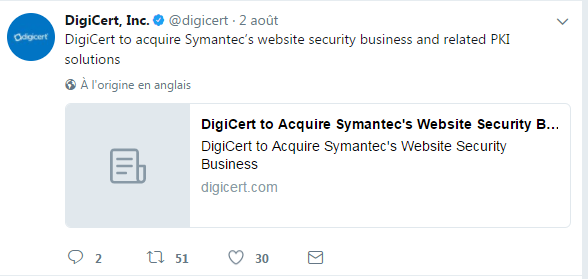
Digicert acquires Symantec’s certificates activity
DigiCert’s Twitter account

You have certainly already heard about this disagreement opposing two companies on a certain number of certificates issued by Symantec and the possible loss of trust towards these certificates in the next versions of Chrome. Many information and dates have been flowing on this subject, sometimes contradictory, it can be sensitive to evaluate the impact on your own certificates.

Nameshield as a Symantec’s Platinum partner, has followed very closely the development of this case to ensure that its customers and partners don’t risk to be impacted and suffer from a loss of trust within their browsers. The very latest developments of this case lead us to communicate the following important information:

What happened?

Google and Symantec had a dispute in 2015, Symantec’s teams taking for example certificates often based on the CN google.com, by really issuing them to delete them afterwards. It was objectively a mistake and Google has sanctioned Symantec by making compulsory the subscription of all certificates within the Certificate Transparency base, which since became the market standard and a mandatory for all Certification Authorities. This decision was effective on June 1st, 2016.

At the beginning of 2017, Google and Mozilla announced the discovery of 127 Symantec certificates with irregularities, leading to a thorough investigation from Google, which would have found nearly 30 000 impacted certificates. Google decided to severely sanction Symantec by reducing the certificates’ duration to 9 months and by deleting the EV status for Symantec certificates in a very short period. Symantec has immediately reacted by sanctioning 4 partners who were at the roots of the errors. Many discussions between the two groups, and with many important actors of the industry, took place since March 2017. A part of these publications, proposals and counter-proposals has created confusion.

These different discussions have led Google and Symantec to an agreement on a method and a transition calendar towards a new PKI infrastructure for Symantec. Google officially communicated on this subject on Friday, July 28th. This communication can be consulted here.

Symantec is committed to create a new PKI infrastructure in collaboration with a third party to prove its good faith, answer to the transparency requirements of Google and maintain the high degree of trust which has always benefited the group from the web users. This infrastructure change will take place on December 1st, 2017 and will require the replacement (or if any, the renewal) of all the existing certificates for Symantec brands, Thawte, Geotrust and RapidSSL. This extended deadline will allow a smooth transition, without impact on web users.

Since August 2nd, we know that this trusted third party will thus be Digicert.

What Calendar?

Google distinguishes Symantec certificates issued before June 1st, 2016 from those issued after this date (Mandatory subscription in Certificate Transparency). The loss of trust in these two categories of certificates will arrive through two different versions of Chrome, hence the following calendar:

– Category 1: Certificates issued before June 1st, 2016, will have to be replaced (or renewed*) between December 1st, 2017 and March 15th, 2018 (arrival of the beta Chrome 66)

– Category 2: Certificates issued between June 1st, 2016 and November 30th, 2017, will have to be replaced (or renewed*) between December 1st, 2017 and September 13th, 2018 (beta Chrome 70 arrival).

The eventual emergency communicated by the different market actors is therefore not relevant.

*anticipated renewal: a renewal can be done until 90 days before the expiration date of a certificate, without penalizing the duration of the new issued certificate.

Are you impacted?

Yes you are, if you dispose of certificates issued with one of Symantec brands (Symantec, Thawte, Geotrust, RapidSSL) through Nameshield or other providers with whom you would be working. All that remains is to distribute them in the two mentioned categories. We could help you identify the eventual impacted certificates and their distribution in the right categories, in order to plan the actions to carry out from December 1st, 2017.

And Digicert in all this?

Digicert is an American company, of which the actual market share represents 2.2% of the world market, based on the last report of W3tech. It’s a company renowned for the work quality of its authentication team and its conformity with the CAB forum’s Baseline Requirements. Digicert is regularly growing for several years on serious values and manages certificates portfolios of very important companies and websites around the World.

Digicert will become a major actor of the certificates market, by taking the 14% of the global market shares of Symantec. More interesting, the 40% of market shares on EV certificates and 30% on OV certificates which represents Symantec.

On paper, this acquisition is good news for all the Symantec customers. It’s a guarantee of continuity in the quality of provided services. It’s the guarantee of a successful transition towards a new PKI infrastructure requested by Google. It remains to monitor Digicert capacity to respect the calendar imposed by Google, we will closely monitor this.

What does Nameshield think of this?

Nameshield trusts Symantec and its teams for several years. On one hand, for its quality of service, which allows us to provide you a service of first level and on the other hand for the brand image and the trust created by this group to the web users. The management of this Google/Symantec crisis doesn’t question the trust we have in this partner, and whose support remains irreproachable.

Furthermore, we were for a few months, in relation with Digicert to extend our solutions portfolio, we welcome this acquisition announcement like a positive news for our customers and partners, by being confident on the continuity of the services we could offer you. It means that the trust you place in us is primordial and if you want to move in a different direction, Nameshield remains at your service to propose alternatives to you.

Nameshield: The first French registrar certified ISO 27001 on all its registrar activity

Nameshield's ISO 27001 certification


Nameshield is proud to announce its ISO 27001 certification on all its registrar activity, the product of many months of work.

Why the ISO 27001 certification?

Since its creation, 23 years ago, Nameshield has taken to heart to provide to its customers the best services under conditions of optimal security. By choosing the ISO 27001 standard, this constant care given to all our services is now certified by a competent authority.

The impressive rise of the occurrence and the force of the cybercriminal attacks has comforted the founder and CEO of Nameshield, Jean-Paul Béchu, in his determination to propose to all our users an ISO 27001 certification on all our registrar activity.

Today, it’s frequent that cybercriminals attack services providers in order to reach indirectly their final targets. And if our Security Officer of Information System monitored already the security of our infrastructure, the ISO 27001 reinforces the requirements.

If Nameshield has engaged in this process, the result of an important investment, human and financial, it’s because it’s essential for us to demonstrate and certify the dimension of our engagement in term of security.

To be certified ISO 27001 is to ensure our customers and partners that the security of the Information systems is completely integrated and that Nameshield is committed to a process of constant improvement requiring specific resources, which we have chosen to deploy.

The certification confirms the competence of Nameshield’s employees and their expertise in the protection of critical information.


What is the ISO 27001 certification?

ISO 27001 is an international standard which describes the requirements for the establishment of an Information security Management System. This one is intended to choose the security measures to set up in order to ensure the protection of sensitive goods of a company on a defined perimeter. In the case of Nameshield, it covers all of its registrar activity.

At a higher level, the ISO 27001 standard requires that the managers of the company are involved in the cyber defense. In parallel, a steering committee follows the implementation of the new arrangements respecting the standard.

An audit carried out by LRQA, the World Leader of the certification of value added Management systems, allows us to deploy our security measures and to become the first French registration office to be certified on the complete perimeter of its registrar activity.

Nameshield, your trusted partner.


Cyber-blurring: the strategy used by Macron’s digital team to face cyberattacks

Cyber-blurring - the strategy used by Macron’s digital team
Photo : www.gouvernement.fr


May the 5th , 2017, two hours before the end of 2017 presidential campaign, thousands of documents owned by the campaign team of the candidate Emmanuel Macron have been leaked and have been made public on American forum 4Chan, relayed by Wikileaks. Social media have played an important role in the attack and content diffusion: internal discussion of the political party, briefing notes, pictures, bills, accounting, which represent 9 gigaoctets of hacked data.

Since the beginning of the presidential campaign, it wasn’t the first attack faced by the team of En Marche’s candidate.  Alerted of a potential attack a long time ago, they have set up a cyber-blurring strategy to defend themselves. This method creates dozens of false documents (false emails, false passwords, false accounts) trying to slow down hackers’ work. This strategy is often used in the banking field to protect their customers. (This diversion method is also called digital blurring.)


L'Express Twitter account - Cyber-blurring: the strategy used by Macron’s digital team to face cyberattacks
L’Express Twitter account


Even if Mounir Mahjoubi, digital director of the En Marche campaign, thinks to have slowed down the hackers’ job with this cyber-blurring method, despite these measures, the attack was not avoided.

The hackers didn’t ask for money in exchange of the documents publishing. These documents which are not compromising for the Emmanuel Macron’s team, were not monetizable because the hackers would have to sort out 9 gigaoctets of data in a few period of time.

Consequences are few on the presidential campaign and the En Marche staff was not really affected. This counterattack was well implemented.

The hackers who were against Macron, didn’t have the success desired. Nevertheless, this failure will get them to become smarter, more ingenious, less visible and better prepared for a next attack.

To be continued.

Connected objects: unavoidable in DDoS attacks?

IoT- DDoS attacks


Nowadays consumers use and are around connected objects. The Internet of Things (IoT) includes all connected objects like a connected refrigerator, captor, light bulb, security camera, router or even a thermostat control. Their common point? To have an IP address and to be connected to communicate.

According to the American company Gartner, connected objects will reach 20.5 billion units by 2020. We will face an impressive growth of IoT in the years to come.

China, North America and West Europe will represent 67% of IoT in 2017.

However these connected objects are spreading frequently with security flaws, which is an opportunity for DDoS attacks!

Nowadays, Distributed Denial of Service (or DDoS) attacks are frequent. For hackers, it’s quite easy to set up attacks against an unprotected target. These attacks could lead to significant financial loss for companies by disruption of service (website or email) or indirectly, by the harm caused to the target’s image (bad buzz, bad reputation…).

With the arrival of connected objects, chances to be confronted to DDoS attacks are high.

These attacks are making a service unavailable by flooding the system with requests. With the help of digital and connected objects, hackers can send a massive number of requests on one or many DNS servers. They get to remotely control our objects because of their security flaws. If the DNS servers are not protected by a strong anti-DDoS filter, then they are under the risk of not absorbing the high number of requests and as a result, won’t respond to the user’s demands anymore.

In October 2016, DYN Company, DNS service supplier had been the victim of a DDoS attack by connected devices. DNS infrastructure services had been unavailable, which then impacted on their customers’ services: Twitter, Netflix, Spotify…

Many hours offline for these web pure players have a direct impact on sales revenue. DYN affirms that “Ten billion of IP addresses were touched” by this attack.

Last week, Melbourne IT Registrar was also a victim of a DDoS attack. Some of its customers were affected by this service disruption.

We might see more powerful attacks of this kind in 2017.

In the past, attacks were done by computers, today connected devices are a real weapon. Luckily those companies have affirmed wanting to reinforce security on their connected products.

DNS is an absolute priority. It’s essential to secure his strategic domain names by using highly secured DNS, so you can have a high permanent availability.

Nameshield offers a DNS Premium solution to gain performance and assure 100% availability.


Let’s talk about DNSSEC

DNSSEC has taken shape, and has become essential in security process recommended by ANSSI as well as the web in general. And yet, it’s a barbaric term that is often scary as we don’t know how it works and what it’s used for. This article will focus on clarifying this term.

The Domain Name System Security Extensions is a standardized protocol of communication allowing to resolve security problems related to DNS. We will begin by a reminder of what is the DNS.

What is the DNS?

Simply put, the Domain Name System is quite like an Internet directory. It’s a service translating a domain name into IP addresses. It relies on a data base distributed to millions of machines. Humans identify, memorize and differentiate more easily names than series of numbers. The DNS has been defined and implemented in the 80’s and has become an essential element of Internet.


How does the DNS work?

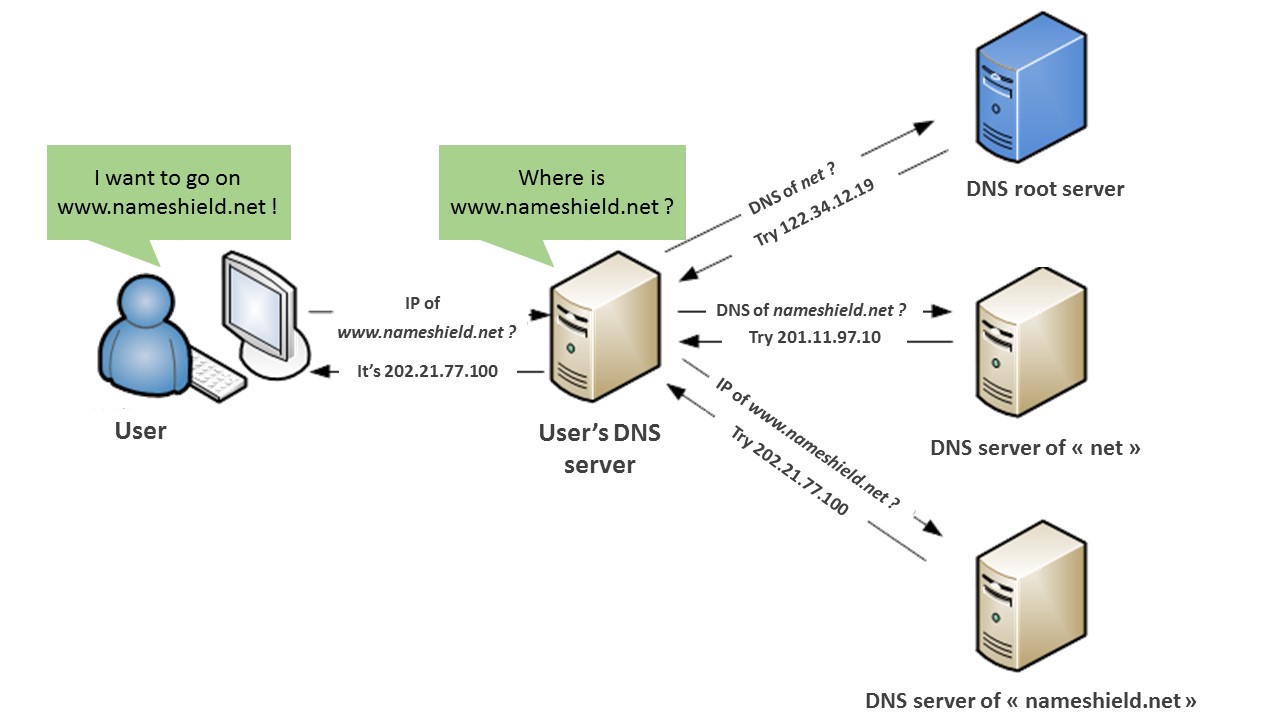
The DNS will allow web user to inform a domain name in his web browser to access a website. The browser will then “resolve” this domain name to obtain the IP address of the web server which hosts this website and displays it. We call this the “DNS resolution”.


DNS resolution 


What are the risks related to the DNS?

If the DNS goes down, your websites and emails are going to be unavailable, which is unthinkable nowadays. Other applications can be impacted in the companies: VPN access, intranet, cloud, VOIP… all that potentially needs a names resolution to IP addresses. DNS must be protected and stay highly available.

If the DNS protocol has been created with security in mind, many security flaws of the DNS protocol have been identified since its creation. The mainly flaws of DNS have been described in the RFC 3833 published in August 2004. Queries package interception, fake answer, data corruption, DNS cache poisoning and Denial of service.

To deal with this vulnerability, DNSSEC protocol has been created.


DNSSEC issues

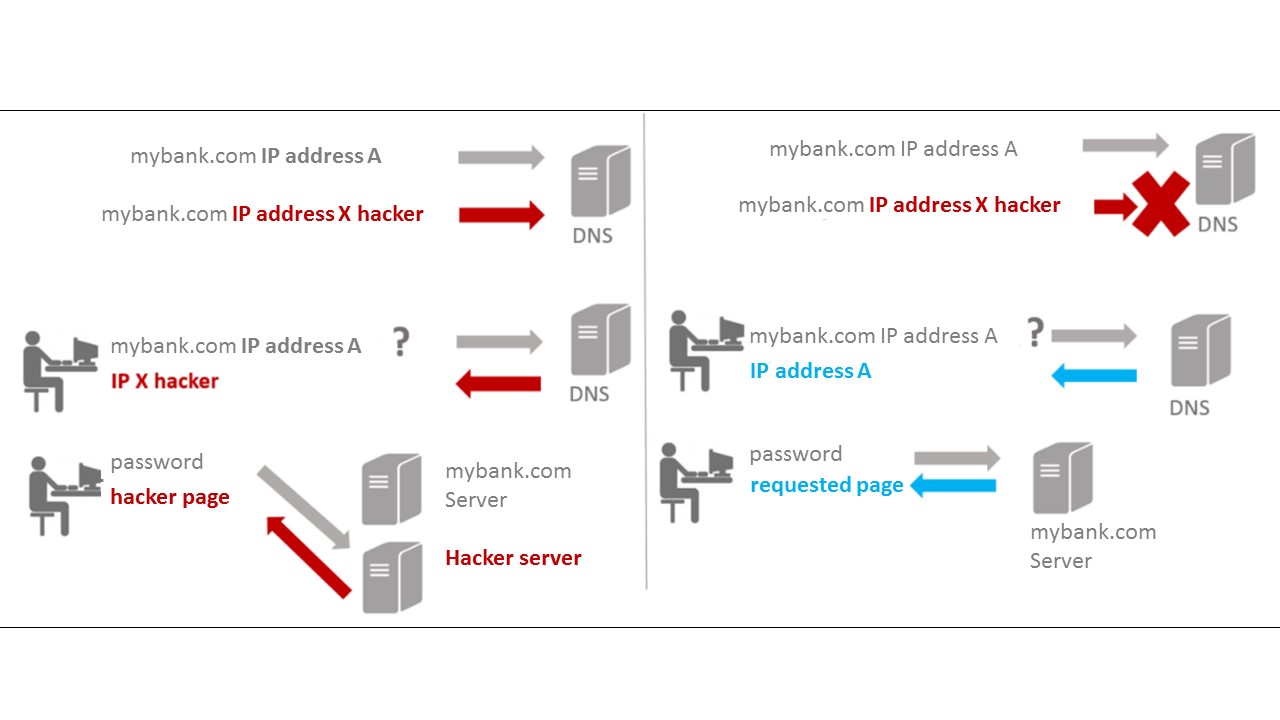
DNSSEC prevents these different attacks, particularly cache poisoning, by securing the integrity of the DNS resolution. DNSSEC issues are:

  • How to secure the data integrity and authenticate DNS (resolver, server with authority) and keep backward compatibility with the DNS at the same time.
  • How to secure access security at the resource asked to billions web users?
  • How to find a solution light enough so it won’t surcharge names servers?


DNSSEC process

To secure the integrity of the DNS resolution, DNSSEC develops a chain of trust that goes back to the DNS root (refer to the DNS root server image above). Data security is done by keys mechanism (KSK for Key Signing Key & ZSK for Zone Signing Key) which signs DNS records in its own zone. Public keys are sent to the corresponding register to be archived; the register being linked by DNSSEC to the root server, the chain of trust is developed. Each DNS parent zone ensures the keys authenticity of its child zones by signing them.


Without DNSSEC                                  With DNSSEC

DNSSEC process

DNSSEC, Nameshield and you:

DNSSEC operates like an essential protection for your strategic names, which secures DNS’ answer authenticity. It would be advisable to identify names that need to be protected. All TLDs don’t propose DNSSEC yet. Here is a list of principal TLDs that does, it can change with many more coming:

TLDs supporting DNSSEC: .fr, .com, .be, .net, .eu, .pl, .re, .pm, .yt, .wf, .tf, .info, .li, .ch, .biz, .de, .sx, .org, .se, .nl, .in, .us, .at, .nu, .la, .ac, .cz, .me, .sh, .io, .uk, .co.uk, .me.uk, .org.uk.

All news gTLDs, like .paris, .club, .xyz, .wiki, .ink, support also DNSSEC.

DNSSEC is included without supplement in Nameshield DNS Premium offer. Nameshield supports you in this process to secure your immaterial assets and manages the integrality of the DNSSEC protocol for you, from keys creation, to storage and renewal.

It’s not the only answer to set, registry lock system, DNS Premium service, SSL certificates are complementary solutions to implement, we will have the opportunity to discuss it in other articles or in the next nameshield.cafe.