The General Data Protection Regulation (GDPR)
has without a doubt a negative impact on the enforcement efforts, according to
the participants at the INTA 2019 annual meeting (International Trademark
Association) in Boston.
Margaret Lia Milam, domain name strategy and
management lead at Facebook warned that the platform’s scale makes it a “huge
target for bad actors”.
Milam stated that because the site is working
at such a scale, it cannot turn to lawyers for the “thousands” of requests it
receives.
Statton Hammock of MarkMonitor said that
MarkMonitor had suffered a loss of efficiency of 12% due to the GDPR. His team
has “historically used WHOIS to protect IP rights” but because of the GDPR, all
the data they have cached “become less and less useful with each passing day”.
Alex Deacon, founder of Cole Valley Consulting,
echoed Milam and Hammock’s comments warning that the Spamhaus Project, an
international organization aiming to track emails spammers, is struggling to
manage its blacklist because of the GDPR.
In the domain names’ world, the rules applied by many registries of “first come, first served” often lead to many cases of abusive registrations and of cybersquatting in particular. This is a practice that consists in taking a domain name by registering it, using or mentioning a trademark, a business name, a patronym or any name on which the applicant has any right, in order to make material or moral profit from its current or future notoriety.
In order to fight against these fraudulent actions and to assert their rights, brands’ owners can implement a targeted action to recuperate or suppress the cybersquatted domain name, called UDRP procedure (Uniform Domain Name Dispute Resolution Policy). This procedure is administered by an Arbitration Center like the one of the WIPO, the World Intellectual Property Organization.
According to the WIPO’s General Director, Francis
Gurry: “Domain names involving fraud and
phishing or counterfeit goods pose the most obvious threats, but all forms of
cybersquatting affect consumers. WIPO’s UDRP caseload reflects the continuing
need for vigilance on the part of trademark owners around the world.”
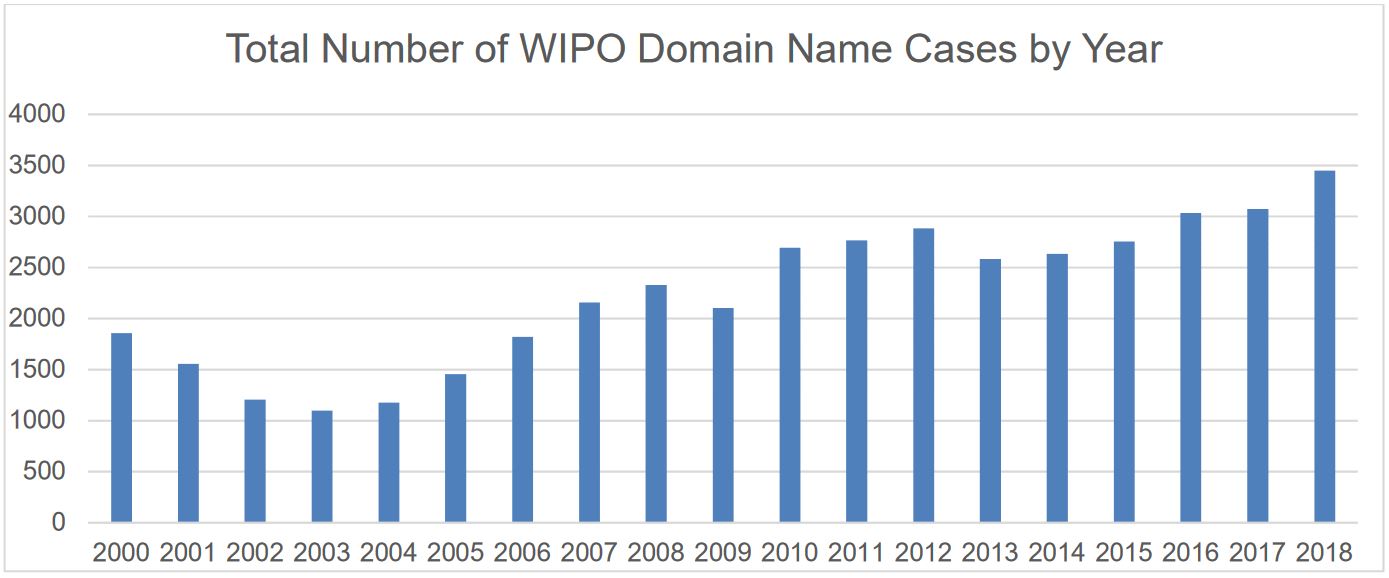
UDRP complaints filed with WIPO in 2018*
On March 15, 2019, the WIPO published its last annual report on domain names’ disputes.
In 2018, the WIPO’s Arbitration and Mediation Center received a record of 3447 UDRP cases filed by brands’ owners, i.e a rise of 12% compared to the previous year.
Source: WIPO Statistics Database
However these disputes concerned 5655 domain
names, a decrease comparing to 2017 which counted 6371 names.
The main gTLDs in the cases filed with WIPO are unsurprisingly, the .COM (far ahead with 72.88%), the .NET (4.62%), the .ORG (3.50%) and the .INFO (2.23%).
Regarding the disputes on the domain names registered in the new extensions, they represent nearly 13% of the disputes, mostly in .ONLINE, .LIFE and .APP domains.
And lastly, nearly 500 complaints regarding names registered in ccTLDs have been filed, nearly 15% of all the disputes administered by the WIPO in 2018.
The 3 main sectors of complainant activity are
the sectors of banking and finance, biotechnology and pharmaceuticals, and
Internet and IT.
Geographically, France is placed second with 553 cases filed with the WIPO, just behind the United States (976 complaints) and is one the most reactive countries on this subject.
Note that on all the UDRP cases filed in 2018, Nameshield ranks second in the filing world complaints with 343 cases filed and 66 represented customers**.
Our teams are of course at your disposal to inform you on the possibilities of contentious domain names recovery actions.
*Source: WIPO Statistics Database
**Source: Nameshield’s report on UDRP procedures, 2018
Image source : Nick Youngson CC BY-SA 3.0 Alpha Stock Images
Launched in 1999, the UDRP process (Uniform Domain Name Policy) is today the fastest and the most affordable solution for resolving clear cases of cybersquatting.
Indeed, UDRP offers to brands
owners a transparent process, carried out by independent experts allowing them
to retrieve or delete a domain name infringing their brands. It is important to
note that the expert cannot allocate the damages and interests to the requester.
MARQUES, a European association representing brand owners’ interests, raised,
on the 1st of February 2019 in a letter addressed to ICANN, the issue of the
costs supported by the brands owners for the defense of their brands in case of
cybersquatting.
The association collected several information regarding UDRP complaints
registered with seven Arbitrage Centers providing or having provided this
process, and in particular the ones concerning the number of UDRP complaints
filed and the associated costs.
In particular, between 1999 and December 2018, the WIPO (World
Intellectual Property Organization) registered 42 535 complaints filings. Knowing that the cost of the
arbitration fees of the WIPO (besides the representation fees) is at least
$1,500 USD, WIPO then collected at least $63,802,500
USD from administrative fees over nearly 20 years.
Furthermore, MARQUES proceeded to an estimation of the costs regarding
complaint filings by taking into account the fees of the representation by a
legal consultation and concluded that the cost of a UDRP complaint filing would
be $5,000 USD. Knowing the
arbitration fees, the representation fees by a legal consultation would then be
$3,500 USD.
Thus MARQUES estimates the costs (which regroup administrative fees and
legal consultation fees) supported by the trademarks owners are $360,190,000 USD for the period 1999 to
the end of 2018.
However, some members of the association, think that this is a low
estimation and that it would not take into account other expenses related to
the protection of their rights (revenue loss, monitoring costs, defensive
registration, lifting anonymity, research, etc).
The case of Ethereum foundation and the «.ETH » extension.
Ethereum is a foundation created during 2015, by Vitalik Buterin, a 21 years old Canadian. This foundation aims to promote the Ethereum blockchain technology, created by this young computer engineer, who proposes in addition to a virtual currency, like the Bitcoin blockchain, the possibility to create applications ensuring traceability, inviolability and sustainability of the transactions they manage. To allow to the greatest number of people to access to these applications, the Ethereum foundation has recently presented the ENS for «Ethereum Name Service», and its corollary, the «.ETH» extension.
Thus, if we take the example of the Bitcoin blockchain, the purpose was to create a virtual currency. The major interest consists in the absence of any central regulatory body, since it is controlled and managed by the community members, in a fully decentralized way. Any transaction done on the blockchain leads to an inscription in a block, published on a registry shared between the members. The transactions’ inscription in a block is carried out by « miners », who check, register and secure the transactions in the blockchain. This database hence lists all the transactions in blocks, creating a blocks chain supposed to be immutable and inviolable, due to the use of electronic signatures, and redistributed on the network, since it is decentralized.
Ethereum blockchain also has its currency, namely the Ether. But unlike Bitcoin, Ethereum didn’t create a virtual currency but has extended the use of the blockchain to other applications: the «smart contracts». Thus, Ether must not be considered as a currency but rather as a consumable allowing to exchange on the blockchain, use the applications it hosts.
The « smart contracts » concept
Ethereum proposes many possibilities of decentralized applications usable on its blockchain. These smart contracts are defined by the Blockchain France website as being « autonomous programs, which once started, automatically execute predefined conditions. They operate as any conditional instruction of « if – then » type (if such condition is verified, then such consequence is executed) ».
Concretely, this is a decentralized application, developed according to the Ethereum programming language (the Solidity), which automatically executes predefined instructions, on the conditions that the requirements are met, without the assistance of a third party, and ensuring that no modification is possible. These programs are executed on the Ethereum blockchain and controlled and certified by its members.
Thus, the promise is to delete intermediaries thanks to the total decentralization, managed by the processes automation.
For example, among possible applications, Ethereum foundation has announced on May 4th 2017, the creation of Ethereum Name Service, allowing domain names registration using «.ETH » extension.
Names’ registration in «.ETH »
The Ethereum Name Service, or ENS, corresponds to the Internet DNS, managed by ICANN, but unlike the latter, ENS is not based on root servers, but on the multitude of servers/machines, members of the Ethereum blockchain.
This is not a new registry having created another extension, but rather an alternative notion of the Internet.
Indeed, ENS is neither attached to the Global DNS, or to the IANA organization, nor to ICANN. ENS is a naming system specific to the Ethereum blockchain.
Domain name registration using «.ETH » is operating in a different way than classic domain name registration. This is a bidding system by anonymous deposit of a number of Ethers. In short, the name request opens a 72 hours period allowing other persons to bid. A second period of 48 hours then opens, during this period, each bidder must disclose their bid. The best bidder wins the name registration and is refund of their bid, minus the value corresponding to the difference of amounts between the two best bids. These funds are kept in a contract during 1 year minimum and can be removed at the end of this period, subject to release the name. If the name is the subject of one bid only, the bid’s winner is refund of the invested Ethers, except 0.01 Ether, corresponding to the minimum bid. This system should allow according to the ENS developers to prevent from speculation on domain names registration.
The system then doesn’t need an authority like ICANN, since the names ‘attribution is automated thanks to an IT program distributed and secured on the blockchain.
Nevertheless, if you type a domain name in «.ETH » in your browser search field, like Google Chrome, or Mozilla Firefox, an error page will be displayed. Indeed, the registered names in «.ETH » are not recognized by these browsers, since they aren’t part of the DNS network, they aren’t recognized as a domain name. Google Chrome extensions are proposed to create a bridge between the « web Ethereum » and the Internet that we know.
Hence, essentially, names currently registered in «.ETH » are only usable on the Ethereum blockchain, and therefore don’t affect the general public.
Lastly, the first use of ENS is, like the DNS, to allow the user to read and remember more easily an address by giving it a meaning. The DNS allows to translate an IP address in a legible address via the domain name.
Thus, ENS allows to translate an Ethereum user’s address (a user portfolio) of type «f14955b6f701a4bfd422dcc324cf1f4b5a466265 » in « myfirstname.eth ».
For example, when a user wishes to send Ether to another user, they only have to know their domain name and not their user address anymore. These domain names have a quite limited use, but may thereafter be used to access to future Ethereum applications.
The risks of the «.ETH » for brands owners
To this day, current web browsers don’t support these extensions, it seems that brands owners have no need to worry.
However, many French and international brands are « cybersquatted ». I.e. Ethereum users have won bids on brands names like « samsung.eth » or « volkswagen.eth ». They take over the name’s ownership for one year.
At the end of this first year of registration, the owners may release these names to retrieve the Ether stock associated to the name.
Risks should not be excluded in a near future if the «.ETH » are led to become more common and to offer interesting uses for the general public. Under this hypothesis, current web browsers could natively integrate «.ETH », in the same way as «.COM » or «.XYZ ».
Therefore, the owners of «.ETH » taking registered trademarks, for example may seek to benefit from this registration by using the reputation or identity of these protected brands, in order to divert the traffic to their own products or services. It may also be competitors seeking to tarnish their competitor’s brand image.
In the ICANN system, the rules enacted, in particular with UDRP procedures, propose to overcome these risks afterwards by allowing brands owners to try to recover a domain name using unjustly their brand. The restrictive nature of these rules, accepted and respected by registration offices, facilitates the application of the decision of Arbitration Center experts, and thus a domain name transfer to their rightful owner.
In the ENS system, there is no central authority which could enact these rules. Furthermore, domain names in «.ETH » have no real Whois file. To register such a domain name, they need to have Ethers and to create a portfolio. The identity is concealed behind a characters sequence, i.e. the digital impression of a cryptographic key. Therefore, it seems difficult to know the real identity of an owner in «.ETH ».
Furthermore, unlike the current system, it seems difficult to justify a territorial competence for «.ETH». The blockchain is not linked to any territory, it is distributed on all its members ‘machines, and thus all around the world.
The solution could eventually be developed by the Ethereum users themselves. It’s not to be excluded that an application is created in order to check the legitimacy of a domain name owner, on the basis of criteria defined in a program, like for example, the risk of confusion regarding a preexisting brand, and the good faith criteria in the use made of them. The constitution of a «popular jury » with voting materials would allow to decide on the issue as the result of a complaint from another member.
Glencoe is an “unforgettable place of dramatic mountains, rare beauty and haunting history” in the Scottish Highlands.
It is also a UK trademark, registered by several companies including The National Trust for Scotland. NTS’s 2016 trademark is registered for goods including beauty products, jewellery and clothing. A prior UK Glencoe mark protecting articles of clothing was registered in 1996 by Glenmuir Limited, a “family-run business dedicated to producing the finest golf wear” but it does not currently appear to be used on any articles of their clothing.
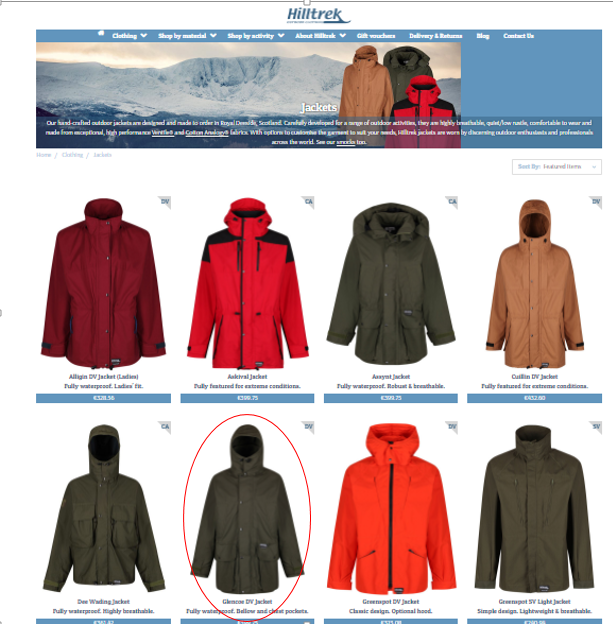
It is similarly the name that Hilltrek Outdoor Clothing gives to one of their hand crafted outdoor jackets.
The company, based in Aboyne, on the edge of the Highlands, has a 30 year history of manufacturing quality outdoor clothing. They have a long standing policy to name their jackets after some of their favourite places in Scotland. On the website you can find a link to a glossary providing information about the names and places used for their clothing.
Earlier this month Hilltrek owner Mr Shand received a cease & desist letter from NTS demanding they stop selling the Glencoe jacket. Mr Shand was surprised that a place name could be registered as a trademark. The Hilltrek website respects trademark rights, displaying the ® symbol next to several marks but not Glencoe.
The letter instructed Hilltrek to stop selling any goods bearing the name Glencoe immediately and refrain from using the name on any future products. Mr Shand published the letter that he found “bullying and threatening” on social media, saying that he would have understood and preferred a polite letter explaining the situation and asking for a dialogue.
This case raises serval interesting points for consideration.
Is it correct to register a place name to thereby blocking others from using it? NTS says that their aim is to protect the properties in their care and stop them being exploited. They encourage and support local business but have contacted a number of companies using trademarked names which are not local, including businesses based in France.
It is important to show tact when defending your IP rights in cases such as this. Reacting too harshly can result in this case with negative media attention for the complainant and great advertising opportunity for the “infringer”.
Which both underline the necessity of obtaining professional advice from an experienced IP Counsel whether you are defending a trademark or using one, even if you are not yet aware of it.
Nameshield uses cookies
Nameshield wishes to use cookies to ensure the proper functioning of the site and, with our partners, to measure its audience🍪.
Nameshield wishes to use cookies to ensure the proper performance of the website and, with our partners, to monitor its audience. More information in our Cookie Policy 🍪.
Necessary cookies are absolutely essential for the website to function properly. These cookies ensure basic functionalities and security features of the website, anonymously.
Cookie
Duration
Description
cookielawinfo-checkbox-advertisement
1 year
Set by the GDPR Cookie Consent plugin, this cookie is used to record the user consent for the cookies in the "Advertisement" category .
cookielawinfo-checkbox-analytics
11 months
This cookie is set by GDPR Cookie Consent plugin. The cookie is used to store the user consent for the cookies in the category "Analytics".
cookielawinfo-checkbox-functional
11 months
The cookie is set by GDPR cookie consent to record the user consent for the cookies in the category "Functional".
cookielawinfo-checkbox-necessary
11 months
This cookie is set by GDPR Cookie Consent plugin. The cookies is used to store the user consent for the cookies in the category "Necessary".
cookielawinfo-checkbox-others
11 months
This cookie is set by GDPR Cookie Consent plugin. The cookie is used to store the user consent for the cookies in the category "Other.
cookielawinfo-checkbox-performance
11 months
This cookie is set by GDPR Cookie Consent plugin. The cookie is used to store the user consent for the cookies in the category "Performance".
CookieLawInfoConsent
1 year
Records the default button state of the corresponding category & the status of CCPA. It works only in coordination with the primary cookie.
viewed_cookie_policy
11 months
The cookie is set by the GDPR Cookie Consent plugin and is used to store whether or not user has consented to the use of cookies. It does not store any personal data.
Functional cookies help to perform certain functionalities like sharing the content of the website on social media platforms, collect feedbacks, and other third-party features.
Performance cookies are used to understand and analyze the key performance indexes of the website which helps in delivering a better user experience for the visitors.
Analytical cookies are used to understand how visitors interact with the website. These cookies help provide information on metrics the number of visitors, bounce rate, traffic source, etc.
Cookie
Duration
Description
_ga
2 years
The _ga cookie, installed by Google Analytics, calculates visitor, session and campaign data and also keeps track of site usage for the site's analytics report. The cookie stores information anonymously and assigns a randomly generated number to recognize unique visitors.
_gat_gtag_UA_25904574_14
1 minute
Set by Google to distinguish users.
_gid
1 day
Installed by Google Analytics, _gid cookie stores information on how visitors use a website, while also creating an analytics report of the website's performance. Some of the data that are collected include the number of visitors, their source, and the pages they visit anonymously.
Advertisement cookies are used to provide visitors with relevant ads and marketing campaigns. These cookies track visitors across websites and collect information to provide customized ads.
Cookie
Duration
Description
NID
6 months
NID cookie, set by Google, is used for advertising purposes; to limit the number of times the user sees an ad, to mute unwanted ads, and to measure the effectiveness of ads.