
50 years after Arpanet, the Internet’s ancestor

Arpanet - Internet’s ancestor - Nameshield Blog
Image source: geralt via Pixabay

On October 29, 1969 UCLA sends the very first e-message to Stanford Research Institute through Arpanet network (Advanced Research Projects Agency Network) laying the foundation for today’s networked world.

Arpanet, the Internet’s precursor 

Arpanet is the first data transfer network developed by the Advanced Research Projects Agency (ARPA) which belonged to the U.S. Defense Department.

The first Arpanet node was set up at UCLA on August 30, 1969, the second node, at the Stanford Research Institute, was set up on October 1st 1969. The first message was sent between the two institutions on October 29 1969 by the UCLA computer science professor Leonard Kleinrock who wished to send the word “login” but the system crashed so only two letters, “l” and “o”, were transmitted, the complete word will only be transmitted 1 hour later.

Arpanet connected some universities and research institutes: first, UCLA and Stanford Research Institute, followed by UC Santa Barbara and the University of Utah. At the end of 1969, Arpanet counted 4 nodes, in 1971, 23 nodes were created and 111 nodes in 1977.

In 1983, Arpanet has been divided in two networks: one military, the MILnet (Military Network) and the other academic, the NSFnet.

On January 1st 1983, the name “Internet” already in use to define all of Arpanet, became official.

World Wide Web turns 30 years old

In 1989, Tim Berners-Lee, a researcher working for the CERN, proposed a hypertext system working on the Internet. This system was originally developed for scientists working in universities and institutes around the world, so they could instantly share information. His vision of universal connectivity became the World Wide Web, which sent Internet usage skyrocketing.

In 1993, Mosaic, the first popular web browser was created by Marc Andreessen and Eric J.Bina, two students of the National Center for Supercomputing Applications (NCSA) of the University of Illinois. It was not the first graphical web browser but Mosaic was particularly fast and allowed the users to display images inside web pages instead of displaying images in a separate window, which has given it some popularity and contributed to increase the World Wide Web’s popularity.

Internet Protocol – From IPv4 to IPv6

The Internet Protocol (IP) is a set of communication protocols of IT networks developed to be used on the Internet. IP protocols allow a unique addressing service for all connected devices.

IPv4 the first major version was invented in the 70’s and introduced to the public in 1981. It is still the dominant protocol of the Internet today. Twenty years ago, the IETF (Internet Engineering Task Force) started predicting the depletion of IPv4 addresses and began working to create a new version of the Internet Protocol: IPv6.

IPv4 uses a 32-bit addressing scheme to support 4.3 billion devices, while IPv6 possesses a much larger address space. Indeed, IPv6 uses a 128-bit address allowing 3.4 x 1038 possible addresses.

DNS – Domain Name System

At the request of the Advanced Research Projects Agency of the U.S. Defense Department, the DNS (Domain Name System) was invented in 1983 by Jon Postel and Paul Mockapetris, in order to associate complex IP addresses with humanly understandable and easy-to-remember names. Thus a logical address, the domain name, is associated to a physical address, the IP address. The domain name and IP address are unique.

In 1998, is created ICANN (Internet Corporation for Assigned Names and Numbers), the regulatory authority of the Internet. Its main purpose is to allocate the Internet protocol addresses spaces, to attribute the protocol identifier (IP), to manage the domain name system of top level for generic codes (gTLD), to assign the country codes (ccTLD), and to carry out the functions of the root servers’ system management.

With 351.8 million domain names registrations in the first quarter of 2019, domain names registrations continue to climb, but with the increase of the number of threats aiming the DNS at the same time.

The emergence of cyber threats

Considered as one of the first cyberattacks and certainly the first to attract the media’s attention, the Morris Worm was launched in 1988 by a student of the Cornell University, Robert Tappan Morris. Originally, the malware developed by the student didn’t have for purpose to cause damage but simply to estimate the extent of the Internet. However this worm affected about 60 000 computers estimated connected to the Internet and the cost of the damages was about 100 000 to 10 million dollars. This event marks the turning point in the field of online security.

Today, cyberattacks are abundant, frequent and more and more sophisticated. The evolution of techniques and the arrival of new technologies make cyberattacks increasingly complex and offer new opportunities to attackers.

There are various types of cyberattack like attacks aiming the DNS: DDoS, DNS cache poisoning, DNS spoofing, Man in the Middle… (In 2019, according to IDC – International Data Corporation, 82% of companies worldwide have faced a DNS attack over the past year) or attacks directly aiming users and having for purpose to obtain confidential information to steal an identity (phishing).

The consequences for victimized companies can be significant. For example, today the cost of a data breach is 3.92 million dollars on average according to IBM Security, this cost has risen 12% over the past five years.

An IP traffic estimated in 2022 more important than the one generated from 1984 to 2016

With more than 5 billion Google searches made every day, e-commerce continuing to thrive, social media growing in popularity and the increasing number of connected objects, the traffic volume on the Internet has risen considerably.

Indeed, in 1974, daily traffic on the Internet surpassed 3 million packets per day. According to a Cisco’s research in 2017, the global IP traffic reached 122 exabytes per month, the company estimates that this volume should reach 396 exabytes by 2022.

“The size and complexity of the Internet continues to grow in ways that many could not have imagined. Since we first started the VNI Forecast in 2005, traffic has increased 56-fold, amassing a 36% CAGR (Compound Annual Growth Rate) with more people, devices and applications accessing IP networks” said Jonathan Davidson, senior vice president and general manager of Service Provider Business at Cisco.

Today, 50 years after the birth of the Internet’s ancestor, Arpanet, there are more Internet connected devices than people in the world. In 2022, the web users will represent 60% of the world’s population and more than 28 billion devices will connect to the Internet.


NBA: Phishing doesn’t spare sports institutions

NBA: Phishing doesn’t spare sports institutions
Image source: mohamed_hassan via Pixabay

On last May 10th, in a press release, the Pacers Sports & Entertainment (PSE) organization, owner of the NBA’s basketball team the Indiana Pacers, revealed that they were the victim of a sophisticated phishing attack at the end of 2018.

For reminder, phishing is a technique used to obtain personal information in order to commit an identity theft.  This is a «social engineering» technique, i.e. consisting in exploiting not an IT flaw but a «human flaw» by deceiving web users through an e-mail seemingly coming from a trustworthy company, typically a bank or a business website.

Pacers Sports & Entertainment victim of a phishing attack

At the end of 2018, the company PSE has then been the target of a phishing emails campaign resulting in the unauthorized access to emails containing personal information related to a limited number of individuals.

This cyberattack affected a limited number of individuals but the amount of the stolen information is important: name, address, date of birth, passport number, driver’s license, state identification number, account number, credit/debit card number, digital signature, username and password and for some individuals, the Social Security number.

The American company has quickly implemented measures to secure the affected email accounts and investigate the incident with the assistance of forensic experts. This investigation then revealed that the hackers had access to the accounts of a limited number of persons between October 15th and December 4th, 2018. The press release doesn’t give any details regarding the identity of the targeted persons.

PSE individually notified each victim whose information has been stolen and assures that “to date, PSE has no evidence of actual or attempted misuse of any personal information”. The organization offered to the victims of the cyberattack an access to credit monitoring and identity protection services at no cost.

Some simple rules against phishing

Phishing attacks are increasing. Above all, they are becoming more and more sophisticated, and target all kinds of industries. Each and every one of us must be extra vigilant.

Lastly, for reminder, here are some simple rules to protect yourself against phishing attempts:

  • Do not reply when someone asks for your personal data by email;
  • Do not ever open an attachment from an unknown sender, or from one who is not entirely trustworthy;
  • Check the links by hovering the cursor over them (without clicking) to ensure that they link to trustworthy websites;
  • Do not trust the name of the mail’s sender. If there is any doubt, contact the sender through another method.

Russia – Vladimir Putin signs the « Sovereign Internet » bill into law

Russia – Vladimir Putin signs the « Sovereign Internet » bill into law
Image source: essuera via Pixabay

In a previous article of Lucie Loos dated of the 21st of last February, the study by the Duma, the lower Chamber of the Russian Parliament, of a draft legislation with the aim to create a “sovereign Internet” in Russia was mentioned. With this law, the country would be able to function in total independence if Russia was cut from the major global servers, by creating Russia’s internal DNS system, which would ensure the link between web address and IP address of the corresponding web servers, without relying on the root servers of the global Internet.

On Wednesday, the 1st of May 2019, Vladimir Putin signed a bill to create Russia’s “Sovereign Internet” into law, its entry into force is planned for November 2019.

Sovereign Internet: IT security or control of Internet?

The bill thus plans to create an “infrastructure allowing to ensure the functioning of the Russian Internet resources in case of the impossibility for the Russian operators to connect to the foreign sources Internet servers”.

The Russian Internet service providers will have to implement technical means allowing a “centralized control of the traffic” on their networks in order to face potential cyberattacks from foreign powerful countries. A control that will be done by Roskomnadzor, the agency in charge of the monitoring of the Russian Telecom and Medias, which has been often accused of arbitrarily blocking web content, and by the Russian Federal Security Service (FSB).

Officially, the “sovereign Internet” was created for the purpose of IT security, but according to many experts, this might be an excuse. This bill is criticized and deemed by many militants as an attempt to control web contents and progressively isolate the Russian Internet in an environment of increasing pressure from the authorities regarding the freedom of expression on Internet.

Many rallies against this bill were organized in Moscow and gathered thousands of Russians last March. Several weeks later, in a joint statement, many international human rights and freedom of expression organizations, of which Reporters without borders and Human Rights Watch, had called on Vladimir Putin not to sign the bill that is “against Moscow’s international commitments in terms of respect for Human rights and particularly poses a threat to media freedom and the rights to freedom of information for people in Russia”. Despite this, the Russian president chose to ignore it and thus the bill was signed on the 1st of May 2019, and will enter into force starting this coming November.

ANSSI annual report – The 5 cyber threats observed in 2018

ANSSI annual report – The 5 cyber threats observed in 2018
Image source: TheDigitalArtist via Pixabay

On April 15, 2019, ANSSI (the National Cybersecurity Agency of France), unveiled its annual report during a press conference. The agency identified 1869 alerts, 391 incidents without counting critical importance operators, 16 major incidents and 14 cyber defence operations for 2018. ANSSI also identified 5 major trends in terms of cyber threats observed in France and in Europe in 2018.

Analysis of cyber threat in 2018 – The 5 major trends

1.Cyber-espionage

Major concern for ANSSI in 2018, according to the agency, cyber-espionage represents the highest risk for the organizations.

Extremely discrete, benefiting from important financial resources, the attackers plan for many years highly targeted and highly sophisticated attacks. In 2018, it was noted that the cyber attackers are increasingly interested in vital activity sectors and specific critical infrastructures like the defence, health or research sectors.

2.Indirect attacks

According to ANSSI, indirect attacks have known an important increase in 2018. Indeed, to avoid the security measures implemented by big companies, which are more and more aware of the cyber risk, the attackers aim intermediaries, like providers, who are more vulnerable, to reach their final targets.

Compromising one partner is enough to reach many companies. So it is essential to choose partners that place their information system’s security at the top of their concerns.

3.Destabilization and influence operations

Because of the nature of the targets and the claims, these attacks though technically moderate, have often an important symbolic impact. An increase has been observed in 2018.

4.Cryptojacking

For reminder, cryptojacking is a cyberattack that consists in using the computer’s power of its victim to mine cryptocurrency.

In 2018, many attacks of this kind were observed. The more and more organized attackers benefit from the security flaws to compromise their victims’ equipment by placing cryptocurrencies’ miners without them knowing it.

5.Online frauds

Online frauds represent as much of a constant cyber threat for the companies and the big organizations as for the individuals. ANSSI noted an important growth of online frauds last year. Big operators are becoming more concerned about cybersecurity, so the attackers turn towards targets less exposed but more vulnerable, like territorial authorities or actors in the health sector which thus were the targets of many phishing attacks in 2018.

Conclusion

The multiplicity and the magnitude of the attacks observed during 2018, prove that it is essential to implement security measures to prevent these cyber threats, within big organizations, big groups as well as small companies.

“The conclusion is clear: 2018 proves once again that digital risk, far from being ethereal, must be at the heart of our concerns. Not only those of ANSSI! The cyberattacks affect all of society. That is why we must all seize the matter.” explains Guillaume Poupard, ANSSI’s General Director.

Cybersquatting: Increase of UDRP complaints filed with WIPO in 2018

Cybersquatting: Increase of UDRP complaints filed with WIPO in 2018
Image source: janjf93 via Pixabay

In the domain names’ world, the rules applied by many registries of “first come, first served” often lead to many cases of abusive registrations and of cybersquatting in particular. This is a practice that consists in taking a domain name by registering it, using or mentioning a trademark, a business name, a patronym or any name on which the applicant has any right, in order to make material or moral profit from its current or future notoriety.

In order to fight against these fraudulent actions and to assert their rights, brands’ owners can implement a targeted action to recuperate or suppress the cybersquatted domain name, called UDRP procedure (Uniform Domain Name Dispute Resolution Policy). This procedure is administered by an Arbitration Center like the one of the WIPO, the World Intellectual Property Organization.

According to the WIPO’s General Director, Francis Gurry: “Domain names involving fraud and phishing or counterfeit goods pose the most obvious threats, but all forms of cybersquatting affect consumers. WIPO’s UDRP caseload reflects the continuing need for vigilance on the part of trademark owners around the world.”

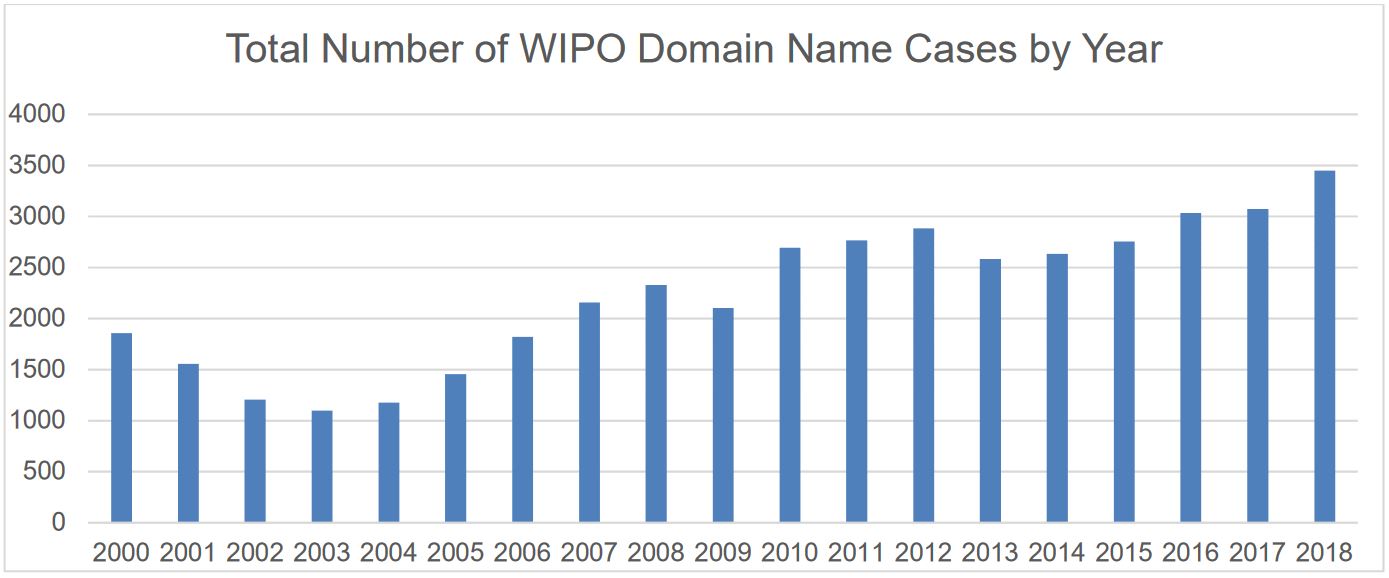
UDRP complaints filed with WIPO in 2018*

On March 15, 2019, the WIPO published its last annual report on domain names’ disputes.

In 2018, the WIPO’s Arbitration and Mediation Center received a record of 3447 UDRP cases filed by brands’ owners, i.e a rise of 12% compared to the previous year.

Cybersquatting: Increase of UDRP complaints filed with WIPO in 2018
Source: WIPO Statistics Database

However these disputes concerned 5655 domain names, a decrease comparing to 2017 which counted 6371 names.

The main gTLDs in the cases filed with WIPO are unsurprisingly, the .COM (far ahead with 72.88%), the .NET (4.62%), the .ORG (3.50%) and the .INFO (2.23%).

Regarding the disputes on the domain names registered in the new extensions, they represent nearly 13% of the disputes, mostly in .ONLINE, .LIFE and .APP domains.

And lastly, nearly 500 complaints regarding names registered in ccTLDs have been filed, nearly 15% of all the disputes administered by the WIPO in 2018.

The 3 main sectors of complainant activity are the sectors of banking and finance, biotechnology and pharmaceuticals, and Internet and IT.

Geographically, France is placed second with 553 cases filed with the WIPO, just behind the United States (976 complaints) and is one the most reactive countries on this subject.

Note that on all the UDRP cases filed in 2018, Nameshield ranks second in the filing world complaints with 343 cases filed and 66 represented customers**.

Our teams are of course at your disposal to inform you on the possibilities of contentious domain names recovery actions.


*Source: WIPO Statistics Database

**Source: Nameshield’s report on UDRP procedures, 2018