The General Data Protection Regulation (GDPR)
has without a doubt a negative impact on the enforcement efforts, according to
the participants at the INTA 2019 annual meeting (International Trademark
Association) in Boston.
Margaret Lia Milam, domain name strategy and
management lead at Facebook warned that the platform’s scale makes it a “huge
target for bad actors”.
Milam stated that because the site is working
at such a scale, it cannot turn to lawyers for the “thousands” of requests it
receives.
Statton Hammock of MarkMonitor said that
MarkMonitor had suffered a loss of efficiency of 12% due to the GDPR. His team
has “historically used WHOIS to protect IP rights” but because of the GDPR, all
the data they have cached “become less and less useful with each passing day”.
Alex Deacon, founder of Cole Valley Consulting,
echoed Milam and Hammock’s comments warning that the Spamhaus Project, an
international organization aiming to track emails spammers, is struggling to
manage its blacklist because of the GDPR.
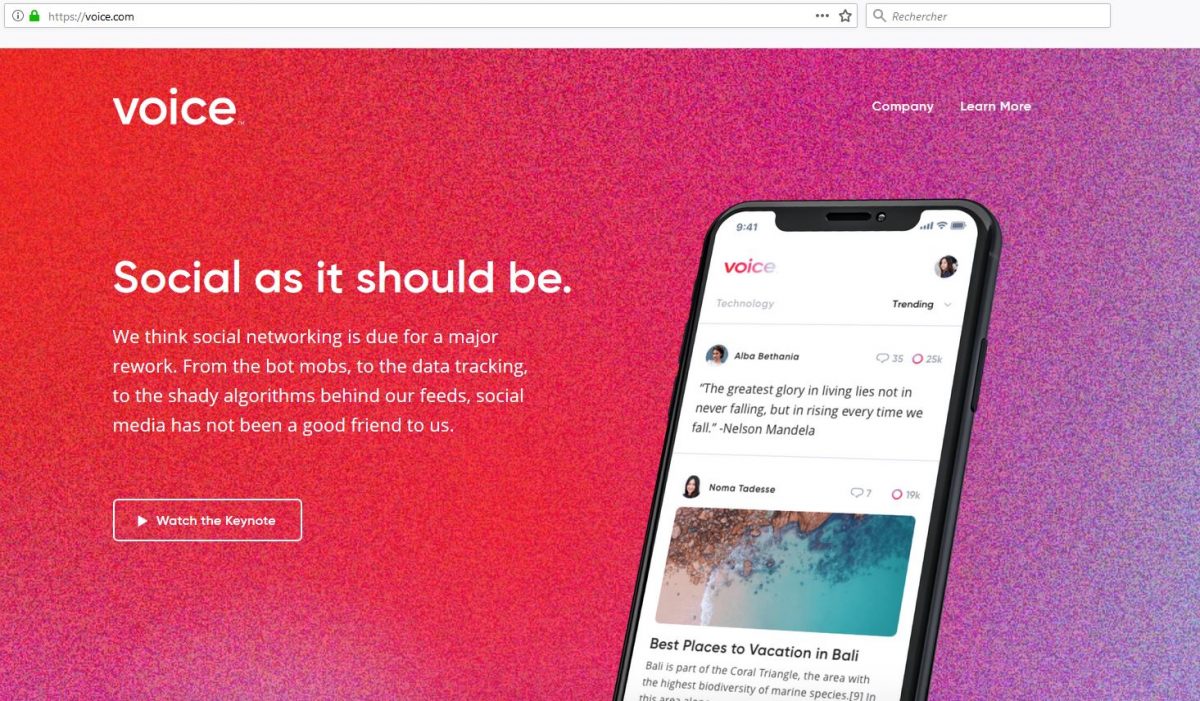
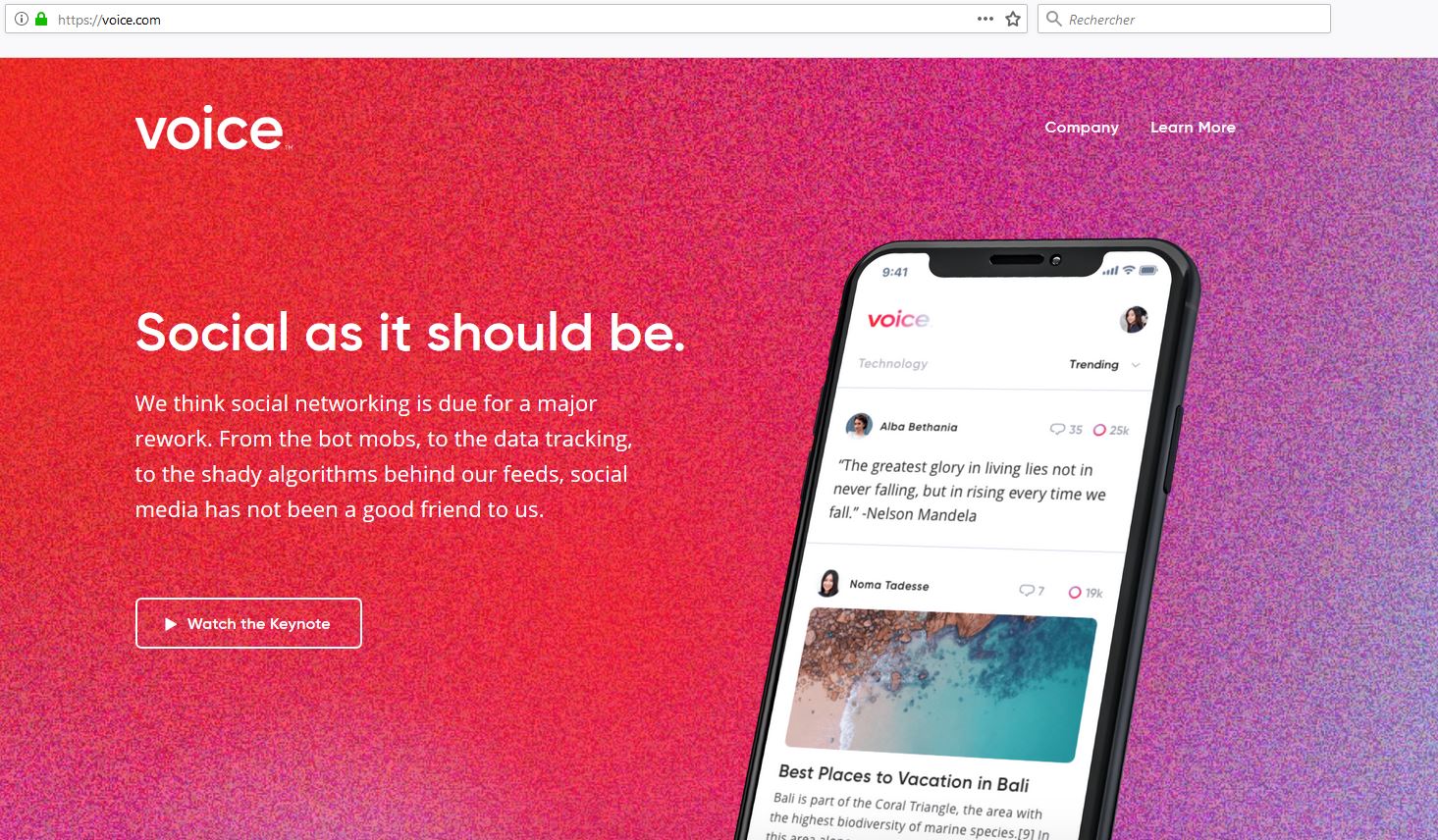
Block.one (EOS), the startup behind the EOS cryptocurrency acquires the voice.com domain name for the amount of $30 million.
This is how the Chief Marketing Officer of
MicroStrategy explains this acquiring at a high price: “Block.one has made a
smart strategic decision in choosing Voice.com to be the internet domain name
for its new social media platform. The word “voice” is simple and universally
understood. It’s also ubiquitous ― as a search term […]. An ultra-premium
domain name like Voice.com can help
a company achieve instant brand recognition, ignite a business, and massively
accelerate value creation”.
It places this sale in the top 5 of the biggest
domain names’ sales:
Lasvegas.com $90 million in 2005.
CarInsurance.com $49.7 million in 2010.
Insurance.com $35.6 million in 2010.
PrivateJet.com $30.18 million in 2012.
Voice.com $30 million in 2019.
After having raised more than $4 billion
through a fundraising in cryptocurrencies (ICO), the startup Block.one plans to
use the domain name with the aim to compete with the social media platform
Facebook.
The social media platform VOICE is opened since June, 1st 2019.
At a keynote, EOS’ CEO Brendan Blumer and Dan Larimer Block.one’s CTO, presented VOICE as an absolute alternative to everything that represents Facebook.
“Our content. Our data. Our attention. These
are all incredibly valuable things. But right now, it’s the platform, not the user
that reaps the reward. By design, they run by auctioning our information to
advertisers, pocketing the profit, and flooding our feeds with hidden agendas
dictated by the highest bidder. Voice changes that.”
In order to differentiate from Facebook, VOICE will function on the following basis:
VOICE
will operate on EOS blockchain, which is upgrading to a faster version 2 for
the occasion;
An
anti-bot policy and other trolls will be implemented, without more details
disclosed on the technology approach;
The
blockchain will be public;
The
arbiter of what must be seen or not, will not be the algorithm but the consensus;
Regarding
security, a partnership with Yubico, makers of the Yubikey was announced. EOS seems
to aim for an integration with WebAuthn, a standard for authentication without
password recently approved by the W3C.
In other words, EOS wants to propose a model
opposite to Facebook: the control by everyone of their personal data and their
possible monetization.
On last May 10th, in a press release, the Pacers Sports & Entertainment (PSE) organization, owner of the NBA’s basketball team the Indiana Pacers, revealed that they were the victim of a sophisticated phishing attack at the end of 2018.
For reminder, phishing is a technique used to obtain personal information in order to commit an identity theft. This is a «social engineering» technique, i.e. consisting in exploiting not an IT flaw but a «human flaw» by deceiving web users through an e-mail seemingly coming from a trustworthy company, typically a bank or a business website.
Pacers Sports & Entertainment victim of a phishing attack
At the end of 2018, the company PSE has then been the target of a phishing emails campaign resulting in the unauthorized access to emails containing personal information related to a limited number of individuals.
This cyberattack affected a limited number of
individuals but the amount of the stolen information is important: name,
address, date of birth, passport number, driver’s license, state identification
number, account number, credit/debit card number, digital signature, username
and password and for some individuals, the Social Security number.
The American company has quickly implemented
measures to secure the affected email accounts and investigate the incident
with the assistance of forensic experts. This investigation then revealed that
the hackers had access to the accounts of a limited number of persons between
October 15th and December 4th, 2018. The press release
doesn’t give any details regarding the identity of the targeted persons.
PSE individually notified each victim whose
information has been stolen and assures that “to date, PSE has no evidence of
actual or attempted misuse of any personal information”. The organization offered
to the victims of the cyberattack an access to credit monitoring and identity
protection services at no cost.
Some simple rules against phishing
Phishing attacks are increasing. Above all, they are becoming more and more sophisticated, and target all kinds of industries. Each and every one of us must be extra vigilant.
Lastly, for reminder, here are some simple rules to protect yourself against phishing attempts:
Do
not reply when someone asks for your personal data by email;
Do
not ever open an attachment from an unknown sender, or from one who is not
entirely trustworthy;
Check
the links by hovering the cursor over them (without clicking) to ensure that
they link to trustworthy websites;
Do
not trust the name of the mail’s sender. If there is any doubt, contact the
sender through another method.
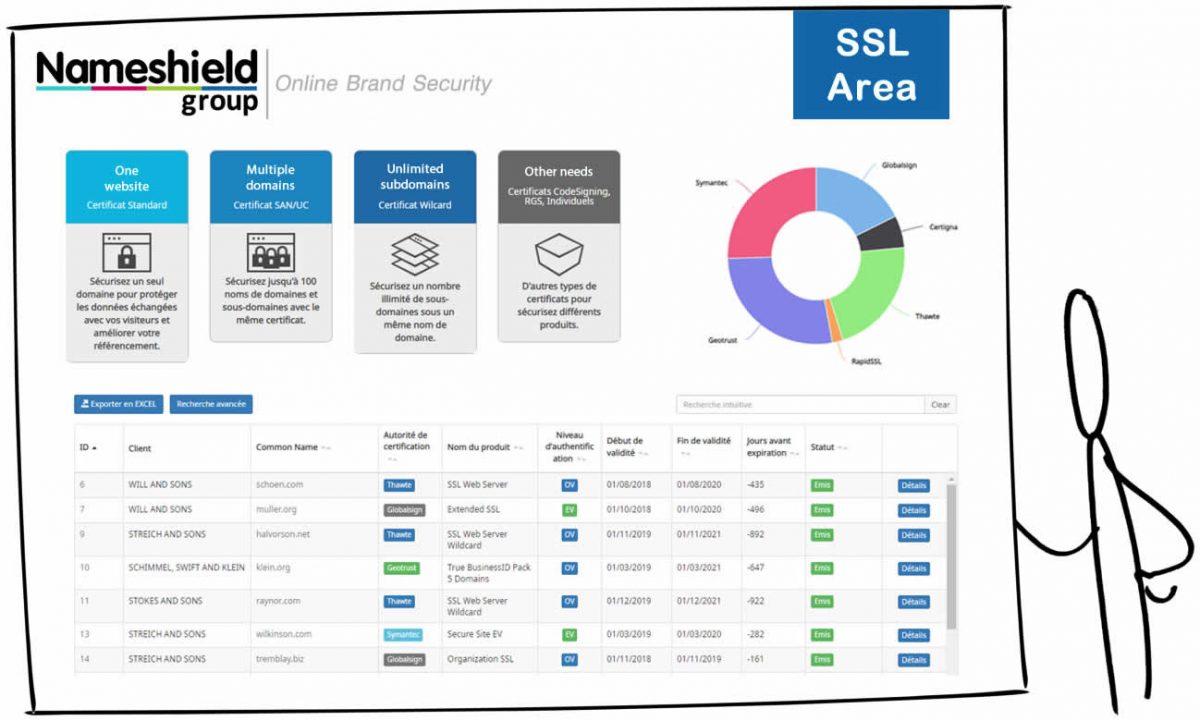
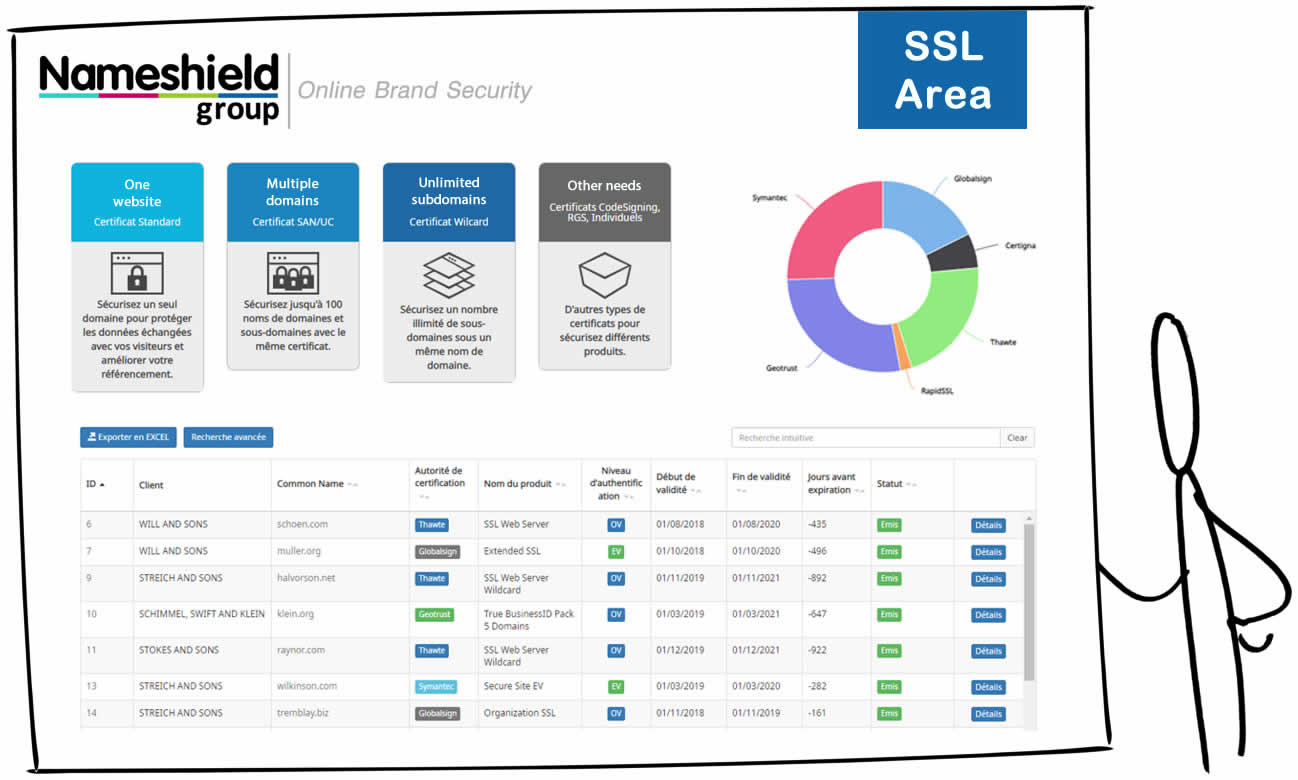
More user-friendly, more comprehensive, more
attractive… our brand new and improved
Nameshield SSL interface is being launched on Thursday, June 13th allowing
you to manage all of your certificates.
You will now have access to key metrics on your
certificate portfolio, to different certificate lookup views (such as complete
portfolio, detailed overview, certificates nearing expiry, pending orders,
expired or revoked certificates), to an Organization and Contact management
tool and a redesigned ordering system.
Lastly, a decision support tool has been
included in the interface to help you choose the certificate that’s right for
your needs.
The certificate range has been updated to cover
all types of certificates, SSL, RGS, Code Signing, Individual certificates and
with all levels of authentication.
The SSL team remains at your disposal for a
demonstration and a complete user guide is available covering all possible
operations and actions.
On Friday May 17th, 2019, the
Council of Ministers of the European Union presented the creation of a
blacklist identifying the perpetrators of cybercrimes located outside the EU.
Thus this is a new legal context which has been
validated by the EU in order to try to reduce the continuously growing
cyberattacks’ number. Now, the EU will indeed be able to sanction individuals
or entities involved in the cyberattacks carried out from outside the EU.
Europe seeks through this measure to protect as
far as possible the most critical infrastructures, regarding electoral or
health systems for example, from cybercriminals, by abolishing the impunity
which the international hackers seemingly enjoyed.
If there is no name on this famous list today,
the situation could change soon.
Recently, the British Foreign Secretary, Jeremy Hunt declared that “for too long now, hostile actors have been threatening the EU’s security through disrupting critical infrastructure, attempting to undermine democracy and stealing commercial secrets and money running to billions of Euros. Hence, this decision was necessary.”
It’s now very clear that the cyberattacks carried out by nations, against nations or entities, tend to multiply. It’s important to note that these sanctions can be retroactive. To this day, the sanctions are not clearly defined: travel bans and assets freeze against those we know have been responsible for these actions? Several options are presently being studied.
Nameshield uses cookies
Nameshield wishes to use cookies to ensure the proper functioning of the site and, with our partners, to measure its audience🍪.
Nameshield wishes to use cookies to ensure the proper performance of the website and, with our partners, to monitor its audience. More information in our Cookie Policy 🍪.
Necessary cookies are absolutely essential for the website to function properly. These cookies ensure basic functionalities and security features of the website, anonymously.
Cookie
Duration
Description
cookielawinfo-checkbox-advertisement
1 year
Set by the GDPR Cookie Consent plugin, this cookie is used to record the user consent for the cookies in the "Advertisement" category .
cookielawinfo-checkbox-analytics
11 months
This cookie is set by GDPR Cookie Consent plugin. The cookie is used to store the user consent for the cookies in the category "Analytics".
cookielawinfo-checkbox-functional
11 months
The cookie is set by GDPR cookie consent to record the user consent for the cookies in the category "Functional".
cookielawinfo-checkbox-necessary
11 months
This cookie is set by GDPR Cookie Consent plugin. The cookies is used to store the user consent for the cookies in the category "Necessary".
cookielawinfo-checkbox-others
11 months
This cookie is set by GDPR Cookie Consent plugin. The cookie is used to store the user consent for the cookies in the category "Other.
cookielawinfo-checkbox-performance
11 months
This cookie is set by GDPR Cookie Consent plugin. The cookie is used to store the user consent for the cookies in the category "Performance".
CookieLawInfoConsent
1 year
Records the default button state of the corresponding category & the status of CCPA. It works only in coordination with the primary cookie.
viewed_cookie_policy
11 months
The cookie is set by the GDPR Cookie Consent plugin and is used to store whether or not user has consented to the use of cookies. It does not store any personal data.
Functional cookies help to perform certain functionalities like sharing the content of the website on social media platforms, collect feedbacks, and other third-party features.
Performance cookies are used to understand and analyze the key performance indexes of the website which helps in delivering a better user experience for the visitors.
Analytical cookies are used to understand how visitors interact with the website. These cookies help provide information on metrics the number of visitors, bounce rate, traffic source, etc.
Cookie
Duration
Description
_ga
2 years
The _ga cookie, installed by Google Analytics, calculates visitor, session and campaign data and also keeps track of site usage for the site's analytics report. The cookie stores information anonymously and assigns a randomly generated number to recognize unique visitors.
_gat_gtag_UA_25904574_14
1 minute
Set by Google to distinguish users.
_gid
1 day
Installed by Google Analytics, _gid cookie stores information on how visitors use a website, while also creating an analytics report of the website's performance. Some of the data that are collected include the number of visitors, their source, and the pages they visit anonymously.
Advertisement cookies are used to provide visitors with relevant ads and marketing campaigns. These cookies track visitors across websites and collect information to provide customized ads.
Cookie
Duration
Description
NID
6 months
NID cookie, set by Google, is used for advertising purposes; to limit the number of times the user sees an ad, to mute unwanted ads, and to measure the effectiveness of ads.