
ICANN66 at Montreal – A contrasting summit

During the first half of November, the 66th ICANN Summit was held in Montreal, Canada. This third and final annual summit devoted to policies applicable to Internet naming was eagerly awaited as the topics under discussion are numerous. At its closing, however, it left many participants a little bit disappointed.

A preview of the topics and postures during the weekend before the official launch of the Summit

The weekend before the official opening of the Summit is usually an opportunity to get an overview of the topics and postures involved. Not surprisingly, the expedited Policy Development Process (ePDP) which aims to develop a consensus rule to specify future conditions of access to personal data that are no longer published in the WHOIS, the domain name search directory, due to GDPR, is one of the major topics.

Among other related topics, the replacement of the same WHOIS by the RDAP (Registration Data Access Protocol) probably next year for generic domain names. This replacement is not insignificant when we know that WHOIS has been in use for nearly 35 years.

The body representing governments, the GAC, has weighed up the issue of domain name abuse, which has taken off considerably on the new generic extensions launched in 2012. When we know the rise of Internet practices aimed at weighing on elections in certain countries and the economic impact of computer attacks and hacking, we understand that this subject is being pushed by the GAC. While one of ICANN’s topics is to clarify in their texts the notion of malicious uses, this term refers to domains registered for phishing, malware, botnets and spam, the other part concerns the means to stem them. The existence of abusive domains indeed threatens the DNS infrastructure, impacts consumer safety and threatens the critical assets of public and commercial entities. Finally, and not surprisingly, the subject of a future round of new generic extensions has also been on many lips.
ICANN66 at Montreal - A contrasting summit
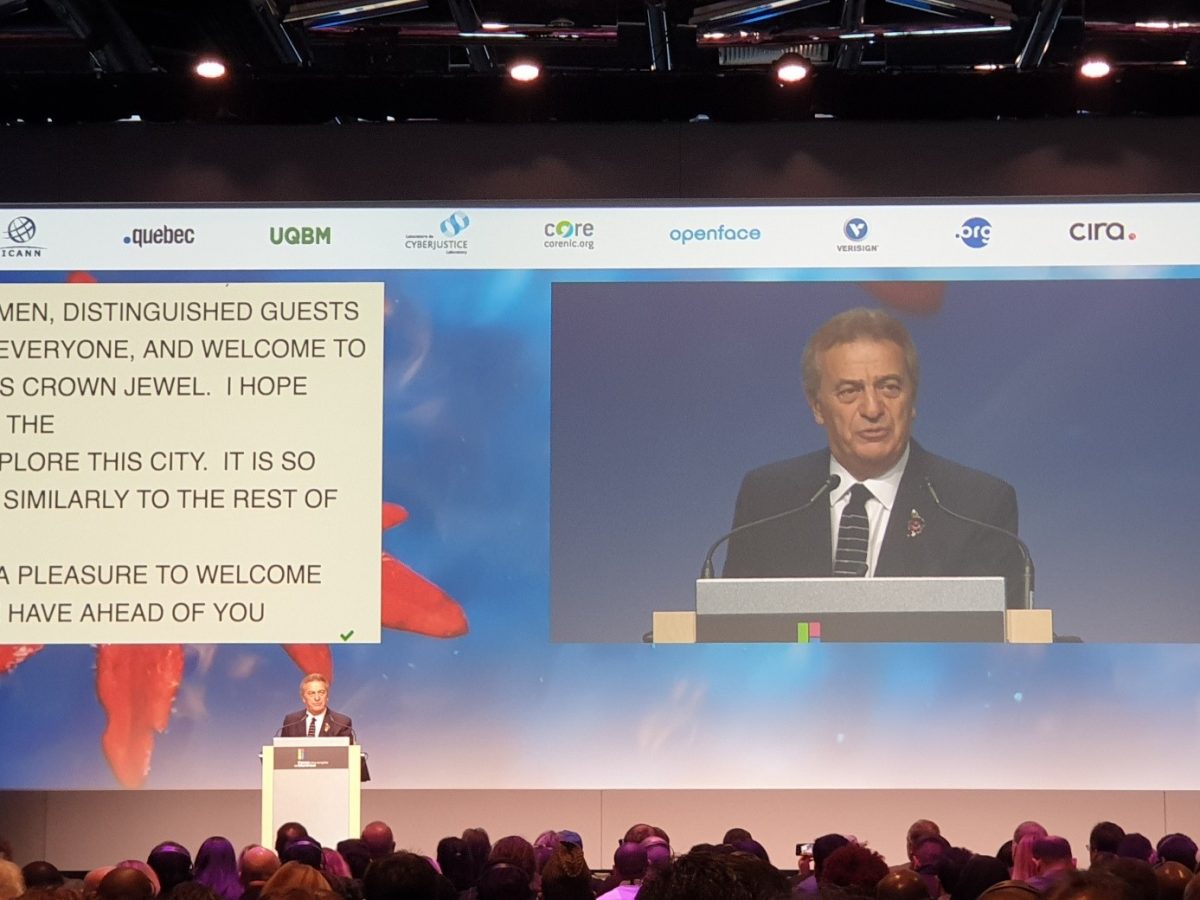
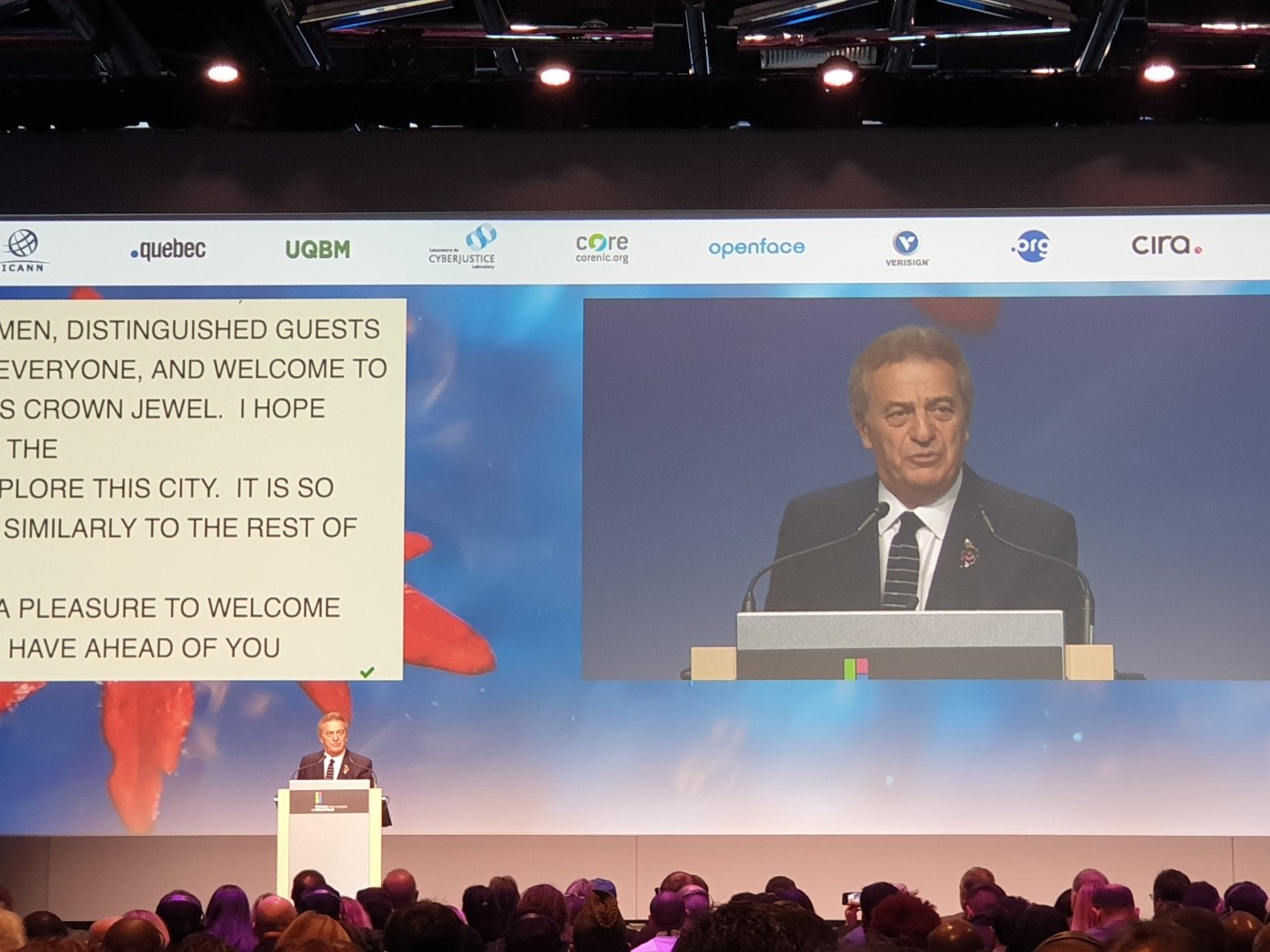
Cherine Chalaby at the ICANN Summit held in Montreal

“The best ICANN summit”, really?

During the traditional opening ceremony, which brings together all the guests for one hour (2500 according to Goran Marby, ICANN CEO) in a huge room to listen to various speakers, including Martin Aubé of the Quebec Government’s Ministry of Economy and Innovation, Cherine Chalaby, one of the ICANN Board members whose term ends at the end of the year, told his audience that ICANN66 would be the “Best ICANN summit”. It must be said, however, that at the end of the week of debates and meetings, which followed one another at a sustained pace, while the subjects under discussion are really numerous, the feeling regarding this assertion was more than mixed for many participants.

First, the expeditious process for access to WHOIS non-public data is progressing with a framework constrained by ICANN and the Personal Data Protection Authorities. The outcome of this process is envisaged between April and June 2020 and it is currently a centralized model where ICANN would allow the future lifting of anonymity of data that are now masked due to GDPR which holds the line.

Then the subject that was probably most often mentioned during this new summit week concerned abuses with domain names. For ICANN, the subject is central because it is directly correlated to its totem: the stability of the Internet for which they are the responsible. Since February 2019, ICANN has been publishing some metrics on malicious practices identified through DAAR, their Domain Abuse Activity Reporting.

Their latest report presented in Montreal shows that 364 extensions (mainly new generic extensions from the 2012 round) revealed at least one threat posed by one of the domain names activated on these extensions. More worryingly, new generic extensions would still account for nearly 40% of malicious uses, compared to 60% for historical generic extensions. This figure should be highlighted with the volume of these two categories of extensions. Indeed, out of just over 200 million generic names, new generic domains represent only 15% of the total number of registered names. ICANN therefore wants this subject to be taken up by the entire community present in Montreal.

Proposals were made by the various bodies present, some of which went so far as to request a policy development process (PDP). This last proposal, if it were to obtain ICANN’s approval, would have the unfortunate consequence of postponing the hypothetical schedule for a next round of new extensions, a subject that interested many of the guests present in Montreal. Indeed, for ICANN, the problem of the concentration of malicious practices in the new generic extensions must be solved before any future round, so that the PDP still in progress on the review of the last round of 2012 has gone almost unnoticed.  

If the rules are slow to evolve on malicious uses, your Nameshield consultant can already provide you with adapted solutions to your needs on this key matter.


50 years after Arpanet, the Internet’s ancestor

Arpanet - Internet’s ancestor - Nameshield Blog
Image source: geralt via Pixabay

On October 29, 1969 UCLA sends the very first e-message to Stanford Research Institute through Arpanet network (Advanced Research Projects Agency Network) laying the foundation for today’s networked world.

Arpanet, the Internet’s precursor 

Arpanet is the first data transfer network developed by the Advanced Research Projects Agency (ARPA) which belonged to the U.S. Defense Department.

The first Arpanet node was set up at UCLA on August 30, 1969, the second node, at the Stanford Research Institute, was set up on October 1st 1969. The first message was sent between the two institutions on October 29 1969 by the UCLA computer science professor Leonard Kleinrock who wished to send the word “login” but the system crashed so only two letters, “l” and “o”, were transmitted, the complete word will only be transmitted 1 hour later.

Arpanet connected some universities and research institutes: first, UCLA and Stanford Research Institute, followed by UC Santa Barbara and the University of Utah. At the end of 1969, Arpanet counted 4 nodes, in 1971, 23 nodes were created and 111 nodes in 1977.

In 1983, Arpanet has been divided in two networks: one military, the MILnet (Military Network) and the other academic, the NSFnet.

On January 1st 1983, the name “Internet” already in use to define all of Arpanet, became official.

World Wide Web turns 30 years old

In 1989, Tim Berners-Lee, a researcher working for the CERN, proposed a hypertext system working on the Internet. This system was originally developed for scientists working in universities and institutes around the world, so they could instantly share information. His vision of universal connectivity became the World Wide Web, which sent Internet usage skyrocketing.

In 1993, Mosaic, the first popular web browser was created by Marc Andreessen and Eric J.Bina, two students of the National Center for Supercomputing Applications (NCSA) of the University of Illinois. It was not the first graphical web browser but Mosaic was particularly fast and allowed the users to display images inside web pages instead of displaying images in a separate window, which has given it some popularity and contributed to increase the World Wide Web’s popularity.

Internet Protocol – From IPv4 to IPv6

The Internet Protocol (IP) is a set of communication protocols of IT networks developed to be used on the Internet. IP protocols allow a unique addressing service for all connected devices.

IPv4 the first major version was invented in the 70’s and introduced to the public in 1981. It is still the dominant protocol of the Internet today. Twenty years ago, the IETF (Internet Engineering Task Force) started predicting the depletion of IPv4 addresses and began working to create a new version of the Internet Protocol: IPv6.

IPv4 uses a 32-bit addressing scheme to support 4.3 billion devices, while IPv6 possesses a much larger address space. Indeed, IPv6 uses a 128-bit address allowing 3.4 x 1038 possible addresses.

DNS – Domain Name System

At the request of the Advanced Research Projects Agency of the U.S. Defense Department, the DNS (Domain Name System) was invented in 1983 by Jon Postel and Paul Mockapetris, in order to associate complex IP addresses with humanly understandable and easy-to-remember names. Thus a logical address, the domain name, is associated to a physical address, the IP address. The domain name and IP address are unique.

In 1998, is created ICANN (Internet Corporation for Assigned Names and Numbers), the regulatory authority of the Internet. Its main purpose is to allocate the Internet protocol addresses spaces, to attribute the protocol identifier (IP), to manage the domain name system of top level for generic codes (gTLD), to assign the country codes (ccTLD), and to carry out the functions of the root servers’ system management.

With 351.8 million domain names registrations in the first quarter of 2019, domain names registrations continue to climb, but with the increase of the number of threats aiming the DNS at the same time.

The emergence of cyber threats

Considered as one of the first cyberattacks and certainly the first to attract the media’s attention, the Morris Worm was launched in 1988 by a student of the Cornell University, Robert Tappan Morris. Originally, the malware developed by the student didn’t have for purpose to cause damage but simply to estimate the extent of the Internet. However this worm affected about 60 000 computers estimated connected to the Internet and the cost of the damages was about 100 000 to 10 million dollars. This event marks the turning point in the field of online security.

Today, cyberattacks are abundant, frequent and more and more sophisticated. The evolution of techniques and the arrival of new technologies make cyberattacks increasingly complex and offer new opportunities to attackers.

There are various types of cyberattack like attacks aiming the DNS: DDoS, DNS cache poisoning, DNS spoofing, Man in the Middle… (In 2019, according to IDC – International Data Corporation, 82% of companies worldwide have faced a DNS attack over the past year) or attacks directly aiming users and having for purpose to obtain confidential information to steal an identity (phishing).

The consequences for victimized companies can be significant. For example, today the cost of a data breach is 3.92 million dollars on average according to IBM Security, this cost has risen 12% over the past five years.

An IP traffic estimated in 2022 more important than the one generated from 1984 to 2016

With more than 5 billion Google searches made every day, e-commerce continuing to thrive, social media growing in popularity and the increasing number of connected objects, the traffic volume on the Internet has risen considerably.

Indeed, in 1974, daily traffic on the Internet surpassed 3 million packets per day. According to a Cisco’s research in 2017, the global IP traffic reached 122 exabytes per month, the company estimates that this volume should reach 396 exabytes by 2022.

“The size and complexity of the Internet continues to grow in ways that many could not have imagined. Since we first started the VNI Forecast in 2005, traffic has increased 56-fold, amassing a 36% CAGR (Compound Annual Growth Rate) with more people, devices and applications accessing IP networks” said Jonathan Davidson, senior vice president and general manager of Service Provider Business at Cisco.

Today, 50 years after the birth of the Internet’s ancestor, Arpanet, there are more Internet connected devices than people in the world. In 2022, the web users will represent 60% of the world’s population and more than 28 billion devices will connect to the Internet.