ICANN70: At the crossroads of different policy development processes

Initially scheduled to take place in Cancun, Mexico, like ICANN67 , the recent summit on Internet governance was once again held entirely by videoconference due to the global health situation. The PDPs, the Policy Development Processes, were the main thread of this summit.
ICANN 70
ICANN70 was the fourth summit held remotedely

The PDP, Policy Development Process, is the central community mechanism used by the Generic Names Supporting Organization (Gnso), the body responsible for policy developments on generic domain names, to propose new requirements and revise existing rules to update them. Each PDP results in a series of reports that are ultimately forwarded to the ICANN Board of Directors, which decides on the fate of the recommendations they contain. 

News on the PDP of the new generic extensions

It is with this mechanism that ICANN launched a program of new generic extensions that led to 1930 applications in Spring 2012 and 1233 delegated extensions by the end of 2020. The opportunity to consider a new round of applications was materialized by a PDP initiated by Gnso in late 2015. Five years later, this process to review and improve the Gnso recommendations for the 2012 cycle has entered its final stretch. It is now up to the ICANN Board to decide on the recommendations of the working groups that worked on this PDP. The Board of Directors should launch a last phase of consultations of the community before pronouncing on the continuation of their works. The community was expecting an announcement at this summit or perhaps even a timetable to mark out the next steps until the next round of applications, but we have to admit that hopes have been dashed. Indeed, no announcements were made, even though we know that the prospect of a future round of applications is now approaching fast. Regarding the content of the recommendations this time, the elements discussed mainly during ICANN70 were about a pre-evaluation of the future registries, the improvement of the predictability to evaluate the future applications and the ways to improve the applicants’ support.

The PDP: A solution to the impasse over malicious use of the DNS?

Another topic, related to the implementation of the PDP mentioned above, is the malicious uses of the DNS, a topic commonly referred to as DNS abuse.

ICANN’s monitoring of malicious practices in generic names covers some 205 million domain names, of which barely 11% are from the cycle of extensions created since 2012. The observation made through their analyses shows that around one million domains concentrate these infringements, that is to say 0.5% of them. Another notable fact is that the new generic extensions are more used for malicious practices than the historical generic extensions like .COM, .NET, .ORG, .BIZ and .INFO. In fact, ICANN indicated that in February 2021, 35% of security breaches came from names created in the new generic extensions against 65% in the historical extensions, a ratio that even rose to 40% in November 2020. ICANN also said that 90% of malicious practices in the new extensions were concentrated in 23 extensions. As for the most common types of attacks, spamming is involved at 85%, phishing at 8.4%, botnets (malicious programs that operate remotely) at 3.9% and malware at 2.7%. The new generic extensions concentrate more spamming and phishing practices. Although DNS abuse has been a central topic of discussion between the bodies representing the stakeholders of the Internet community for five summits now, positions still diverge on the measures to be taken to curb these harmful practices. Here again, the expectations of the community at this summit were high.

The GAC, the body that represents governments, has already supported the idea of a dedicated PDP on this topic. It advocates for a holistic approach that addresses all extensions, existing and future. GAC highlighted the work of the SSAC, the Security and Stability Advisory Committee, which advises the community and the ICANN Board on issues related to the security and integrity of the Internet’s naming and addressing systems. Indeed, it published an advisory prior to ICANN70 urging the Board before launching the next round of new gTLDs to commission a study of the causes, responses and best practices for mitigating domain name abuse proliferating in the new gTLDs in the 2012 round. To their credit, they also made a series of recommendations to the ICANN Board, ranging from the systematic presence of security experts in all future contract negotiations to an ePDP (expeditive Policy Development Process).  As for Gnso, it is continuing consultations for the moment without ruling out the use of a PDP.

And the ePDP phase 1 and 2 on access to registration data

Another topic, another PDP process, the ePDP in connection with the GDPR for access to domain name registration data. Initiated in 2018, it was intended to replace a Temporary Specification that involved redacting personal data from freely available registration data of generic names. Phase 1 of the ePDP, not finalized at this time, is intended to replace the Temporary Specification with a future-proof provision. Phase 2 aims to create a standardized data access system for legitimate applications commonly referred to as SSAD. This phase has now reached the end of the roadmap, as it is now in the hands of the ICANN Board of Directors after the Gnso has approved all the provisions formulated by the working groups that have worked on this subject, even those that did not reach consensus. The Gnso assumed this position under the pretext that it was necessary to take its responsibilities and that the recommendations were a whole, a breach of the process of creating new policies that normally wants to be consensual and that led the ALAC (At-Large Advisory Committee) that represents the end users to express concerns, the IPC (Intellectual Property Constituency) that represents the interests of the intellectual property community even going so far as to ask not to continue with the review of the recommendations. The ICANN Board has simply launched an Operational Design Phase to consider the operability of the future system and intends to take a position on the recommendations at a later stage.

A new PDP on domain name transfer policies

Another PDP process was officially launched at ICANN70 to revise the rules for domain name transfers: transfers between registrars and transfers between two registrants. The latter aims to simplify, secure and make name transfers more efficient. A vast project that could extend over several years…

Concerns about the concentration of the sector

Indicative of the concerns of the Internet community, the public forum this year was marked by many questions around the concentration that is accelerating among the players of domain names. The latest is Ethos Capital, a private equity firm founded in 2019, which after buying the operator of .ORG, PIR, has just taken over Donuts, which manages no less than 242 new generic extensions and had recently acquired Afilias, which is among other things manager of the extension .INFO. The community has expressed concerns about these new players whose expectations are not necessarily in line with one of ICANN’s totems, which is to defend competition, trust and consumer choice. ICANN, for its part, does not see a problem in this phenomenon, which has become a trend, because these mergers trigger very closely supervised procedures for analyzing and approving the changes that are brought about. 

ICANN70 has highlighted the fact that ICANN is looking at a number of potentially high-impact topics in domain name management, most of which are about to be materialized into new policies that Nameshield will implement for its customers. Beyond this framework, Nameshield, an independent French player, has already implemented solutions that provide answers to the problems that some of these policies must address. Do not hesitate to reach your consultant with your needs so that we can study together the solutions that we can already bring.


.ORG News – ICANN rejects the sale of the .ORG Registry to Ethos Capital

Sale of .ORG registry - PIR Public Interest Registry - dot ORG - Nameshield

The news came on 30 April through a press release from the ICANN Board announcing that it had taken the decision to reject the sale of Public Interest Registry (PIR), the .ORG registry, to the private equity firm Ethos Capital.

For reminder, at the end of 2019, the announcement of the sale of the .ORG registry to Ethos Capital created a real debate and caused several concerns from NGOs, such as the increase of .ORG prices and the implementation of rights protection policies that could lead to a form of censorship (Find all the articles on this subject on the blog).

In mid-April, while the organization had to decide whether or not to approve the sale of the registry, the transaction was still pending. ICANN allowed itself additional time to complete its review, after receiving numerous letters of opposition, including one from California’s Attorney General, Xavier Becerra.

The decision to reject this deal was finally announced on Thursday 30 April “as a result of various factors that create unacceptable uncertainty over the future of the third largest gTLD registry”.

One of the main reasons for this decision is the “change from the fundamental public interest nature of PIR to an entity that is bound to serve the interests of its corporate stakeholders, and which has no meaningful plan to protect or serve the .ORG community.”

Among the reasons for this rejection is also the issue of financing, since this transaction could compromise the financial stability of the registry. Indeed, the proposed sale would change PIR from a not-for-profit entity to a for-profit entity with a $360 million debt obligation, which would not benefit PIR or the .ORG community, but the financial interests of Ethos and its investors.

Furthermore, the PIR proposal to implement a “Stewardship Council“, which aimed to make the entity more accountable to the community, did not convince ICANN either. According to the organization, this council “might not be properly independent“.

ICANN’s decision is therefore a victory for the .ORG community and Electronic Frontier Foundation, which does not stop there and adds “the .ORG registry still needs a faithful steward, because the Internet Society has made clear it no longer wants that responsibility. ICANN should hold an open consultation, as they did in 2002, to select a new operator of the .ORG domain that will give nonprofits a real voice in its governance, and a real guarantee against censorship and financial exploitation.”

.ORG News – ICANN delays again the sale of the .ORG Registry

Sale of .ORG registry - PIR Public Interest Registry - dot ORG - Nameshield

A few months ago, in previous articles, we mentioned the sale by Internet Society of Public Interest Registry (PIR), the .ORG registry, to Ethos Capital, a private equity firm.

The .ORG is the reference extension for non-profit organizations and the .ORG registry represents more than 10.5 million domains. For reminder, the announcement of the sale of the registry caused several concerns in the NGO community.

In front of these many complaints, ICANN had already postponed the approval of the .ORG registry’s sale to Ethos Capital and requested additional information from Internet Society.

Further postponement of the .org registry’s sale after the intervention of the Attorney General of California

On Thursday 16 April, when the ICANN Board was to decide whether or not to approve the sale of the registry, it was finally decided at that meeting, to postpone it again until 4 May 2020. This fourth postponement was caused by a letter received the day before from California’s Attorney General, Xavier Becerra, asking ICANN to reject the sale. He explains that it “raises serious concerns that cannot be overlooked“.

“Empowering a for-profit entity that could undermine the accessibility and affordability of the .org domain, which serves nonprofits, should concern all of us” the Attorney General’s office told The Register.

The secret nature of Ethos Capital is a source of concern

In his letter, the Attorney General expressed several concerns about the transaction, including the secret nature of the proposed buyer, Ethos Capital: “Little is known about Ethos Capital and its multiple proposed subsidiaries“. Ethos Capital is criticized for its unusual corporation structure (the purchase involves six different companies, all of which were registered on the same day in October 2019) and its lack of transparency regarding its future plans.

In its notice published last Thursday, ICANN affirms having listened to the community and having demanded greater transparency and more guarantees from PIR. According to the organization, the Attorney General’s letter does not take into account the recent work that PIR has done regarding Public Interest Commitments, to make the entity more responsible to the community. ICANN requested PIR to strengthen these commitments, and a draft of the revised Public Interest Commitments has been provided to ICANN.

ICANN’s behavior and Internet Society criticized

ICANN has also been subject to a number of criticisms during the entire process, particularly as it appeared that the organization’s staff was pushing for approval of the transaction despite near universal opposition to it from the Internet community.

In addition, early last week, ICANN’s founding CEO Michael Roberts and original Board Chair Esther Dyson wrote a letter to Xavier Becerra criticizing the transaction and accusing their successors of abandoning ICANN’s core principles.

According to the Attorney General, this transaction will have an impact on ICANN’s reputation given the way the organization has handled the situation.

Not only ICANN and Ethos have been criticized by the Attorney General’s office, Xavier Becerra also blames the Internet Society for proposing the sale of the .ORG registry to Ethos Capital: “ISOC purports to support the Internet, yet its actions, from the secretive nature of the transaction, to actively seeking to transfer the .ORG registry to an unknown entity, are contrary to its mission and potentially disruptive to the same system it claims to champion and support“.

Xavier Becerra’s letter does not threaten ICANN with action if it does approve the sale. However, it does indicate that the Attorney General of California holds significant authority over the organization and is prepared to act, particularly since this sale could affect hundreds of thousands of other non-profit organizations.

“Given the concerns stated above, and based on the information provided, the .ORG registry and the global Internet community – of which innumerable Californians are a part – are better served if ICANN withholds approval of the proposed sale and transfer of PIR and the .ORG registry to the private equity firm Ethos Capital. This office will continue to evaluate this matter, and will take whatever action necessary to protect Californians and the nonprofit community.”

In a notice published last Thursday, ICANN thus declared the postponement of its decision: “We have agreed to extend the review period to 4 May 2020, to permit additional time to complete our review.”

ICANN67 – COVID19 : 0-1

ICANN67 - COVID19 : 0-1
Image source: geralt via Pixabay

The 67th annual ICANN Summit, a summit dedicated to Internet naming regulations, was to be held in Cancún, Mexico, from 7th to 12th March. Often referred to by the acronym ICANN67, it is finally another acronym COVID19 that designates the now famous coronavirus that forced ICANN to reconsider all the logistics of this major event.

Since 1999, ICANN has organised three annual meetings devoted to the regulations applicable to Internet naming and a fourth devoted to more operational aspects, often referred to as the GDD Summit (Global Domain Division Summit). These meetings are an opportunity for participants from some 150 countries to discuss live the hot topics related to the Domain Name System (DNS).

For the past few weeks, however, world attention has focused on a completely different subject: the ongoing spread of the coronavirus, which according to the latest figures available has contaminated some 75,465 people in mainland China and caused the death of 2,236 people since its emergence in December in Wuhan, capital of Hubei province. While South Korea also now has more than 150 confirmed cases, the list of countries with confirmed cases keeps growing. More than 30 countries are now in this situation.

Quite logically, in recent weeks, behind the scenes of the ICANN organization, coronavirus has been rising as a major concern for the players in the domain name industry. More and more potential participants were talking about the fact that they would prefer not to travel for this event, which is important to them, while others were asking whether it was appropriate to hold this event in such a context. Recent cancellations of similar events have indeed echoed their concerns. Earlier this month, the GSMA, the organizers of the world’s largest mobile industry exhibition, Mobile World Congress 2020, effectively cancelled the event after more than 30 exhibitors and sponsors withdrew due to the outbreak. The Fintech Festival of India (IFF 2020) organised by the government of Maharashtra, the Ministry of Electronics and Information Technology (MeitY), the National Payments Corporation of India (NPCI) and the Fintech Convergence Council also similarly announced this week that it would postpone the event to a “more appropriate time” due to coronavirus-related issues. The event was scheduled to take place on 4-5 March 2020.

At the 19 February session of the ICANN Board, which was extended by one hour, ICANN finally decided :

« Resolved (2020.02.19.01), by virtue of the public health emergency of international concern posed by COVID-19, the daily evolving developments, and the high global risk still identified, the Board directs the ICANN President and CEO, or his designees, to take all necessary actions to not hold ICANN67 as an in-person meeting in Cancún, Mexico.

Resolved (2020.02.19.02), as the Board has determined to not proceed to Cancun, Mexico for ICANN67, the Board directs the ICANN President and CEO to move ICANN67 to ICANN’s first fully remote public meeting. »

The ICANN Board communiqué confirms that the summit, which is usually held in person, will for the first time be entirely managed remotely with means still to be clarified.

If the holding of such event in a remote mode is unprecedented, it should be noted that in the past ICANN has already changed the organization of its meetings for similar reasons. Indeed in June 2016, for example, ICANN decided to move ICANN56 from Panama City to Helsinki in Finland because of the Zika virus. The only difference is that their decision could have been anticipated earlier.

This is why ICANN has already taken up the subject for the holding of the following events : the GDD Summit planned in Paris in May and then the ICANN68 planned in Kuala Lumpur in Malaysia in June.

ICANN66 at Montreal – A contrasting summit

During the first half of November, the 66th ICANN Summit was held in Montreal, Canada. This third and final annual summit devoted to policies applicable to Internet naming was eagerly awaited as the topics under discussion are numerous. At its closing, however, it left many participants a little bit disappointed.

A preview of the topics and postures during the weekend before the official launch of the Summit

The weekend before the official opening of the Summit is usually an opportunity to get an overview of the topics and postures involved. Not surprisingly, the expedited Policy Development Process (ePDP) which aims to develop a consensus rule to specify future conditions of access to personal data that are no longer published in the WHOIS, the domain name search directory, due to GDPR, is one of the major topics.

Among other related topics, the replacement of the same WHOIS by the RDAP (Registration Data Access Protocol) probably next year for generic domain names. This replacement is not insignificant when we know that WHOIS has been in use for nearly 35 years.

The body representing governments, the GAC, has weighed up the issue of domain name abuse, which has taken off considerably on the new generic extensions launched in 2012. When we know the rise of Internet practices aimed at weighing on elections in certain countries and the economic impact of computer attacks and hacking, we understand that this subject is being pushed by the GAC. While one of ICANN’s topics is to clarify in their texts the notion of malicious uses, this term refers to domains registered for phishing, malware, botnets and spam, the other part concerns the means to stem them. The existence of abusive domains indeed threatens the DNS infrastructure, impacts consumer safety and threatens the critical assets of public and commercial entities. Finally, and not surprisingly, the subject of a future round of new generic extensions has also been on many lips.

ICANN66 at Montreal - A contrasting summit
Cherine Chalaby at the ICANN Summit held in Montreal

“The best ICANN summit”, really?

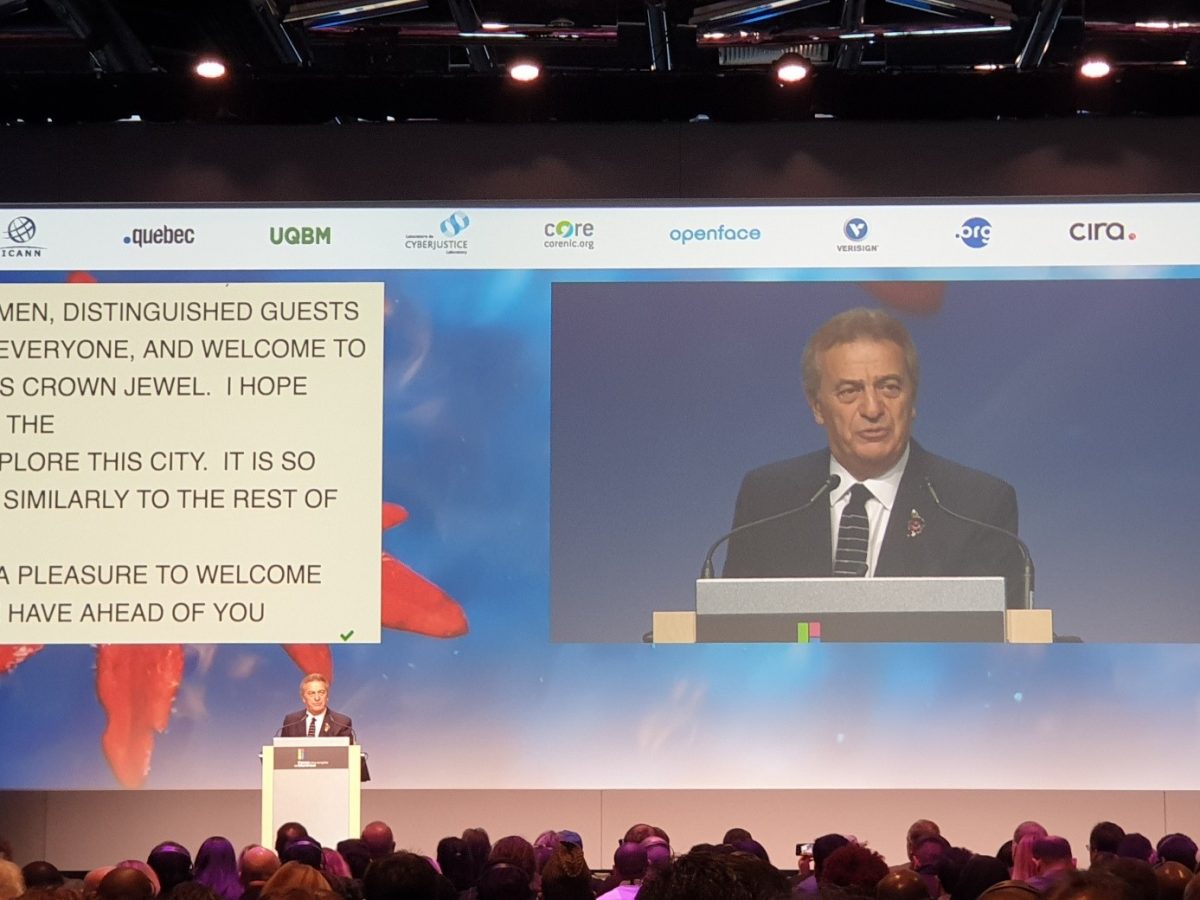
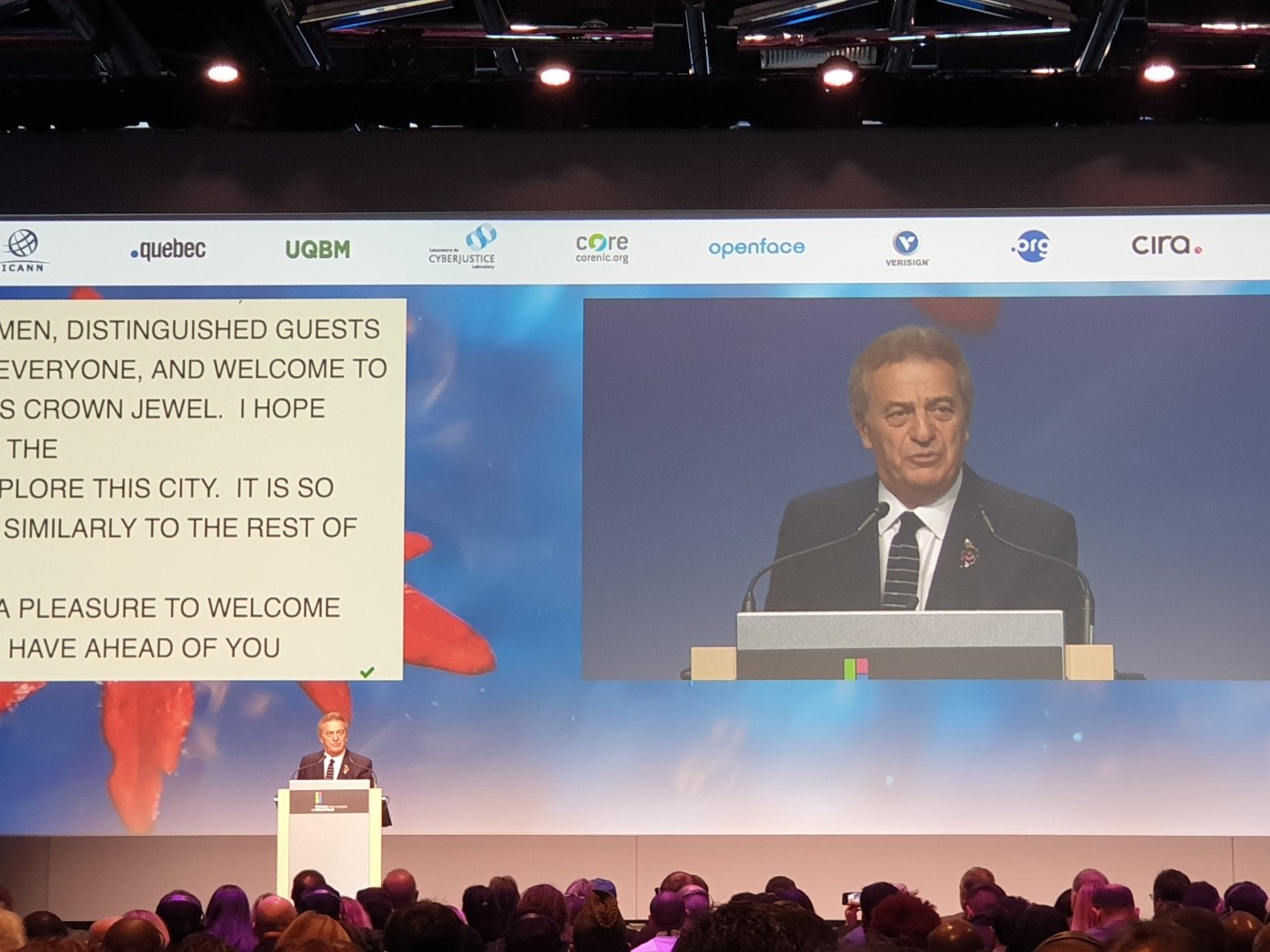
During the traditional opening ceremony, which brings together all the guests for one hour (2500 according to Goran Marby, ICANN CEO) in a huge room to listen to various speakers, including Martin Aubé of the Quebec Government’s Ministry of Economy and Innovation, Cherine Chalaby, one of the ICANN Board members whose term ends at the end of the year, told his audience that ICANN66 would be the “Best ICANN summit”. It must be said, however, that at the end of the week of debates and meetings, which followed one another at a sustained pace, while the subjects under discussion are really numerous, the feeling regarding this assertion was more than mixed for many participants.

First, the expeditious process for access to WHOIS non-public data is progressing with a framework constrained by ICANN and the Personal Data Protection Authorities. The outcome of this process is envisaged between April and June 2020 and it is currently a centralized model where ICANN would allow the future lifting of anonymity of data that are now masked due to GDPR which holds the line.

Then the subject that was probably most often mentioned during this new summit week concerned abuses with domain names. For ICANN, the subject is central because it is directly correlated to its totem: the stability of the Internet for which they are the responsible. Since February 2019, ICANN has been publishing some metrics on malicious practices identified through DAAR, their Domain Abuse Activity Reporting.

Their latest report presented in Montreal shows that 364 extensions (mainly new generic extensions from the 2012 round) revealed at least one threat posed by one of the domain names activated on these extensions. More worryingly, new generic extensions would still account for nearly 40% of malicious uses, compared to 60% for historical generic extensions. This figure should be highlighted with the volume of these two categories of extensions. Indeed, out of just over 200 million generic names, new generic domains represent only 15% of the total number of registered names. ICANN therefore wants this subject to be taken up by the entire community present in Montreal.

Proposals were made by the various bodies present, some of which went so far as to request a policy development process (PDP). This last proposal, if it were to obtain ICANN’s approval, would have the unfortunate consequence of postponing the hypothetical schedule for a next round of new extensions, a subject that interested many of the guests present in Montreal. Indeed, for ICANN, the problem of the concentration of malicious practices in the new generic extensions must be solved before any future round, so that the PDP still in progress on the review of the last round of 2012 has gone almost unnoticed.  

If the rules are slow to evolve on malicious uses, your Nameshield consultant can already provide you with adapted solutions to your needs on this key matter.