On July 22, the registry operator Verisign announced the delegation of .web. The news might almost have gone unnoticed during this sweltering summer, when the domain name industry was focused on the application window for the new ICANN round, which closed on August 12.
This delegation, which heralds the upcoming launch of .web, is a major event in the domain naming industry. Indeed, .web was seen very early on as having universal appeal and the potential to become a true alternative to .com.
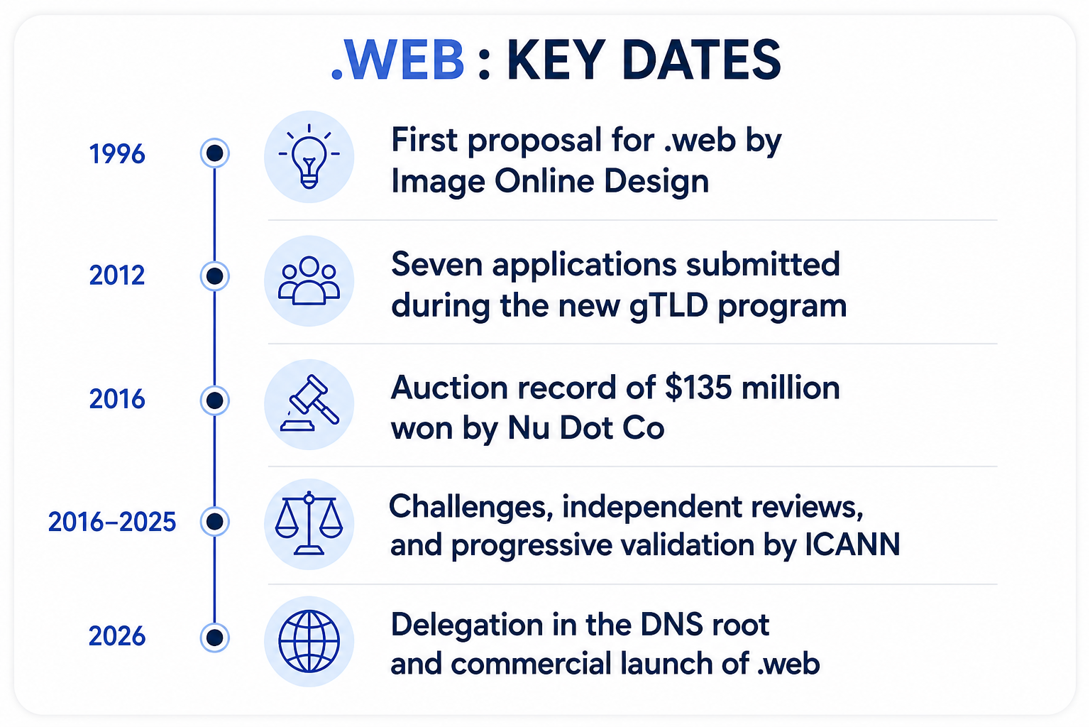
Proposed even before ICANN was created, and later at the heart of the new gTLD program launched in 2012, this domain extension will finally hit the market in 2026, after more than ten years of proceedings and nearly thirty years of history.
A look back at an iconic case that profoundly influenced the rules of the latest round of new gTLDs.
A Top-Level Domain conceived even before ICANN
Few readers know that .web did not originate in 2012.
In fact, as early as 1996, the California-based company Image Online Design (IOD) proposed a .web domain on an alternative DNS system that was not integrated into the official DNS root. At that time, one of the Internet’s founding figures, Jon Postel, had already envisioned adding new extensions to the historic ones such as .com, .net, and .org. However, in 2000, when ICANN launched its first true selection process for new gTLDs, the .web extension supported by IOD was not selected bringing the project to an end.
2012: Seven applicants for a single Top-Level Domain
It wasn’t until 2012, when ICANN launched a series of new top-level domains with more open application rules, that proposals to create a .web top-level domain (TLD) resurfaced. While the .app TLD attracted a record 13 applications at the time, the .web TLD generated the most interest with seven applications, as most saw it as a potential alternative to .com.
The record-breaking auction that changed everything
In 2012, when multiple applicants competed for the same TLD, ICANN’s rules first called for a private resolution of the dispute. If no agreement could be reached, a last-resort auction would be held to decide between the applicants. For the .web extension, no agreement was reached, and the auction held on July 27 and 28, 2016, resulted in a victory for Nu Dot Co, which won the bid for $135 million—an amount that was unprecedented at the time for a new gTLD.
A few days later, Verisign confirmed that it had financed Nu Dot Co’s bid as part of an agreement stipulating that the registry contract could subsequently be transferred to it, subject to ICANN’s approval. This announcement marked the beginning of a new phase in the history of .web: several bidders challenged the process, while ICANN initiated the various review and resolution steps that would ultimately delay the launch of the domain extension.
Why did the launch take ten years?
One might assume that the launch of .web was subsequently delayed by technical difficulties. That was not the case. Following the 2016 auction, the process continued through a series of appeals, Independent Review Processes, and successive reviews by ICANN, focusing in particular on the terms of the transaction, the financing of Nu Dot Co’s bid, and the competitive issues related to the operation of the .web domain. Several decisions and reviews by the ICANN Board followed one after another before the matter could finally move forward.
2026: The launch at last
Finally delegated to the root zone in July 2026, the .web domain is now entering its launch phase, with a Sunrise period coming up, followed by a priority access period, and then its general availability on a date yet to be officially announced soon. Verisign is carefully preparing for this launch by drawing on the experience of its .com and .net infrastructure, which has been proven over decades.
One question remains—more commercial than technical: Is the context in 2026 favorable for such a launch? Since the launch of the first wave of new gTLDs, the domain naming landscape has changed significantly. More than a thousand new extensions have emerged, some of which have managed to establish themselves long-term—such as .xyz, .shop, and .online—while others are set to arrive next year as part of the 2026 round. As a result, .web now benefits from a much more mature market and evolving registration habits. Is it too late to shake up the market? It’s undoubtedly too early to say. But one thing is certain: after thirty years of waiting, .web finally has everything it needs to write its own story.
As the next round of new gTLDs enters the application review phase, the launch of .web symbolically brings to a close the cycle that began in 2012. After more than a decade of proceedings, the industry will finally be able to gauge the true potential of this domain extension, which has long been touted as the only one capable of rivaling .com. At the same time, the lessons learned from this process—which served as a true test case for ICANN—have shaped the rules of the new program, with the goal of making future launches faster, more transparent, and less contentious.
Stay tuned for our upcoming announcements to know the dates and terms of the .web launch. Your account managers are here to assist you.